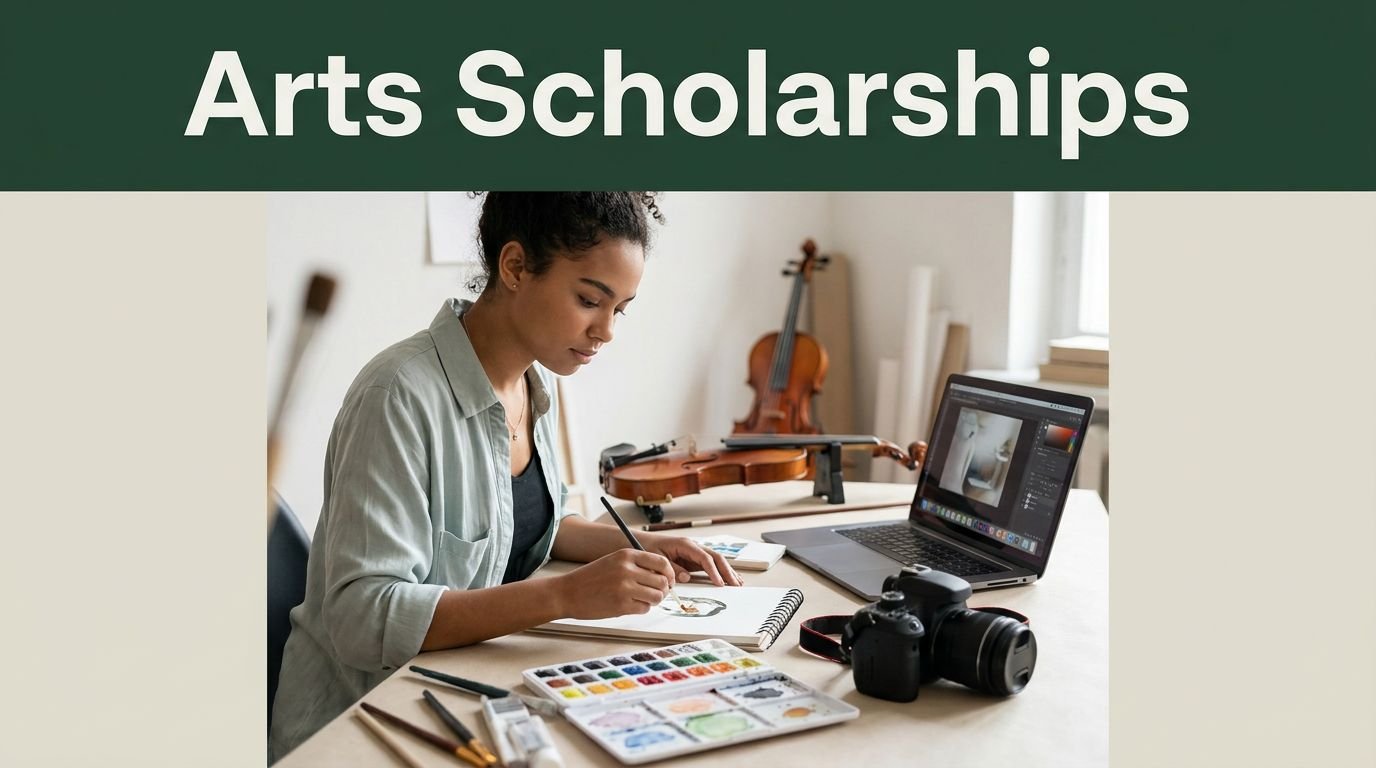
Arts scholarships help students cover the cost of studying visual arts, performing arts, design, film, and related fields, where tuition, supplies, and training often add up fast.
We see a wide range of awards, some based on talent, some on financial need, and many tied to a specific school, country, or art form. Competition is high because the number of strong applicants is usually larger than the pool of funding, so small details like deadlines, portfolio quality, and eligibility rules matter.
This guide looks at how arts scholarships work across borders, what schools and sponsors tend to look for, and where students often miss out.
What arts scholarships really cover, and why they are not all the same
Arts scholarships can look similar at first glance, but the fine print changes the picture fast. Some cover only tuition. Others help with fees, materials, housing, or travel tied to study. A few are tied to a specific school, while others follow the student’s work or financial need.
That difference matters because the real value of an award is not always the headline amount. A scholarship that pays part of tuition at a costly school may still leave a large bill. Another award may be smaller on paper but cover supplies, studio costs, or part of living expenses, which can make it far more useful. As Scholarship money and living expenses shows, the terms decide everything.
Merit awards based on talent, grades, or both
Merit-based arts scholarships reward what students bring to the table. In many cases, that means creative ability first. Schools and arts groups often want to see original work, technical skill, range, and a clear point of view. A strong artistic voice can matter more than a perfect transcript.
Some awards look only at talent. Others weigh grades, test results, or class rank alongside creative work. That mix matters because an applicant with strong academic habits may be seen as more likely to handle a demanding arts program. Still, many arts scholarships do not expect straight A’s. They want evidence of promise, discipline, and growth.
We also see schools use mixed review models. A student might earn an award for a standout portfolio, then receive a larger amount because of strong academics. In those cases, the scholarship committee is usually trying to balance artistic merit with signs of steady performance in the classroom.
A polished transcript can help, but in arts awards, the work itself often opens the door first.
Portfolio-based and competition-based awards
Portfolio-based awards depend on the quality of the submitted work. Competition-based awards add another layer, because applicants are ranked against one another, sometimes through juried review, live auditions, or a final challenge. In both cases, the presentation matters almost as much as the piece itself.
Judges usually look for clarity, originality, and control. They want to see that the applicant can edit work well, follow directions, and show personal style without losing technique. A scattered portfolio weakens a strong applicant, while a well-organized one can make average work feel stronger.
Different fields ask for different materials. Schools and sponsors may request:
- Visual arts: drawings, paintings, sculpture images, mixed-media pieces, or process sketches
- Design: branding samples, page layouts, typography, product concepts, or UX mockups
- Photography: themed series, contact sheets, or edited final images
- Film: short films, storyboards, scripts, reels, or directing samples
- Music: recordings, compositions, recital videos, or performance clips
- Theater and dance: monologues, scene work, audition tapes, choreography reels, or live performance footage
- Animation: character studies, storyboards, motion tests, and finished shorts
Presentation is part of the evaluation. Clean file names, clear labels, and the right format all matter. A strong portfolio that arrives in the wrong format can lose ground before it is even reviewed.
School-specific, need-based, and group-based opportunities
Some arts scholarships are tied to a single college, conservatory, or art school. These awards often come from the institution itself and may only apply if the student enrolls there. That is one reason two schools can offer very different aid packages to the same applicant.
Need-based awards work differently. They depend on family income, assets, and cost of attendance. In some cases, they can be combined with merit aid, which helps reduce the total price further. Need-based and merit aid compared explains the basic split, and the same principle shows up in arts funding too.
Group-based awards add another layer. Some scholarships are reserved for students from certain regions, backgrounds, communities, or underrepresented groups. Others focus on first-generation students, women in specific fields, local residents, or applicants with a shared heritage or identity. These awards can be generous, but they are also tightly defined.
The rules vary widely, so careful reading is non-negotiable. One scholarship may count applicants from the whole country. Another may only accept students from a single county, a named city, or one academic department. Some ask for proof of need, while others ask for nothing beyond enrollment and eligibility documents.
A quick comparison shows how much these awards can differ:
Scholarship type |
What it usually rewards |
What it may cover |
Common catch |
|---|---|---|---|
Merit-based |
Talent, grades, or both |
Tuition, fees, sometimes more |
Strong competition |
Portfolio-based |
Artistic quality and presentation |
Often tuition or partial tuition |
Submission rules are strict |
Need-based |
Financial need |
Tuition, fees, and sometimes living costs |
Income documentation required |
School-specific |
Fit with one institution |
Varies by school |
Must attend that school |
Group-based |
Region, background, or identity |
Varies by sponsor |
Narrow eligibility rules |
The pattern is clear. Arts scholarships are not one fixed product. They are a set of funding models, each with its own aim, its own limits, and its own conditions. Some pay for the classroom. Others help with the life around the classroom, which can matter just as much once the bills start to arrive.
Where to find arts scholarships without wasting time
The fastest searches start close to the source. Schools, arts groups, and local sponsors often post awards in places that general scholarship search engines miss, and those listings usually carry the clearest rules. That matters because arts scholarships are often tied to a medium, a department, or a student status that narrows the field before the first application is even read.
College, conservatory, and art school websites
School websites are often the best place to find awards that never get broad publicity. Admissions pages, financial aid pages, and department pages often list funding by category, so admitted students can spot awards that are easy to miss elsewhere. Many schools also separate merit aid, portfolio prizes, and international student funding, which helps applicants avoid dead ends.
The key is to search each school site with purpose. We usually start with the financial aid office, then move to the art department, school of fine arts, or conservatory page. A school that gives strong studio support may place scholarships beside admissions details, while another may bury them under grants and tuition assistance.
A short site search saves time. Terms like “fine arts scholarship”, “portfolio award”, and “international student funding” often reveal pages that the main menu hides. For a clear example of how schools organize this kind of aid, Academy of Art University scholarships and grants shows how awards can be grouped by eligibility and type.
School websites often list the least crowded awards first, and that can make them the smartest place to begin.
Trusted scholarship databases and arts organizations
Scholarship databases help widen the search, but we get the best results by staying selective. Large search engines can return hundreds of matches, yet many are outdated, duplicate, or too broad to help much. The better approach is to use well-known databases, then filter hard by art form, school level, country, and deadline.
Arts organizations also matter because they often sponsor awards that fit a very specific path. Professional groups, local guilds, and specialist academies tend to know the field well, so their grants may favor a discipline such as painting, animation, dance, or music performance. The Art Students League scholarships and grants page is a good example of how a focused arts body presents merit-based support clearly and directly.
A disciplined search usually works better than a wide one. We keep the list tight and favor official sources first:
- Official school pages for institution-specific funding
- Arts organizations for medium-based or practice-based awards
- Trusted databases for broader national and international options
A curated database like Bold.org art scholarships can help surface options by major or discipline, but the final check should always be the sponsor’s own page. That is where deadline changes, file requirements, and eligibility rules are most reliable.
Local foundations, museums, festivals, and community sponsors
Some of the most practical arts scholarships come from places that never appear on national lists. Local arts councils, museums, cultural centers, community trusts, and festival sponsors often run smaller grants that are tied to a city, county, region, or medium. These awards can be less competitive because they speak to a narrower audience.
That narrower focus is often the advantage. A local museum may support young painters. A regional festival may fund film, photography, or performance work. A community foundation may back students from one area or one school district, which can make the applicant pool far smaller than a national award.
These sponsors also tend to care about local connection. We see them ask for residence, school enrollment, or a short explanation of community involvement. In return, they may offer awards that feel modest on paper but cover supplies, travel, tuition, or a key project expense.
Good places to check include:
- Local arts councils
- Museum education offices
- Festival and event sponsor pages
- Community foundations
- Cultural associations
- Municipal grant lists
The pattern is simple. National searches cast a wide net, but local searches often catch the fish first. For arts students, that smaller pond can be easier to enter and easier to win.
How to qualify for arts scholarships before the deadline arrives
Arts scholarship deadlines move faster than many applicants expect. The strongest applications usually start with eligibility, not the portfolio, because a perfect submission still misses the mark if one rule is off. We keep seeing the same pattern: students spend weeks polishing work, then lose time on citizenship rules, subject mismatch, or missing documents.
That is why the first step is a hard check of the basics. Scholarship committees often sort applications by category before they ever review the art itself. If the file does not fit the rules, the rest rarely matters.
Check the fine print on citizenship, residency, and enrollment status
Some arts scholarships are open to international students. Others are limited to citizens, permanent residents, or applicants who live in a specific state, county, or country. A few are even narrower and only accept students at a partner school, which means the award is tied to enrollment, not just talent.
Visa status can matter as well. An international applicant may qualify for a merit award, but not for need-based aid that requires local financial forms or residency proof. Enrollment level also matters, because some scholarships only fund full-time undergraduates, while others are open to part-time students, graduate students, or first-years only.
Before an application goes anywhere, we should check for these common filters:
- Citizenship or residency rules
- Visa or immigration status limits
- Full-time, part-time, undergraduate, or graduate status
- Current enrollment at a partner school
- Country, state, or regional restrictions
University of Hartford’s scholarship page shows how clearly these distinctions can shape access, especially for international applicants. The lesson is simple, if the sponsor does not list the applicant’s status as eligible, the rest of the packet is wasted effort.
Match the scholarship to the right art field
Arts scholarships often look broad from a distance, but many are built for one discipline. Fine art, graphic design, fashion, film, photography, architecture, music, dance, and theater each have their own expectations. A student can have excellent work and still be overlooked if the subject area is off by even a little.
That match matters because committees want proof that the applicant fits the award’s purpose. A fashion scholarship may not favor a general illustration portfolio. A film award may not accept still photography as a substitute. In arts funding, close subject fit can matter as much as raw talent.
We get the best results by reading the award title and the brief twice. If the scholarship is built for musicians, a visual arts applicant should move on. If it covers multiple fields, then the portfolio or audition needs to show clear relevance, not a loose connection.
A quick self-check helps narrow the field fast:
- Name the exact major or medium
- Compare it with the scholarship’s stated focus
- Look for required work samples or audition types
- Skip awards that only loosely match the subject
For applicants outside the United States, this step matters even more because some schools group awards by department, while others group them by degree level or campus. A strong fit is often the difference between being read quickly and being set aside.
Gather the documents schools usually ask for
Most arts scholarships ask for the same core paperwork. The names change, but the packet usually includes a transcript, an application form, a portfolio, and some proof of academic or financial standing. Missing one item can delay the review or push the application out of the pool entirely.
The most common documents include:
- Application form
- Official transcript
- Portfolio of original work
- Personal essay or statement
- Letters of recommendation
- Resume or CV
- Proof of financial need, when the award is need-based
- Proof of identity, citizenship, or residency, when required
- Extra media files, such as videos, writing samples, or audio recordings
A scholarship checklist works best when it stays practical. We usually separate items into three groups, first the documents that can be requested from a school, then the materials that need time to prepare, and finally the items that often cause last-minute stress, such as recommendations or financial forms. That order keeps the deadline from turning into a scramble.
The portfolio deserves special care because it often carries the most weight. Many applications also have strict limits on file size, number of pieces, format, or labeling. The Art Students League scholarship guidance is a useful reminder that instructions matter as much as the work itself. A strong submission is not just creative, it is complete, clean, and filed on time.
The deadline is usually won long before submission day, because the real test is whether the applicant has every required piece in place.
A final pass before sending the application should focus on three things: whether the award is open to the student’s status, whether the art field matches the sponsor’s focus, and whether every document is ready in the correct format. That simple discipline keeps arts scholarship applications from failing on preventable details.
Building a portfolio that makes scholarship judges pause
A strong arts portfolio does more than show skill. It gives judges a reason to stop, look twice, and remember the work after the pile of applications moves on. That happens when the portfolio feels selective, coherent, and easy to read, not crowded with every piece ever made.
The best arts scholarships often go to applicants who understand editing. Judges do not need quantity for its own sake. They need evidence of judgment, control, and a point of view that feels real.
Choose your strongest work instead of showing everything
A smaller set of strong pieces usually makes a better case than a large mixed collection. Too many works can blur the message, especially when some are polished and others are still learning pieces. Selection matters because every included item should earn its place.
We should choose work that fits the award, shows technical strength, and gives the judge a clear sense of where the artist is headed. A drawing that shows clean line control may do more for a portfolio than three weaker studies. The aim is clarity, not volume.
It also helps to cut anything that feels repetitive. When several pieces say the same thing, the portfolio loses shape. One strong example of a subject, medium, or style is usually enough unless the brief asks for more.
Judges remember portfolios that feel edited. They forget ones that feel dumped together.
A good rule is to keep only work that does one of these jobs well:
- Shows technical control
- Reveals original thinking
- Fits the scholarship’s subject area
- Adds a different skill or medium
- Strengthens the overall story of the portfolio
The best portfolios feel intentional from the first piece to the last. For a useful model of how schools explain portfolio expectations, CCAD’s art and design portfolio guidance gives a clear picture of how selection and presentation work together.
Show range, technique, and a clear point of view
Judges want to see range, but range is not the same as randomness. A portfolio can move across subjects, styles, or formats while still feeling like it comes from one artist. That balance matters because it shows both skill and self-awareness.
Technique is the baseline. Clean drawing, strong composition, control of materials, and careful observation all count. Range adds proof that the artist can handle more than one challenge. A portrait, a still life, and a figure study can tell a stronger story than three near-identical pieces.
Personal voice matters just as much. The work should reveal how the artist sees the world, what subjects pull attention, and how ideas are handled. When every piece looks the same, repetition weakens the portfolio. Judges may start to wonder whether there is depth behind the surface.
A useful mix often includes:
- One or two finished pieces that show polish
- One piece that demonstrates technical control
- One piece that shows experimentation or risk
- One piece that reflects personal subject matter
- One piece that reveals process, if the scholarship allows it
That mix gives the judge something to read. It also keeps the portfolio from feeling flat. Tuition Rewards’ arts portfolio advice makes the same basic point, strong portfolios show artistic vision, not just output.
Present the work clearly, cleanly, and professionally
Even excellent work can lose force if the presentation looks careless. Blurry images, uneven crops, weak file names, and mismatched formats can make a portfolio feel unfinished before anyone studies the art itself. Presentation is part of the work.
Image quality comes first. Photos should be sharp, well lit, and cropped so the viewer can see the piece without distraction. If the portfolio includes three-dimensional work, the images should show scale, texture, and angle clearly. For video, audio, or animation, the files should play smoothly and open in the format requested.
Sequencing matters too. The order should move with purpose, often from strongest work to strong supporting pieces, or from broad skill to more personal work. Captions should be short and useful, with titles, medium, size, and date if the application asks for them.
A clean submission usually gets handled better when it includes:
- Correct file format
- Clear file names
- Readable labels or captions
- Good image resolution
- Logical order of pieces
Poor presentation can damage even excellent work. A judge who has to hunt for basic information may move on faster than expected, which is why the quiet details often shape the final decision as much as the art itself.
Writing applications that feel thoughtful instead of rushed
Strong arts scholarship applications rarely look dramatic on the page. They feel steady, specific, and complete. The best ones connect the artist’s past work, current focus, and future direction without overselling any of it.
That balance matters because reviewers read for substance. A rushed application usually sounds vague, repeats itself, or leans on big claims with little proof. A thoughtful one reads like someone has taken time to know their own work.
Write about the artist’s journey, goals, and growth
A personal statement should do three jobs at once. It should explain where the artist has been, what they are working on now, and where they hope to go next. The strongest version keeps those parts connected, so the statement feels like one clear thread rather than three separate ideas.
We should start with real experience. A sketchbook habit, a school production, a first exhibition, or a local performance can anchor the story far better than a grand claim. From there, the statement should show growth, such as stronger technique, better focus, or a wider range of ideas.
Future plans should stay grounded. Instead of promising to change the world, we can point to practical goals, such as building a stronger portfolio, training at a specific school, or developing work in a certain medium. That gives the committee a sense of direction without turning the statement into a speech.
A useful structure often looks like this:
- A brief opening that shows what draws the artist to the field
- A middle section that connects past work to current study or practice
- A closing section that explains what the scholarship would support next
The writing should stay direct. Simple sentences often carry more weight than polished but empty language. The Truman Scholarship’s writing guidance makes the same basic point, strong statements are specific, clear, and personal.
We also need to keep the tone honest. The best statements do not try to sound larger than life. They sound like a student who has worked, learned, and grown with purpose.
A good personal statement does not perform certainty. It shows honest progress and clear intent.
Ask for recommendation letters that add real proof
Recommendation letters matter most when they add evidence the application cannot show on its own. A teacher, mentor, director, or studio lead can describe the artist’s habits, discipline, and development in ways that sound concrete. That kind of proof carries more weight than broad praise.
We should ask people who know the work closely. An art teacher may speak to drawing skill, revision, and classroom focus. A music director may discuss timing, preparation, and stage presence. A studio lead or mentor may describe how the artist handles feedback and uses it well.
Generic letters often fail because they say very little. “Hard-working” and “talented” are easy words to write, but they do not help much. A strong letter includes a specific example, such as a difficult project the student finished, a technique they improved, or a way they contributed to the group.
It helps to give recommenders the right material early. We should share the deadline, the scholarship brief, and a short note on what matters most. If the sponsor wants growth, they should know that. If the award values leadership or community work, that should be visible too.
A strong letter usually covers:
- How the recommender knows the student
- What kind of artist or student they are
- One or two real examples of skill or progress
- Why the student stands out in practice, not just in theory
- Why the award would fit their path
Fastweb’s guide to scholarship personal statements also reflects this same principle, real detail beats general praise. The same logic applies to letters. Specifics make the case believable.
Track deadlines, file formats, and submission rules carefully
Many strong arts scholarships are lost to small mistakes. A late upload, a missing signature, or the wrong file type can push an otherwise good application aside. That is why the final review matters as much as the writing and the portfolio.
We should treat every submission as a set of instructions, not a single form. Some sponsors want PDF files. Others want images named in a certain way, or video files uploaded through one portal and essays through another. Word limits, page counts, and file sizes can all vary.
A simple checklist helps keep the process under control:
- Check the deadline in the sponsor’s time zone, not just our own.
- Confirm the required file names and save them exactly as listed.
- Match the word count, page limit, or file size without guessing.
- Follow the upload order and submission method on the official page.
- Review every attachment before the final send button is pressed.
Those details sound small, but they often decide the outcome. An application that arrives neatly labeled and complete feels handled with care. One that misses the instructions can look rushed, even when the work itself is strong.
The safest habit is to read the rules twice, then compare the final file against them line by line. That last pass often catches the problem that would have cost the award.
Country-specific paths that global students should know about
Arts funding changes shape once borders enter the picture. In some countries, scholarships sit inside the admissions process. In others, they come through government programs, exchange routes, or private foundations with narrow eligibility rules. For global students, the real task is not just finding money, but finding the system that fits the application.
Scholarship patterns in the United States, Canada, and the UK
The United States, Canada, and the UK rely heavily on school-based funding. In arts programs, merit aid is often tied to the application itself, so the admission decision and the funding decision can happen together. A strong portfolio, audition, or creative proposal may open both doors at once.
Arts conservatories and specialist schools use this model often. Some offer tuition discounts, while others give named awards for performance, studio work, or academic strength. International applicants should also expect the award to depend on enrollment, which means the scholarship may disappear if admission does not go through. The Academy of Art University scholarship page shows how merit, need, and portfolio review can sit inside one aid system.
In these systems, admission and funding often move together, so one decision can shape the other.
Canada follows a similar pattern, with university awards doing much of the work. The UK also leans on institutional scholarships, although some national awards add a broader layer. For arts students, the common thread is simple: the award usually follows the place, not the student alone.
Options across Europe, Asia, Africa, and Latin America
Outside North America and the UK, the funding picture often mixes government programs, university awards, cultural exchanges, and private foundations. Germany, Japan, and the UK are well known for large national schemes, while many other countries support arts study through university scholarships or exchange funding rather than large standalone arts awards. For broader study-abroad options, Go Overseas scholarship listings give a useful sense of how international funding is often packaged.
Europe has a strong tradition of public support through universities and national agencies. Asia includes major government-backed routes, plus school awards that may target incoming international students. In Africa and Latin America, funding is often more mixed, with support coming from foundations, bilateral exchange programs, cultural bodies, and local higher education institutions.
The key point is restraint. Availability changes by country, field, and year, so we should treat regional options as pathways to check, not guarantees. The strongest applications usually match a sponsor’s mission, whether that sponsor is a ministry, a university, or a private arts fund.
What international applicants should double-check first
Before anything else, global applicants should check the rules that can quietly block an otherwise strong file. Language requirements matter, because some schools want proof of English, French, or another working language before they review the full application. Visa rules matter too, since an award may not support the visa type or study length a student needs.
Proof of funds is another common test. Some scholarships cover only tuition, while others can cover housing, travel, and insurance. If an award pays tuition only, the applicant still needs a plan for rent, food, and daily costs. That difference can change whether a program is realistic at all.
Portfolio standards also vary more than many applicants expect. One school may want images, another may ask for video, and another may set exact limits on number, size, or format. The safest route is to read the sponsor’s submission rules line by line, then compare them with the portfolio already prepared.
A practical filter helps reduce wasted effort:
- Confirm the language requirement and accepted test scores.
- Check visa eligibility and whether the award fits the study period.
- Read the funding rules to see if it covers tuition only or wider costs.
- Match the portfolio format to the exact school or sponsor request.
- Verify whether the award is open to international students at all.
For applicants crossing borders, that checklist acts like a gatekeeper. It keeps the search focused on awards that can actually be used, not just admired from a distance.
Mistakes that quietly ruin otherwise strong applications
The weakest arts scholarship applications are not always the ones with weak work. More often, they fail on fit, compliance, or presentation. A strong piece can still lose if the rest of the file sends the wrong signal, or if the scholarship committee never gets past the basic checks.
That is why the small errors matter so much. Judges often start with the rules, then move to the art. If the application misses the brief, the committee may never reach the work at all.
Submitting work that does not fit the scholarship
Excellent art can still miss the mark when it does not match the scholarship’s theme, medium, level, or audience. A portfolio of abstract painting may be strong on its own, but it will struggle in a scholarship built for film students. The same problem appears when a submission feels too advanced, too elementary, or simply off topic.
We see this most often when applicants copy their best work into every award. That approach ignores what the sponsor asked for. A juried music scholarship, for example, wants evidence of performance skill, while a design award may want process, typography, or applied thinking. If the piece does not speak the same language as the brief, the application loses force.
The safest approach is to read the award as carefully as the portfolio. We should match the work to the sponsor’s purpose, not just to our own favorite pieces. For a useful reminder of how applications can go wrong when the fit is off, common scholarship application mistakes often begin with incomplete or mismatched submissions.
Ignoring small instructions that matter
Small rules are rarely small to reviewers. File size, naming rules, essay limits, missing signatures, and late uploads can end an application before the talent review begins. A committee that receives 100 files often looks for compliance first, because it needs a fast way to separate complete applications from weak ones.
That means basic details carry real weight. If a sponsor asks for a PDF under a certain size, a file that goes over the limit may fail to upload or arrive distorted. If the application asks for a signature, a blank line can make the packet incomplete. If the deadline closes at 5 p.m. GMT, a late submission from another time zone may still be late.
A careful final check should cover the basics in order:
- Confirm the file name matches the instructions.
- Check the word count, page limit, or image count.
- Make sure every required form is signed.
- Upload before the deadline, not close to it.
- Review the full submission after sending.
Many judges never reach the creative work if the application looks careless at the start.
Using the same application for every award
A generic submission often reads as rushed, even when the art is strong. Scholarship committees can tell when an essay, portfolio order, or personal statement has been copied across multiple awards without adjustment. That kind of sameness makes the applicant look inattentive, and it weakens the case for support.
Tailoring does not need to be time-consuming. It usually means changing the opening to fit the sponsor, choosing samples that suit the award’s focus, and adjusting the language so it answers the right question. A school-based award should sound different from a local arts grant, and a need-based scholarship should not read like a talent-only competition.
The practical rule is simple: we should make each submission feel written for one audience, not for everyone. A generic file may still be complete, but it rarely feels considered. In scholarship review, that difference can decide whether a strong application gets remembered or passed over.
What winners do differently when they apply again and again
Repeated applicants do not treat arts scholarships like a one-off gamble. They treat them like a process, with notes, revisions, and a growing file of what worked last time. That habit matters because many awards reset each cycle, and a strong first attempt does not always carry over without updates.
The biggest difference is discipline. Winners keep moving, even after a rejection, and they make each round cleaner than the one before. They also understand that timing, presentation, and fit can matter as much as raw talent.
Apply early and build a running list of opportunities
Successful applicants start before the pressure peaks. They keep a live list of arts scholarships, deadlines, file rules, and contact details, so nothing gets found at the last minute. That simple habit creates more chances, because it leaves room to compare awards instead of rushing into the first open door.
Early searching also reduces the noise. Instead of chasing every listing, we can sort by medium, school, region, and deadline. A running list makes it easier to spot repeat patterns, like which scholarships ask for the same portfolio format or which sponsors prefer a short artist statement.
It also gives us revision time. If a portfolio needs stronger images or a personal statement needs a clearer focus, we still have days or weeks to fix it. A late search often turns small problems into missed opportunities.
We also keep the list active, not static. New awards appear, deadlines shift, and old listings disappear. A regular check saves us from relying on memory alone, which is where many good applications go stale.
Keep the portfolio and personal statement updated
Winners rarely resend the exact same materials without a second look. They replace weaker work, tighten the order, and remove anything that no longer fits the scholarship. That edit matters because judges notice when a portfolio feels current and deliberate.
The same applies to the personal statement. Each cycle gives us a chance to sharpen the story, cut soft language, and connect the application more closely to the award. If a scholarship values community work, we should say more about that. If it wants evidence of growth, we should show progress with plain examples.
A few practical upgrades make a clear difference:
- Replace weak or repetitive pieces with stronger, more focused work.
- Reorder the portfolio so the best pieces appear where they carry the most weight.
- Update the statement to match the sponsor’s focus, not a generic template.
- Refresh dates, contact details, and supporting material.
A second attempt should feel more precise, not more crowded. Scholarship tips from Mesa Community College point to the same basic habit, preparation beats last-minute assembly every time.
Treat feedback as part of the process
The strongest applicants do not guess where they are weak. They ask teachers, mentors, and advisors to look at the work with fresh eyes. That outside view helps spot gaps in both the art and the application, especially when the creator has looked at the same files too long.
A teacher may notice that the portfolio lacks range. A mentor may see that the statement sounds vague or repeats itself. An advisor may catch a deadline problem, a missing document, or a format issue before it turns into a rejection.
Feedback works best when it stays specific. We should ask which piece feels strongest, which one feels weakest, and what the application still does not explain. Broad praise helps less than direct comments about image quality, sequence, clarity, or fit.
The goal is not to please everyone. It is to remove the weak spots that make a strong submission look unfinished. That is why repeat applicants often improve faster, because they stop treating review as criticism and start treating it as part of the work.
A simple FAQ on arts scholarships
Arts scholarships raise a lot of the same questions because the rules change by school, country, and medium. We keep the answers practical here, since the fine print often matters more than the headline amount.
Are arts scholarships only for students majoring in art?
No. Many arts scholarships go to students in design, film, music, dance, theatre, animation, and related fields. Some awards also accept applicants outside a formal arts major if their portfolio, audition, or creative work is strong enough.
That said, the eligibility line can be narrow. A scholarship for “fine arts majors” may only cover students in one department, while another award may welcome anyone with clear artistic talent. The safest reading is always the sponsor’s wording, not the short title.
Do arts scholarships need to be repaid?
They do not. Like other scholarships, arts scholarships are gift aid, so the money does not turn into a loan later. That makes them different from borrowing and much closer to a prize for work already shown.
The award can still come with conditions. Some require a certain grade point average, continued enrollment, or participation in a school program. If those rules are broken, the scholarship may stop, even though repayment is still not expected.
The money is free to keep, but the conditions still deserve careful attention.
What do arts scholarships usually ask for?
Most ask for some mix of these items:
- A portfolio, audition, or work sample
- An application form
- A transcript
- A short personal statement
- Recommendation letters
- Proof of need or residency, when the award requires it
The creative sample often carries the most weight. For a visual artist, that may mean images of original work. For a musician or actor, it may mean a recording or audition tape. For film and animation, it may mean a reel or short project.
Can international students apply for arts scholarships?
Yes, many can, but the rules vary a lot. Some awards are open to international applicants, while others are limited to citizens, residents, or students already enrolled at a partner school. Visa status and language requirements can also affect eligibility.
We should also check whether the scholarship covers only tuition or also living costs. A tuition-only award may still leave a big gap for housing, travel, or insurance, especially for students studying abroad.
When should we start applying?
We should start as early as possible, because arts scholarships often need time for portfolios, recordings, references, and forms. Deadlines can arrive before a student has gathered every file, and late applications rarely get a second look.
A better approach is to build a list early, then sort by deadline and eligibility. That gives us room to edit the portfolio, tighten the statement, and fix small errors before submission. Even a strong application can fail if the final upload is rushed.
For a broader search, we can also compare award listings on art scholarships by major and fine arts scholarship listings, then confirm every rule on the sponsor’s own page.
Conclusion
Arts scholarships are still there, but they reward precision more than volume. The strongest applications match the award’s purpose, show clear artistic skill, and meet every rule without shortcuts.
That pattern runs through the whole search. Schools, local groups, and arts nonprofits remain the main sources of funding, while merit and need often sit side by side in the review process. In practice, the best results come when the work, the statement, and the eligibility line all point in the same direction.
We also see a simple truth behind the search for arts scholarships, funding is scattered, but it is real. The most reliable awards are often small, school-based, or local, yet they can still make a serious difference when tuition, materials, and living costs stack up. For global students, the picture is similar, just shaped by country rules, enrollment status, and sponsor focus.
What matters most is fit. A strong portfolio can open a door, but the scholarship still has to make sense for the student, the field, and the sponsor’s goals. That is why the best applications feel measured, complete, and specific, which is often what separates a good artist from a funded one.
This post may contain affiliate links. If you make a purchase through these links, I may earn a small commission at no extra cost to you.