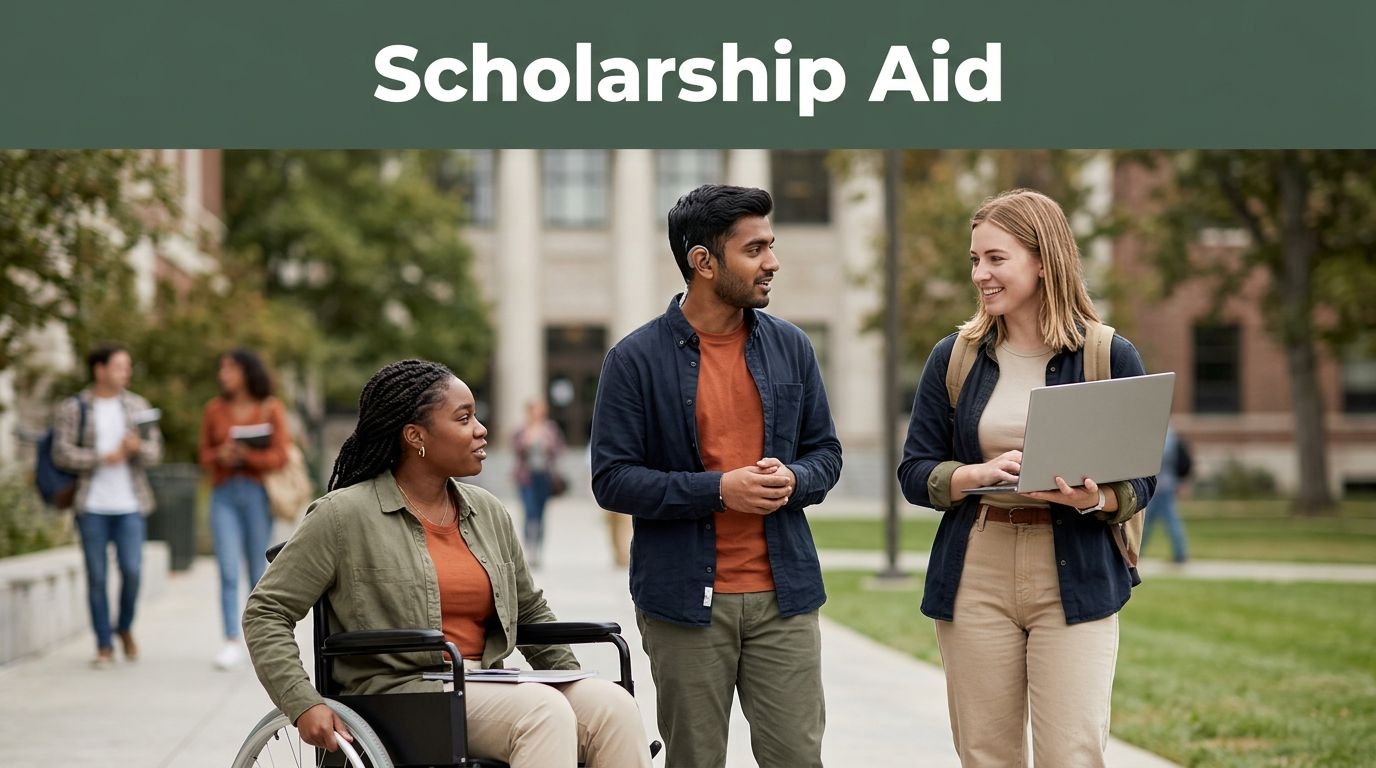
Funding higher education gets expensive fast. Add disability-related costs, and the bill can climb even higher.
That is where disability scholarships matter in 2026. They are not side money or bonus money. For a lot of students, they are what make school feel possible.
If you are a student, parent, or counselor, you probably do not need a giant pile of random names. You need the right places to look, the awards that are active now, and a cleaner way to apply. Start there, and the search stops feeling so messy for students with disabilities.
Key Takeaways
- Prioritize fit over volume: Instead of applying to every scholarship you find, focus on awards that match your specific disability type, academic level, and career goals to increase your chances of success.
- Keep documentation organized: Create a master folder containing your transcripts, disability verification documents, and a core essay draft to streamline the application process and avoid burnout.
- Prioritize accuracy and clarity: Reviewers prefer direct, authentic personal statements that address their specific questions rather than generic or overly polished narratives.
- Leverage niche opportunities: While national awards are well-known, smaller college-based and local community scholarships are often less competitive and represent high-value opportunities.
Where disability scholarships come from in 2026
Most awards for students with disabilities come from three places: national nonprofits, colleges, and smaller community groups. That sounds simple, but the details matter. A student with learning disabilities will often see different awards than a blind student or someone with physical disabilities.
If you want a broad starting point, the Fastweb 2026 scholarships list is useful because it helps students with disabilities find various illness and disability awards in one place. The Scholarships.com disability scholarships page is another strong search spot when you want to compare options by category.
National organizations usually have the clearest rules. They may ask for enrollment proof, disability verification, an essay, transcripts, or letters of recommendation. College-based awards can be smaller, but they are easier to miss and often less crowded. Local community groups can be even better if you fit their profile, because fewer students apply.
National groups with clearer rules
A national award often has a narrow focus. That can sound limiting, but it helps when your background lines up with the criteria. If you have a documented learning disability, are blind or low-vision, or are part of a neurodiverse student group, a focused scholarship can be a better fit than a broad one.
College and local awards are easy to miss
Your school’s financial aid office may list outside scholarships, but not every opportunity gets a big announcement. Some colleges also run private donor awards for students with disabilities. Local civic clubs, disability advocacy groups, and hometown foundations can be less crowded than the big national programs.
You do not need to apply everywhere. You need to apply where the fit is real.
Scholarships worth checking right now
For learning-disability awards, the National Center for Learning Disabilities awards page is one of the most useful places to start. It lists the Anne Ford Scholarship and the Allegra Ford Thomas Scholarship, both of which remain top choices for many students.
Here are some scholarships that are worth a look in 2026.
Scholarship |
Award amount |
Best fit |
What to know |
|---|---|---|---|
disABLEDperson National Scholarship |
$2,000 |
Undergraduate students living with a disability |
A great option for students who can show current enrollment |
Lime Connect Pathways Scholarship |
$1,000 |
High school seniors in the U.S. and Canada with disabilities |
A strong launch point for students heading into college |
National Federation of the Blind Scholarship |
$5,000 |
Legally blind students or those with a visual impairment |
A major option for blind and low-vision students |
Anne Ford Scholarship |
$10,000 total |
Graduating high school seniors with a documented learning disability |
One of the best-known learning-disability awards |
Allegra Ford Thomas Scholarship |
$5,000 total |
Graduating high school seniors attending a 2-year or vocational program |
Good for a shorter academic path |
AAHD Frederick J. Krause Scholarship |
About $1,000 |
Students with disabilities in health-related or disability-related fields |
Useful if your major connects to health or disability studies |
Ruby’s Rainbow Scholarship |
$1,000 to $10,000 |
College students with Down syndrome |
Award amounts vary, so read the current cycle carefully |
Neurodiversity Alliance scholarships |
$1,000 or $2,500 |
Students with dyslexia, ADHD, or other learning differences |
A practical option for neurodivergent students |
The pattern is clear. Some awards are built around one disability type, while others are broader and open to several groups. That means your search should be specific rather than random.
If you only have time to shortlist a few, start with the awards that match your status first, then your disability type, then your school plan. A scholarship application that asks for less extra paperwork is often the one worth chasing first.
What reviewers want to see in your application
Most scholarship reviewers are not hunting for a perfect story. They want proof that you fit the award and can explain your goals without wandering all over the page.
Send the proof they ask for, not every paper you own.
That one habit can save you time. If a scholarship asks for medical documentation, a 504 plan, an IEP, or proof of a documented disability, send the exact document requested. Do not overload the file unless the rules ask for more.
Your personal statement matters too, but not because it needs to sound grand. It needs to sound like you. What has changed in the way you study? What support tools do you use? How do you handle assignments, work, health needs, or travel to class? When including a letter of recommendation, ensure your references can speak to these details, as they help a reviewer understand how you move through school.
A strong personal statement usually does three things well. It shows your academic goal. It explains the disability related challenge without turning the whole piece into a hardship story. It closes with a clear reason this award fits your plan.
Keep the tone direct. If the prompt asks how a disability has shaped your education, answer that question. Do not spend half the statement trying to sound impressive. A clear, honest answer often lands better than a polished speech.
Disability documentation that helps
Some awards only need a self identification statement. Others need more formal paperwork. If the rules are not clear, check the official instructions before you upload anything. Schools and scholarship groups do not all ask for the same proof.
For students with learning differences, the documentation may be different from what a blind student or a student with a mobility disability needs. That is normal. Read the criteria line by line, because the smallest wording change can matter.
How to build a stronger application without burning out
The smartest plan is boring, and that is a good thing. When scholarship season gets busy, a simple system saves your energy.

- Keep one master folder with your college transcripts, test scores if needed, letter of recommendation contacts, disability documentation, and a base essay draft.
- Write one strong core story. Then adjust the first paragraph, final sentence, and scholarship-specific details for each award.
- Ask for recommendation letters early. Teachers, counselors, and mentors need time, and rushed letters usually show it.
- Apply before the deadline, not on the deadline. A small mistake is easier to fix when you still have time.
- Save every finished application. Many awards reopen each year, and your best work should not disappear into a forgotten folder.
You can also reuse parts of your personal statement without sounding copied. The key is to keep the main facts stable while changing the focus. One scholarship may care about your academic drive. Another may care about leadership, service, or your career goal. You do not need a brand-new essay each time. You need a sharper version of the same truth.
If you are applying to several disability scholarships to fund your higher education, treat the process like a small project. Pick a few hours each week to work on your scholarship application. Track deadlines in one place. Keep your file names simple. “Transcript 2026” is better than a random download name you will never find again.
Common mistakes that cost you an award
A lot of good applications get knocked out for small reasons. That part stings, because the fix is usually simple.
- Missing the exact eligibility rule. Some awards are for full-time students only. Others are limited to certain disability types, grade levels, or degree paths. Always double check your application deadline to ensure you meet all requirements.
- Sending a generic essay. If your answer could fit any scholarship on earth, it needs more work.
- Waiting for the biggest award and skipping the smaller ones. Local scholarships and niche awards can be easier to win.
- Uploading extra paperwork that was never asked for. More files do not always help.
- Ignoring renewal rules. Some scholarships pay once, while others renew if scholarship recipients keep their GPA up or stay enrolled.
- Forgetting that dates change. A scholarship page from last year is not enough. Check the current cycle before you submit.
A quick rule helps here: if the application feels confusing, slow down and reread the instructions. A lot of people rush because they think speed matters most. It usually does not. Accuracy wins.
Deadlines are not reminders. Once an application deadline passes, some awards close early, and some never reopen until the next cycle.
That is why it helps to check official pages instead of relying on reposted summaries. One small date change can decide whether your application even gets looked at.
How parents and counselors can help without taking over
If you are a parent, your job is not to write the essay for your student. Your job is to keep the process moving. That means managing deadlines, gathering documents, arranging transportation, and keeping a calm eye on the details.
If you are a counselor, you can save a student hours by pointing them toward the right kind of award. A student with documented learning disabilities may be a better fit for one scholarship, while a blind student or a student with autism may match another. That kind of targeted guidance matters.
Adult learners need a different kind of support. Many people assume that financial aid is only for recent high school graduates, but that is not the case. Whether you are returning to an accredited university as an undergraduate student or pursuing advanced degrees as one of many graduate students, disability-based awards may still fit your situation.
The best support is practical. Ask the student what they need. Do they need help finding documentation? Do they need essay feedback? Do they need a reminder system? Keep the focus on helping them stay organized and empowered, not on taking control of their voice.
Privacy matters too. Not every detail needs to be shared with every person. Ask before forwarding sensitive medical paperwork, and ask before sending a draft essay to others. A little respect goes a long way in building a student’s confidence throughout the application process.
Frequently Asked Questions
Where is the best place to start looking for scholarships?
Start by checking major databases like Fastweb or Scholarships.com to filter awards by disability type. Additionally, consult your school’s financial aid office, as they often have information on local or private donor scholarships that are not advertised nationally.
Do I need to write a new essay for every single scholarship?
No, you should write one strong core story that covers your academic goals and challenges. You can then tailor the introduction and conclusion for each specific application to ensure your message aligns with what that particular committee is looking for.
What kind of disability documentation should I include?
Only provide the specific documents requested by the scholarship provider, such as an IEP, a 504 plan, or medical records. Do not overload your application with extra paperwork that wasn’t asked for, as this can clutter your file and distract from your personal statement.
Are scholarships available for students who aren’t recent high school graduates?
Yes, many disability-based awards are open to undergraduate and graduate students of all ages. Always check the specific eligibility criteria for each program to see if it accommodates returning adult learners or those pursuing advanced degrees.
Conclusion
The best disability scholarships in 2026 are the ones that align with your specific stage, your paperwork, and your personal story. When those three pieces line up, the search for funding becomes much easier and more productive.
Start by prioritizing the awards that fit your disability type and your academic goals. Keep one organized folder for your materials and read every rule twice. A strong application does not need to be perfect, as it simply needs to be clear, authentic, and attentive to the specific requirements of the provider.
If you keep the process simple, your search for financial support stops feeling like a random task and starts looking like a clear path forward. By taking these steps, students with disabilities can confidently navigate the application process and secure the resources they need to thrive.
This post may contain affiliate links. If you make a purchase through these links, I may earn a small commission at no extra cost to you.