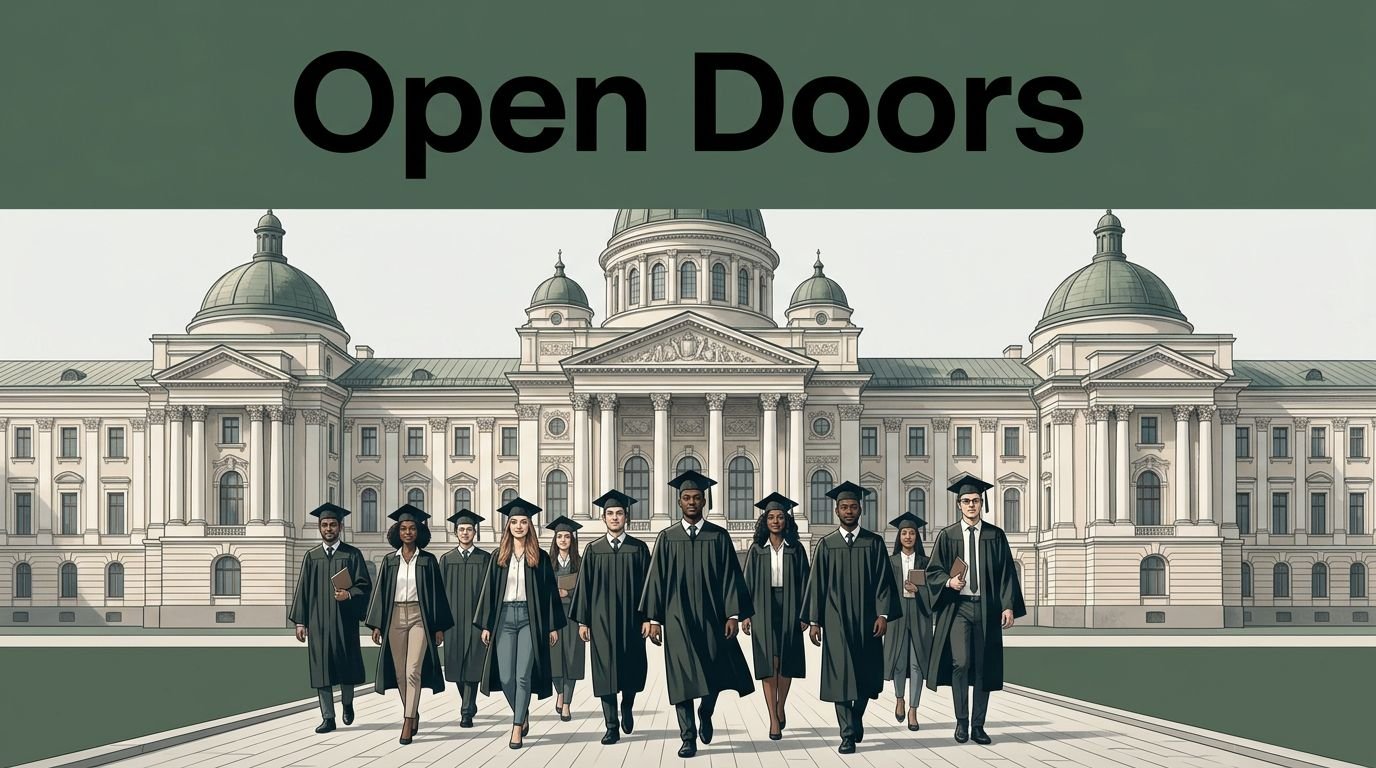
The Open Doors Scholarship attracts significant interest because it provides international students a tuition-free path to study at a Russian university, with academic tracks available for undergraduate, graduate, PhD, and postdoctoral levels. If you are searching for a fully funded route that supports multiple stages of your higher education, this program remains one of the most popular choices.
However, the application process is not something you want to navigate by guesswork. You need to understand who qualifies, what the program covers, how the selection process functions, and where applicants often struggle, so you can leverage this financial aid opportunity to build a stronger application from the start. Keep reading to receive clear, practical guidance that makes the entire process easier to manage.
Key Takeaways
- The Open Doors Scholarship provides a tuition-free path for international students to pursue bachelor’s, master’s, PhD, or postdoctoral programs at participating Russian universities.
- Eligibility hinges on strict criteria including citizenship, age limits, and matching your current educational background to the appropriate academic track.
- While the scholarship covers tuition and often provides a monthly stipend and housing, students must independently budget for daily living costs such as travel, food, and insurance.
- The application process is highly structured and merit-based; success relies on staying organized, meeting firm deadlines, and submitting accurate, high-quality documentation through the official portal.
What the Open Doors Scholarship actually offers
The Open Doors Scholarship is more than a simple tuition discount. If you win, you are looking at a comprehensive package of financial aid that can cover the biggest academic costs and take some pressure off your budget while you study in Russia. This scholarship award can make a significant difference in your ability to pursue higher education, but it does not pay for everything, so you still need to plan ahead.
Which study levels are open to you
The program opens four study paths: bachelor’s, master’s, PhD, and postdoctoral study. Which one fits you depends on where you are right now and what you want next.
If you are finishing secondary school, the bachelor’s track is the place to start. If you already have an undergraduate degree, you will usually look at the master’s track. A PhD track is for students who have completed the right prior degree and want to move into research, while postdoctoral study is for researchers who already hold a doctoral degree and want to continue their academic work.
A simple way to think about it is this: your current education level decides the door you can open, and your long-term goal decides which room you want to enter.
You do not apply just because a level sounds impressive. You apply for the one that matches your academic record and your next step.
What the scholarship pays for, and what it does not
The strongest part of the scholarship is the coverage for tuition and fees. For selected winners, these costs are covered for the full duration of the program, which is a major relief if you are comparing study options with a tight budget.
You can also expect a monthly stipend, although the exact amount can vary by university and program. In some cases, the scholarship also includes free or supported accommodation, usually in a university dormitory. If you are moving abroad for the first time, that housing support can make the whole move feel a lot less heavy.
Here is the part many students miss: the scholarship does not usually cover every day-to-day cost. You should plan for expenses like:
- Travel costs to and from Russia
- Food and personal spending
- Medical or travel insurance
- Communication and local transport
- Books and materials or other course materials
- Other living costs that come up during the year
That means the Open Doors Scholarship can cover the academic backbone of your study plan, but you still need a realistic budget for living expenses. If you know that early, you can prepare without nasty surprises later.
Are you eligible for the Open Doors scholarship?
Before you start polishing your documents, check the basics. The Open Doors scholarship has clear eligibility requirements, and if you miss one of them, the rest of your application does not matter. That sounds blunt, but it saves you time.
The good news is that the rules are easy to follow once you break them into three parts: who you are, what you have studied, and which program level you want. If those pieces line up, you are in the right lane.
Nationality and degree requirements you should check first
The Open Doors scholarship is open to foreign citizens. Russian nationals are excluded, so if you hold Russian citizenship, you should not treat this program as an option. While students in the US might be accustomed to domestic programs that require FAFSA completion, such as a local Open Door Grant Program for a Florida resident, this international scholarship operates through its own dedicated portal.
Your academic background also has to match the level you want to apply for. In simple terms, you need to be at the right stage of study before you move forward as a degree-seeking student.
- Bachelor’s track: You need to have completed secondary school, or be in your final year of high school. If you are still in school but on track to graduate, that can still count.
- Master’s track: You need a master degree equivalent or a bachelor’s degree, or you need to be in your final year of a bachelor’s program. For example, if you finish your degree this academic year, you can still be considered.
- PhD track: You need a master’s degree or the equivalent advanced qualification. If you already have a PhD, this track is not for you.
- Postdoctoral track: You need an earned doctorate, since this level is for researchers who already completed PhD-level study.
If your education level does not match the track, the application stops there, even if everything else looks strong.
That is why you should check both your nationality and your degree status before you spend time on essays, translations, or portfolios.
Age limits and why they matter
Age matters more than many applicants expect. Even if your academic record is perfect, you can still fall outside the allowed range and lose eligibility.
Here is the usual age window for each track:
Track |
Typical age range |
|---|---|
Bachelor’s |
16 to 23 |
Master’s |
20 to 33 |
PhD |
22 to 35 |
Postdoctoral |
24 to 39 |
These limits are checked against the program rules, so you should not assume your degree alone is enough. A 24-year-old student with the right high school record may still miss the bachelor’s track, and a strong master’s applicant can still be too old for the PhD route.
A quick example makes this easier to see. If you are 29, have a bachelor’s degree, and want to study economics, you may fit the master’s track. If you are 36 and hoping to apply for PhD study, the age rule can block you even if your academic profile is solid.
Subjects and universities you can apply to
The Open Doors scholarship is not limited to one narrow subject. It covers a wide set of interdisciplinary fields, including many that align with technical education and career and technical education standards, so you can find options whether your background is technical, scientific, or business-focused.
Common areas include:
- Computer science and data science
- Engineering and technology
- Economics and econometrics
- Biology and biotechnology
- Medicine and public health
- Applied mathematics
- Chemistry and materials science
- Politics, psychology, and related social fields
That range matters because you are not locked into a single academic path. If your degree sits between two areas, like applied math and computer science, or engineering and data analysis, you may still find a field that fits.
The scholarship also leads to study at participating Russian universities, not one fixed school. That gives you more room to match your subject area with the right institution, which can make a real difference when you are comparing programs, faculty, and research fit.
If you already know your field, focus on where it is offered. If you are still deciding, start with the subject list first, then look at the universities attached to it.
How the Open Doors Scholarship application process works
The Open Doors Scholarship application process is more structured than it first looks. To succeed, you must keep a close eye on the application deadline, as time management is essential to navigating the various requirements. You register on the official portal, complete your profile, upload the required details, and then move through a set of competition stages that test your academic fit.
If you approach it like a checklist instead of a rush job, it becomes much easier. The main thing is to stay organized, use the right portal, and enter accurate information the first time.
What happens after you register on the official portal
Your first step is to create an account on the official site, od.globaluni.ru, which is managed by the Global Universities Association. Fill in your personal and academic details carefully. Use an email address you check often, because that is where important messages, login updates, and result notices regarding your status are sent.
After registration, you will normally complete your profile, choose your study level, and add the required documents. This may include your passport details, education records, a motivation letter, and any supporting files the platform requests.
A few things matter here more than you might expect:
- Use the official portal only, rather than a copycat site or a third-party page.
- Enter your name exactly as it appears on your official documents.
- Keep your email active, since missed messages can cause avoidable problems.
- Check deadlines early, because last-minute edits are where people often make mistakes.
If your email is incorrect, your paperwork can be perfect and still go nowhere. Double-check your contact information before you submit.
Once you submit the form, the application usually moves into review. At that point, your account becomes your main dashboard, so it pays to keep your login details safe and your documents easy to access.
What to expect during the competition stages
The competition usually starts with a screening stage, where your application is checked for eligibility and completeness. If your documents and academic background match the track you chose, you move forward to the next level.
From there, the process can include a test, a portfolio review, or a subject-based evaluation. For some tracks, especially postgraduate ones, you may also face an interview or a research-focused task. The exact format can shift, but the structure stays similar, so you can prepare in a smart way.
Here is the usual flow you should expect:
- Initial screening to confirm that your profile fits the requirements.
- Portfolio or document review to assess your academic record and supporting materials.
- Subject-based testing or tasks to measure how well you handle the chosen field.
- Interview or additional evaluation, if your track requires it.
Think of it like a series of gates. You do not need perfection at every step, but you do need consistency. Strong documents, clear subject knowledge, and a clean presentation all help you move ahead.
How the final selection and offer process usually works
After the competition stages, the top candidates are ranked and the final winners are selected. The decision is based on your overall performance, not just one piece of the application, so your documents and test results both matter. Keep in mind that while the selection is merit-based, the subsequent steps regarding university placements often reward those who are quick to respond to administrative requests.
If you are chosen, the next step is usually the admission and enrollment phase. That is where you confirm your place, follow the university instructions, and complete the paperwork needed to join the program. In many cases, the result is a tuition-free study place and a scholarship placement at a partner university.
You may also be guided toward the university or program that matches your ranking and subject area. That is why it helps to stay responsive after results are announced. A missed message here can slow everything down.
Once you receive an offer, read every instruction carefully and act fast. The scholarship may open the door, but enrollment is what gets you through it.
How to build a stronger Open Doors scholarship application
A strong Open Doors scholarship application usually looks less like a lucky break and more like good preparation. You want your file to be clean, complete, and easy for reviewers to trust at a glance.
That means getting your paperwork in order early, showing clear academic fit, and avoiding sloppy mistakes that make an otherwise solid candidate look careless. A little structure here goes a long way.
Documents and records that should be ready early
Start with the basics: your transcripts, diplomas, and academic records. If your documents are not in English or Russian, prepare certified translations as early as you can, because translation delays are one of the easiest ways to miss a deadline.
You may also need a motivation letter, passport details, and proof of any achievements you want included in your portfolio. For some tracks, supporting items like recommendation letters, research summaries, publications, or language certificates can also help your application feel stronger and more complete.
Last-minute document hunting is where good applications get messy. Get your files ready before the portal gets busy.
Keep both digital and scanned copies in one folder, named clearly. That way, if a form asks for a file you did not expect, you are not scrambling for it an hour before submission.
How to show strong academic fit
The Open Doors scholarship rewards academic strength and a clear match between your background and your chosen field. You do not need to pad your application with random extras. Instead, focus on demonstrating how your technical education and past workforce training align with your professional goals. By connecting your background to high-demand jobs, you show reviewers that you have a clear path to success, whether you are pursuing short-term training or a more extensive degree.
Use your grades, projects, research work, internships, awards, or published work to tell that story. If you are applying for data science, for example, mention math results, coding projects, competition results, or research tied to analytics. If you are aiming for engineering, show the technical courses and hands-on work that prove you belong there. As you build your portfolio, highlight any professional credentialing you have earned. Reviewers look for evidence that you are on your way to becoming one of the many credentialed workers who will drive innovation after graduation.
A simple structure works well:
- Show the subject match with relevant coursework.
- Back it up with results like grades or rankings.
- Add proof of interest through projects, papers, or competitions.
- Keep it focused on the field you actually want to study.
The goal is not to sound impressive in every direction. The goal is to look like the right student for that exact track.
Common mistakes that can cost you the scholarship
Most rejected applications do not fail because the student was weak. They fail because something basic went wrong. That is frustrating, because many of these issues are easy to catch before you submit.
Watch out for these problems:
- Missing deadlines, especially if you leave document requests until the last week.
- Weak or incorrect translations, which can make your records hard to verify.
- Choosing the wrong program level, like applying for a master’s track without the right degree.
- Incomplete forms, including skipped fields or mismatched personal details.
- Not reading the instructions carefully, which can lead to the wrong file format or missing portfolio items.
A quick self-check before submission can save you a lot of trouble. Read every requirement once more, compare it against your file, and make sure your name, dates, and education details match across all documents. That final review is small, but it can be the difference between a clean application and an avoidable rejection.
Open Doors scholarship deadlines, official links, and how to avoid scams
If you are serious about the Open Doors scholarship, treat the deadline and the source link like gold. Dates can shift from one cycle to the next, and reposted information often trails behind the official announcement. That is where people miss out, or worse, get fooled by fake pages that look convincing at first glance.
The safest move is simple: verify everything at the source, then move fast once you confirm the details. A few minutes of checking can save you from a bad application, a fake fee request, or a copied website with the wrong login page. Unlike domestic opportunities where you might worry about FAFSA completion, this program operates on its own timeline. If you are unsure how an international degree fits into your professional trajectory, consider visiting your campus career centers to discuss how this global experience aligns with your long-term goals.
Where to check the latest dates and updates
For current dates, registration details, and application changes, use the official Open Doors portal: https://od.globaluni.ru/. That is the main place to check for deadlines, track updates, and access the application process itself. The official contact email listed for project questions is opendoors@globaluni.ru.
Do not rely on screenshots, reposted social media graphics, or old articles alone. Those can be out of date by the time you see them, and scholarship cycles do change. If you find a deadline on a blog or forum, use it as a clue, then confirm it on the official portal before you do anything else.
A quick habit helps here:
- Check the portal directly for registration and deadline updates.
- Compare any reposted information against the official site.
- Save the official link in your browser so you do not land on copycat pages.
- Use the same contact details listed on the portal if you need clarification.
If a scholarship page looks useful but does not point back to the official portal, treat it like a rumor, not a rule.
You should also be careful with university pages and third-party summaries. Some are legitimate and helpful, but they are still secondary sources. For the Open Doors scholarship, the official portal is the final word on deadlines and application instructions.
How to spot a fake scholarship post fast
Fake scholarship posts usually try to rush you, scare you, or ask for money. Because legitimate financial aid is provided to students based on merit and specific criteria, you should never have to pay to apply. If a post feels off, it probably is. You do not need a long investigation to catch most scams, just a sharp eye and a few simple checks.
Watch for these warning signs:
- They ask for payment to apply, register, or reserve a spot.
- The email address looks strange, misspelled, or unrelated to the official domain.
- They promise guaranteed acceptance, which real scholarships never do.
- The link is copied badly, with extra words, strange spelling, or a different domain.
- They push you to act immediately without giving clear official instructions.
- They ask for sensitive personal details too early, like passport scans before any real application step.
A fake post often sounds too smooth. Real scholarship information is usually plain, direct, and a little boring, which is exactly what you want.
You can also use this quick check before you click or share anything:
- Look at the domain. The official Open Doors site is
od.globaluni.ru. - Check the contact email. It should match official project details, not a random Gmail or Yahoo address.
- Read the wording carefully. Scam posts often have awkward grammar or mixed-up program details.
- Search the link separately. Do not trust a button if you are unsure where it leads.
- Compare the message with the official portal. If the post says one thing and the portal says another, trust the portal.
If a scholarship message asks you to pay now, click now, or share private data fast, slow down. That is the red flag waving right in front of you.
Frequently Asked Questions
Does the Open Doors Scholarship cover all my study costs?
No, the scholarship primarily covers tuition fees and may provide a stipend and dormitory housing. You are responsible for personal expenses, including airfare, medical insurance, books, daily meals, and local transportation.
Can I apply for any level of study I choose?
You must apply for the level that corresponds to your current academic standing. For instance, you generally need a completed undergraduate degree to apply for the master’s track, and your age must fall within the specific range designated for that track.
How do I know if a scholarship post is legitimate?
Always verify details exclusively through the official portal at https://od.globaluni.ru/. Be highly suspicious of any site that asks for an application fee, guarantees acceptance, or uses unofficial email domains, as these are common indicators of a scam.
What happens if I miss the application deadline?
The application process is strictly time-bound, and missing a deadline usually means you cannot be considered for that cycle. It is essential to organize your documents well in advance and submit everything through the official portal before the cutoff date.
Conclusion
The Open Doors scholarship is a strong fit if you want a tuition-free route into a Russian university and your academic record lines up with the right track. As one of the most significant funding opportunities for international students, this program provides a valuable pathway for those pursuing advanced degrees or specialized career and technical education abroad. The biggest advantage is simple, as it can take the pressure off tuition while still giving you access to respected programs, stipend support, and a clear path into global study.
What matters most is whether you meet the basics, such as your citizenship, degree level, age range, and subject choice. If those line up, the next move is to read the official rules carefully, prepare your documents early, and keep your application clean from the start.
If the Open Doors scholarship matches your goals, do not wait until the deadline is breathing down your neck. Check the official requirements, confirm your eligibility, and put in the kind of application that gives you a real shot at success.
This post may contain affiliate links. If you make a purchase through these links, I may earn a small commission at no extra cost to you.