
For high school seniors, deadlines for money often show up before the offer letter does. If you wait for your official admission status to start thinking about financial aid, you may miss out on opportunities that were open months earlier.
The good news is that applying for scholarships before admission is common, and in many cases, it is expected. Some awards are tied directly to your admission file, while others operate on their own independent timelines.
Once you understand how the process works, it stops feeling like a guessing game. You can move faster, miss fewer opportunities, and give yourself a better shot at securing real funding.
Key Takeaways
- Many colleges review your profile for merit-based scholarships as soon as you submit your application for admission.
- Most external scholarships have separate deadlines, and they do not wait for you to receive an official decision letter.
- Early Action can matter significantly because some schools use that specific application cycle to determine scholarship eligibility.
- FAFSA and CSS Profile deadlines for financial aid are separate from most private scholarship searches.
- If a school asks you to complete a separate scholarship form, treat that deadline like a hard stop.
How scholarship timing really works
The easiest way to think about scholarship timing is this: admission is not always the finish line. Sometimes it is the starting line.
At many colleges, your admission file doubles as your scholarship application. You apply once, and the school uses that file, which often includes your official transcript, to decide whether you qualify for merit money. That is why early dates matter so much. If a school sets a priority deadline of November 1 or November 15, waiting until winter can shrink your options fast.
The U.S. Department of Education’s scholarship tips page says the best time to apply is right now. That advice sounds simple, but it is the right mindset for undergraduate students. Scholarship searches work better when you treat them like a calendar, not a wish list.
Here is the part people miss. Some awards are automatic, some need a separate scholarship application, and some are completely outside the college. You need to know which bucket each one falls into before you assume you can wait.
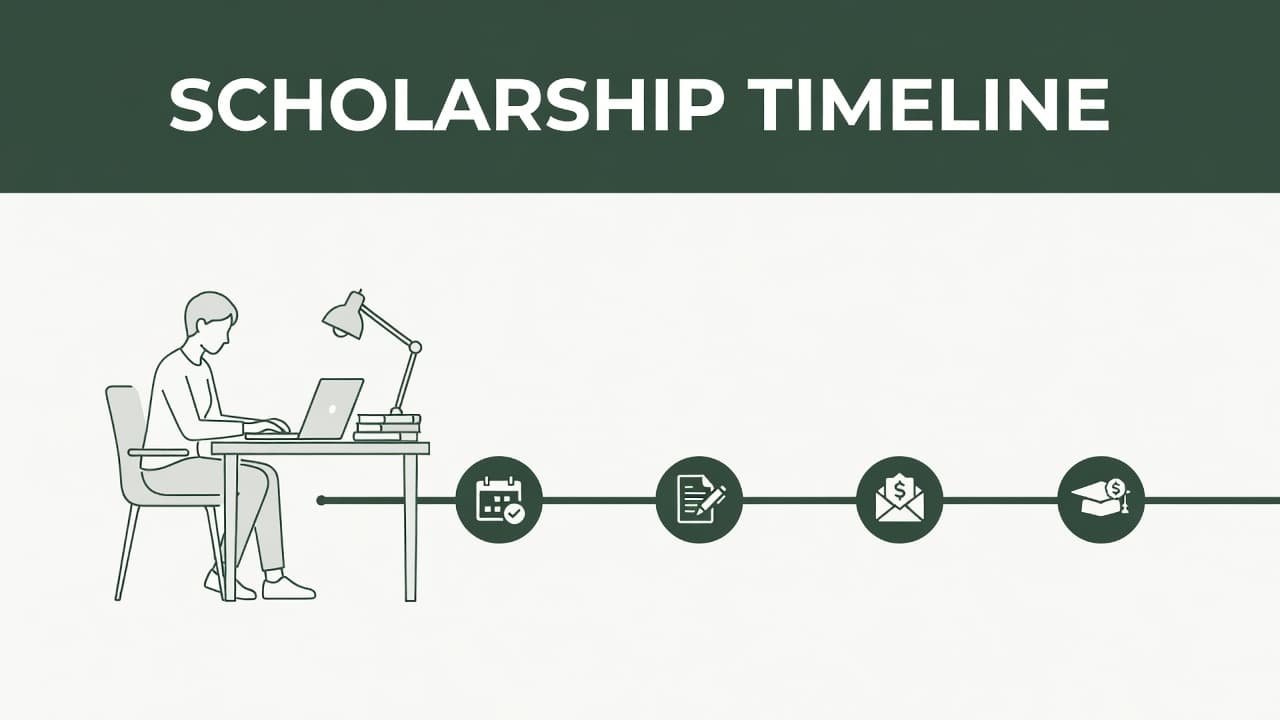
A simple timeline helps. If you are applying in the fall, you are often submitting your materials for admission and financial review at the same time. If you are applying later, you may still be eligible for aid, but some of the biggest awards may already be gone.
School-linked scholarships and external awards are not the same
Not every scholarship follows the same path. Some are built into the college application process, while others are separate, and that difference changes everything.
The table below makes the distinction easier to see.
Scholarship type |
How you apply |
Deadline that matters most |
What you should watch |
|---|---|---|---|
College-specific scholarships |
Submit your admission application |
Early Action or priority admission dates |
GPA, test scores, and school forms |
Need-based aid |
File financial aid forms |
FAFSA and, at some schools, CSS Profile deadlines |
Household income, tax records, and federal financial aid |
External scholarships |
Apply through a foundation, company, or nonprofit |
The scholarship’s own deadline |
Essays, recommendation letters, and eligibility rules |
The main takeaway is simple. College-specific scholarships often depend on how early and how accurately you submit your admission file. External scholarships do not care whether you have been admitted yet; they only care whether your application is complete and submitted on time.
Some colleges make this process even more clear. The University of South Carolina and Clemson both prioritize early action admission for scholarship consideration, with Clemson setting an October 15 deadline. That means the calendar starts moving long before official admission decisions arrive.
For a wider look at timing, Scholarships360’s guide to when to apply for scholarships gives the same basic message: do not wait for the admission letter if you can start applying for external scholarships now.

If you think of it like a race, college-specific scholarships are part of the first lap. External scholarships are their own race entirely. You need to run both, and you need to know which one has the shorter track.
Why waiting for admission can cost you money
Waiting feels safe, but it can cost you in quiet ways. The school may still admit you, but the money pool available to incoming freshmen may already be smaller.
A lot of merit-based financial aid gets assigned on a priority basis. That means the strongest candidates get looked at first, and early applicants often get the first shot at limited funds. By the time you file late, you are not competing against an empty room. You are competing for leftover seats and leftover dollars.
A scholarship deadline is still a deadline, even if the admission portal stays open.
Waiting also creates a paperwork crunch. Recommendations take time. Transcripts take time. Essays take time. If you need translations, school stamps, or updated financial documents, the clock moves faster than you think.
And then there is the technical side. College portals can slow down near deadlines. A file that seems almost done can turn into a missed opportunity because one upload failed or one question stayed blank.
This is where early action admission can help. It does not just give you an earlier answer. It can also put your name in the scholarship pile sooner. For many students, that is the real win.
If you are applying to rolling-admission schools, do not get too comfortable either. Rolling admission means the school keeps reviewing applications, but scholarship funds may not last as long as the admission window does. That is a big difference, and it matters.
What to have ready before you start applying
The easiest way to stay ahead is to build your package before you need it. That way, when an opportunity opens, you are not scrambling for the basics. To maximize your success, you should use a scholarship search engine during this phase to build a list of potential awards that align with your profile.
Keep these items close:
- Transcripts: Have an up-to-date copy ready, plus an unofficial version if a site allows it.
- Test scores: Use them if the scholarship or school still considers them.
- Short essays: Keep a clean draft you can adapt fast.
- Letters of recommendation: Ask your teachers or mentors early, not the night before.
- Financial aid info: FAFSA data and CSS Profile details can take time to gather.
- Translations or extra documents: Important if your records are not in the same language as the application.
A lot of students lose momentum because they are waiting for the right time. The right time is usually before the deadline wave starts. Once applications open, you want to be editing and submitting, not hunting for paperwork.
You also want to read every scholarship page like a checklist, not a flyer. If a school says separate scholarship form, that means separate work. If it lists a priority deadline, treat that as the real deadline. If it asks for honors program enrollment, residency status, or a major-specific essay, do not skip the fine print, as these eligibility requirements are often strict.
That is where a lot of people slip. They assume one form covers everything. It does not always.
When a separate scholarship form shows up
Some colleges keep things simple. Others require a second step, often through a dedicated scholarship portal that manages additional materials. Whether you are an undergraduate or one of many graduate students navigating the enrollment process, you may need to answer extra questions, submit an essay, or list activities in this separate system. Sometimes the deadline for these forms matches your admission date, but frequently, it is earlier.
That extra form can feel like an inconvenience, but it also gives you more control. It tells you exactly what the school wants, so you do not have to guess.
The safest move is to check three places on every school website: admissions, financial aid, and scholarship pages. If those pages provide conflicting information, the earliest date usually wins. You can always confirm the details with the financial aid office, and that short email can save you from a major oversight.
This is also the moment to keep an eye on external funding. Local scholarships offered by community groups, employers, state programs, and national foundations all run on their own unique schedules. If you build a simple calendar, you can keep school deadlines and these external opportunities side by side instead of chasing them one by one.
Frequently Asked Questions
Do I need to be admitted to a college before I can apply for external scholarships?
No, most external scholarships do not require an official admission letter to process your application. These organizations focus on your academic profile and personal achievements, allowing you to secure funding independently of your university status.
Can I miss out on merit-based aid if I wait for an admission decision?
Yes, waiting can be risky because many merit scholarships are awarded on a priority basis. If you apply late, the pool of available funds may have already been depleted, meaning you could lose out on opportunities that were available to earlier applicants.
Does applying for Early Action help with scholarship consideration?
Applying for Early Action can significantly increase your chances because many schools use this cycle to determine financial aid eligibility. By submitting your materials early, you ensure your file is reviewed when the maximum amount of scholarship funding is still available.
Should I assume my admission application covers all school-specific scholarships?
Not necessarily, as some colleges require a separate scholarship form or additional application materials. You should always check the financial aid and scholarship pages of your prospective schools to see if extra steps are needed to be considered for specific awards.
Conclusion
Yes, you can apply for scholarships before admission, and in many cases you should. Some colleges review you for aid through the admission file, while others expect you to apply on a separate timeline.
The students who do best usually are not the luckiest. They are the ones who start early, read the fine print, and treat scholarship deadlines like real deadlines. By being proactive, you can maximize your total funding, which often results in a more favorable financial aid award letter and reduces your long-term reliance on student loans. If you take the time to research and organize your materials, you give yourself more choices, more time, and a much better shot at success by applying for scholarships before admission.
This post may contain affiliate links. If you make a purchase through these links, I may earn a small commission at no extra cost to you.