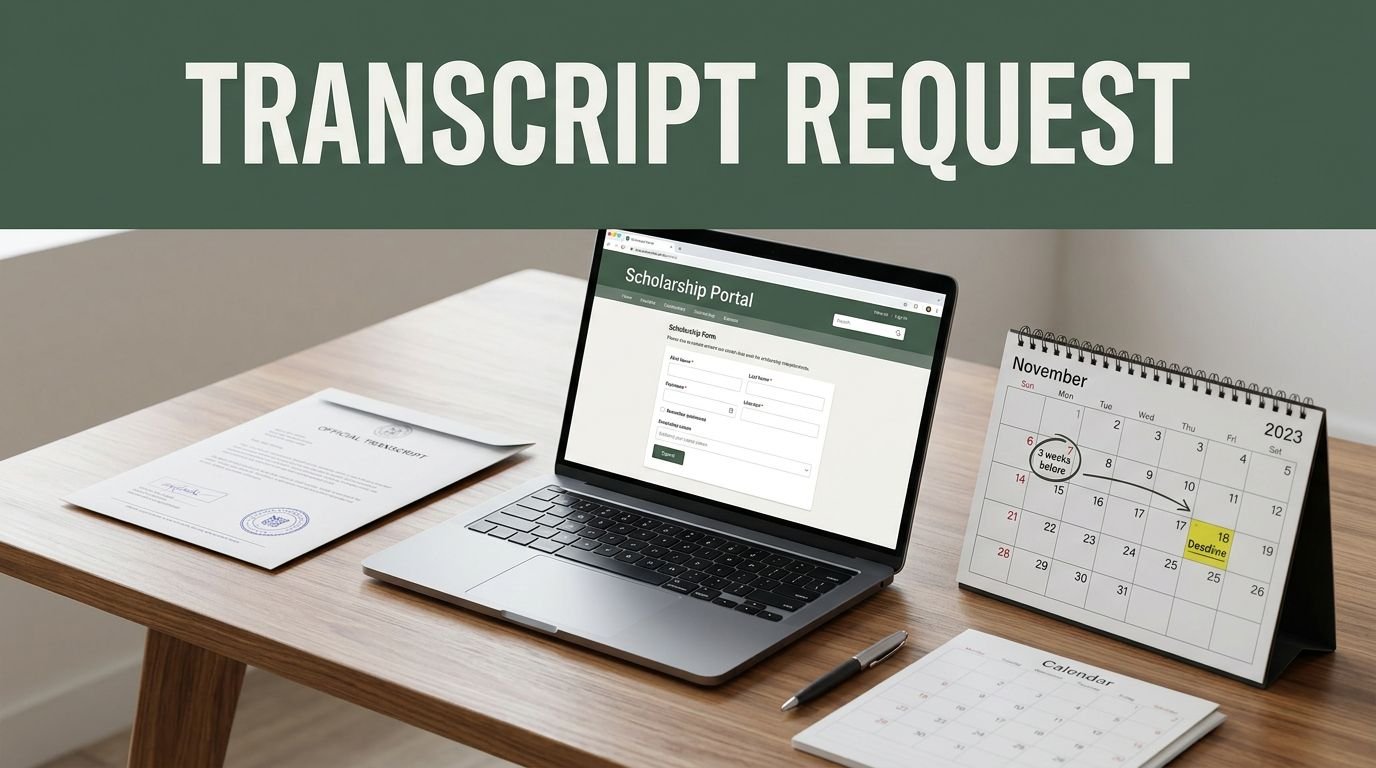
If you’re sorting out official transcripts scholarships paperwork, one late request can throw the whole application off. The transcript itself is simple. The request path isn’t always simple.
You may need a sealed official copy, an uploaded PDF, or a counselor-sent file. The trick is matching the request to the scholarship’s rules before the clock starts yelling at you.
Start with the kind of transcript the scholarship wants, then work backward from there.
Key Takeaways
- Official and unofficial transcripts are not the same thing. Scholarship portals may ask for one or the other, and the wrong file can slow you down.
- Your school counselor or registrar is usually the first stop. Give them the right details, then ask how the transcript will be sent.
- Portal systems can save time, but they still need close attention. Xello, National Student Clearinghouse, and school-specific forms all work differently.
- Request transcripts early. Three to four weeks before the deadline gives you room for delays, fees, and follow-up.
- Always confirm delivery. A transcript is only useful when the scholarship office actually has it.
Official or unofficial transcript? Start there
A lot of confusion starts here. You hear “transcript,” and it sounds like one thing. In practice, it can mean two very different documents.
An official transcript usually comes directly from your school or an approved delivery service. It may be sealed, electronically sent, or attached to a secure portal. An unofficial transcript is the copy you can usually download or print yourself.
Here’s the quick split:
Transcript type |
What it looks like |
Common use |
|---|---|---|
Official transcript |
Sent by the school, registrar, or approved service |
Scholarship offices, college admissions, record verification |
Unofficial transcript |
Student copy, often downloaded as a PDF |
Early review, portal uploads, internal checks |
Some scholarships want an unofficial upload first, then ask for an official copy later. Others want the school to send the record directly from the start. The instructions matter more than the label on the file.
A good example is the SMART Scholarship 2026 process. It asks applicants to upload the most recent unofficial transcript as a PDF in the Academic Background section. The file has to be legible, and it should show your name and school name. If your school does not use a 4.0 scale, you may also need GPA conversion instructions.
That’s why the first question is never “Where do I get a transcript?” It’s “What version does this scholarship actually want?”
Request the transcript from your school early
Most high schools start with the counselor. Most colleges send you to the registrar. Either way, don’t wait until the deadline week and hope for the best.
A clean request usually follows the same path, even when the form looks different.
- Check the scholarship instructions first.
Look for the exact transcript type, delivery method, and deadline. If it says official, don’t upload an unofficial copy unless the rules allow it. - Go to the right office.
For high school records, ask the counselor or registrar. For college records, contact the registrar’s office. If you attended more than one school, request each transcript separately. - Give complete identifying details.
Be ready with your full name, former name if you used one, date of birth, years attended, graduation year, and student ID if you have it. Small details save time. - Ask how the transcript will be sent.
Some schools mail sealed copies. Others use secure electronic delivery. Some will upload it directly into a portal. Don’t guess. - Set the deadline in writing.
Tell the office when the scholarship needs it. If the deadline is November 1, don’t treat October 31 as a safe day. - Keep any receipt or confirmation.
If the school gives you a request number, email, or portal notice, save it. You may need it later. - Follow up before the deadline passes.
A quick check can catch a missed form, an unread email, or a transcript sent to the wrong place.
If you’re helping a younger student, stay close while they fill out the request. The school still decides who can authorize release, so it helps to ask that question early.
Use transcript portals without missing a step
If your school handles requests online, the process is usually faster, but it still needs care. One wrong campus name or one skipped dropdown can send you in circles.
A few systems come up often. Schools using Xello may place the request inside the college-planning area, and you can see how the student workflow works in Xello’s transcript request guide. Districts that outsource delivery may route the record through the National Student Clearinghouse transcript services. Both can work well, but you still need to check the destination.
Here’s a quick way to think about the most common paths:
Request path |
What you do |
Best for |
|---|---|---|
School portal |
Log in and submit the request inside your student account |
Districts with their own records system |
College-planning tool |
Open the transcript request inside Xello or a similar platform |
Schools that manage applications in one place |
Third-party service |
Order through an approved provider like National Student Clearinghouse |
Secure forwarding and cross-school delivery |
Paper form |
Print, sign, and hand it to the registrar |
State aid offices or older school systems |
Some state scholarship offices still use paper-first instructions. Oregon Student Aid, for example, shows a form-based process on its transcript request page. That kind of setup may feel old-school, but it works if you follow each step exactly.
The key is not the tool. The key is the handoff. If the school sends it to the wrong college, the wrong campus, or the wrong portal tab, you lose time you may not have.
Check deadlines, file format, and delivery status
Deadlines are where transcript requests get messy. A scholarship might be due in two weeks, but your school may need several more days to process the request.
Give yourself room. Three to four weeks before the deadline is a smart target. If the deadline falls early in the school year, ask even sooner. Waiting until the last minute is like mailing a postcard during a thunderstorm and hoping for clear skies.
If the scholarship wants an uploaded file, save it as a PDF unless the instructions say otherwise. If the file is blurry, cropped, or missing your name, fix it before you upload. A clean file saves you from avoidable rejection.
A transcript is only “done” when the receiving office confirms it, not when you click submit.
That matters more than people think. Some schools send a confirmation email. Some portals show a status update. Others need a direct follow-up with the counselor or registrar. If you don’t see proof of delivery, ask.
Also, watch for special format rules. Some scholarship systems want the most recent transcript, not an old copy from last semester. If your school uses a grading scale other than 4.0, the scholarship may also want conversion instructions attached or explained somewhere in the file. That small detail can keep a good transcript from getting stuck.
Common mistakes that slow scholarship paperwork
Most transcript delays come from simple mistakes. You use a nickname instead of your legal name. You send the wrong school. You forget that you changed campuses. It happens fast.
The safest move is to match the name on your scholarship application exactly. If you attended more than one high school or college, ask whether each transcript is needed. Don’t assume one file covers everything.
Parents helping with applications should check the student’s current email, school login, and deadline. A transcript request buried in the wrong inbox is still a missed transcript.
Another common slip is sending a screenshot when the portal wants a PDF. Screenshots look fine on your phone and fail on the upload page. If the application wants a file, use the file it asked for.
Finally, don’t assume “official” means the same thing everywhere. Some scholarship portals accept unofficial PDFs first. Others need a direct school send. Read the instruction line twice before you request anything. It saves you from doing the same task twice.
Conclusion
When you request transcripts with a deadline in mind, the whole process gets easier. You know what the scholarship wants, which office handles the request, and how the transcript should move.
The real win is simple. Ask early, confirm delivery, and keep every receipt or status update. That’s how you keep a transcript from becoming the one thing that holds up a strong scholarship application.
This post may contain affiliate links. If you make a purchase through these links, I may earn a small commission at no extra cost to you.