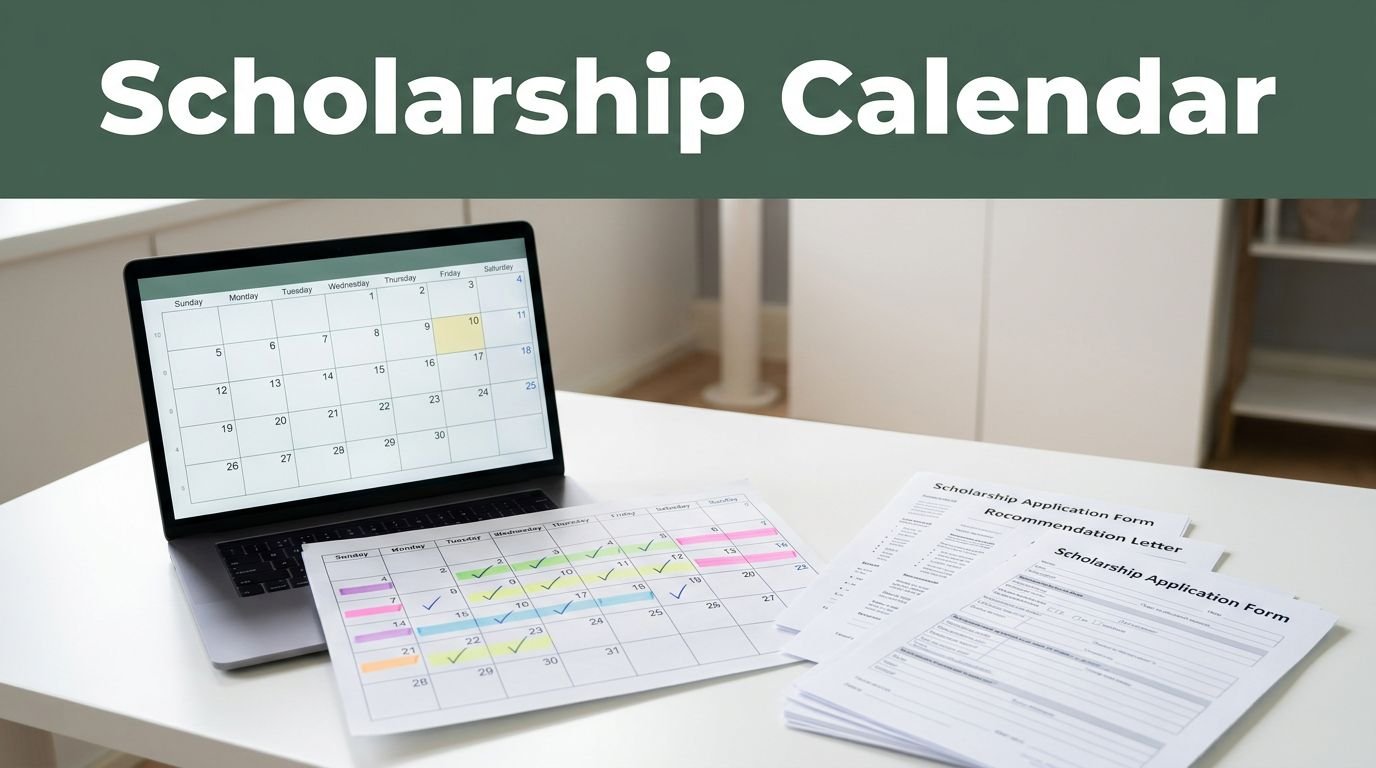
Scholarship season can turn into a chaotic paper chase very quickly. One deadline might be buried in an email, another hidden in an online portal, and a recommendation request might still be sitting in your drafts. A reliable scholarship application calendar pulls all of these moving parts into one place so you stop guessing what comes next.
Staying organized is essential for managing your college funding and overall financial aid strategy. This approach is equally important for high school seniors preparing for their first year and transfer students looking to offset costs at a new institution. The goal is simple: avoid missed deadlines, reduce last-minute panic, and keep your path to debt-free education clear. Here is how you set up a system that you will actually use throughout the year.
Key Takeaways
- Centralize all deadlines: Use one master list to aggregate every scholarship, FAFSA, and internal requirement to prevent missed opportunities.
- Reverse engineer your timeline: Start planning six weeks in advance by setting internal checkpoints for drafts, transcript requests, and letters of recommendation.
- Implement a notification system: Set multiple reminders for each deadline to avoid last-minute issues and always verify the specific time zone of the submission portal.
- Establish a weekly maintenance routine: Dedicate 15 minutes each week to update your calendar, archive submitted materials, and identify new opportunities to ensure the system remains accurate.
Start With One Master List
Before you color-code your schedule, gather every opportunity into one master list. If a deadline lives in three different places, you will likely miss something. That part is almost guaranteed.
Use one notebook, one spreadsheet, or one calendar app. Pick the tool you already open without thinking. If you want a broader look at the scholarship search process, best practices for securing scholarships is a good reminder that research comes before the application rush.
Your list should include more than just due dates. Add the full scholarship name, the award amount, the eligibility requirements, the essay topic, and any extra materials. By capturing these details early, you avoid having to reopen the same webpage ten times. Be sure to include both national awards and any local scholarships you find in your community, as these often have less competition. Additionally, add your FAFSA deadline to the list to ensure you do not miss out on general federal aid.
A simple master list usually needs these details:
- Application due date and time
- Essay prompt and word count
- Recommendation letter deadline
- Transcript or test score request date
- Portal link or submission method
- Renewal date, if the award repeats

A master list works because it stops the scavenger hunt. You are building one central place to check, rather than five.
Work Backward from Each Due Date
Once your master list is in place, do not just stare at the scholarship deadlines and hope for the best. Work backward. This is where your true planning begins.
If a scholarship is due on March 1, your calendar should not only highlight that final date. It should also show when you need to draft your scholarship essays, request a transcript, ask for a recommendation, and submit your materials. Because these dates often overlap with your broader admission application requirements, keeping a month-by-month outline like the one in this college application timeline helps because it breaks one big task into manageable steps.
As you build your schedule, identify a priority deadline for every opportunity, which serves as your internal goal. If a scholarship allows for an early action deadline, treat that as your actual due date to ensure you have a competitive edge.
Here is a simple reverse plan:
Internal checkpoint |
What you do |
|---|---|
6 weeks before |
Read the rules and gather documents |
4 weeks before |
Ask for recommendation letters |
3 weeks before |
Write the first draft of scholarship essays |
1 week before |
Proofread and confirm uploads |
24 hours before |
Submit and save proof |
That kind of buffer keeps one delay from wrecking your entire plan. If your recommender gets busy or your scholarship essays need a major rewrite, you still have the necessary room to breathe.
If you wait until the week of the scholarship deadlines, you are not organizing. You are gambling.
This is where a scholarship calendar starts to feel less like a list and more like a roadmap. Every step you take points directly to the next one, keeping you on track for every admission application and award opportunity on your list.
Turn Reminders Into a Real System
A calendar entry is not enough on its own. You need reminders that catch you before the deadline sneaks up.
Start with three alerts for every scholarship. Set one a week before, one three days before, and one the day before. You should also set alerts for expected scholarship notifications, which helps you track your progress, follow up on results, or begin planning for the next academic year. If the due time is 11:59 PM, always check the time zone. Some scholarship portals use local time, while others use Eastern Time. That small detail can cost you the whole application.
Color-coding helps too. Use one color for essays, another for letters of recommendation, another for transcripts, and another for final submissions. When you scan the week, you should see exactly where the pressure is building.
If you live by your phone, use calendar alerts and task reminders. If you prefer paper, keep a planner nearby. The two together work even better. The paper version lets you see the week at a glance, and the phone catches what your memory misses.
You can also give each scholarship a status label:
- Not started
- In progress
- Waiting on documents
- Ready to submit
- Submitted
That tiny system saves you from opening the same application over and over just to remember where you left off. It also gives parents and students a shared view of what still needs attention.
Track Documents, Recommendations, and Submissions
Deadlines are only half the story. A scholarship application often fails because one small task got ignored. Maybe the essay was ready, but the request for official transcripts was late. Maybe the application went through, but no proof was saved.
Your calendar should track every piece of your application materials that must be prepared before you hit submit. This includes essay drafts, recommendation requests, transcript orders, and file uploads. It also involves tracking renewal deadlines if you are managing scholarship awards or merit scholarships that continue for more than one year. Tracking scholarship renewal deadlines matters because keeping existing funding is much easier when you do not treat the follow-up date like an afterthought.
Keep one folder for each scholarship. Inside it, save the essay, the final PDF, the recommendation request email, and the confirmation screen after submission. If the portal provides a receipt number, save that as well.
A good rule is simple: if someone else has to do it, track it twice. Your recommender, counselor, and the office handling your official transcripts are all on their own schedules. You are the one responsible for holding the deadline together.
The most useful habits are often the plainest ones:
- Write down when you asked for each recommendation.
- Note when official transcripts were requested and received.
- Save final drafts of all application materials with clear file names.
- Keep a screenshot or email confirmation after submitting.
- Mark renewal dates for merit scholarships or other scholarship awards before the school year gets busy.
That is how you avoid the classic scramble where everything is finished except the one thing you forgot to record.
Review and Update the Calendar Every Week
A scholarship application calendar only works if it stays alive. A dead calendar is just a pretty list.
Set a weekly review time, even if it is only fifteen minutes. Sunday night works for a lot of students. So does Monday morning before class. During that review, add new scholarships, move finished ones off the list, and check for deadlines that are getting close.
This is also the moment to filter out scholarships that do not fit you. No point pouring energy into an award you are not eligible for. The reminder from best practices for securing scholarships is simple; read the rules before you spend time on the form. Use this time to check in with your school financial aid office to see if they have listed new local opportunities. You should also monitor updates from Federal Student Aid and keep an eye out for upcoming deadlines for state grants to ensure you are not overlooking essential external funding sources.
A weekly reset keeps the calendar honest. New opportunities show up all the time, and old ones fade fast. If you do not update the system, it starts lying to you.
Keep the review short and focused:
- Add new deadlines you found that week.
- Check which applications are still open.
- Confirm every recommendation request.
- Move any unfinished work into the next week.
- Archive anything you already submitted.
That routine turns the calendar into a habit instead of a project. And habits win when the semester gets messy.
Frequently Asked Questions
What is the best tool to use for a scholarship calendar?
The best tool is one you already use consistently, whether it is a physical planner, a digital spreadsheet, or a mobile calendar app. The goal is to choose a medium you naturally check every day so that your deadlines are always visible.
How far in advance should I start planning my scholarship applications?
You should begin working backward at least six weeks before the final due date to allow for unexpected delays. This buffer ensures you have ample time to gather letters of recommendation and refine your essays without the stress of a looming deadline.
Why is it important to track scholarship renewal dates?
Many merit scholarships require you to maintain a certain GPA or re-apply annually to keep receiving funds. Tracking these dates in your master calendar prevents you from accidentally losing financial aid you have already secured.
What should I do if a scholarship application portal uses a different time zone?
Always check the specific time zone listed on the application page, as many portals use Eastern Time regardless of where you live. To avoid disqualification, treat the deadline as if it occurs two hours earlier than your local time to provide a built-in safety margin.
Conclusion
A scholarship application calendar works best when it makes your next step obvious. By collecting every deadline in one place, working backward from each due date, setting reminders that fit your schedule, and reviewing your progress weekly, you can master the process.
Developing a reliable system is essential for securing competitive scholarships and easing the pressure of your undergraduate admission journey. Staying organized throughout the broader admission application process not only helps you hit every one of your scholarship deadlines but also keeps your focus where it belongs: on crafting the best possible applications.
Ultimately, your calendar does not need to be fancy, but it does need to be consistent. If you prioritize tracking your financial aid opportunities and keep your plan updated, you give yourself a much better shot at the funding that matters most to your future.
This post may contain affiliate links. If you make a purchase through these links, I may earn a small commission at no extra cost to you.