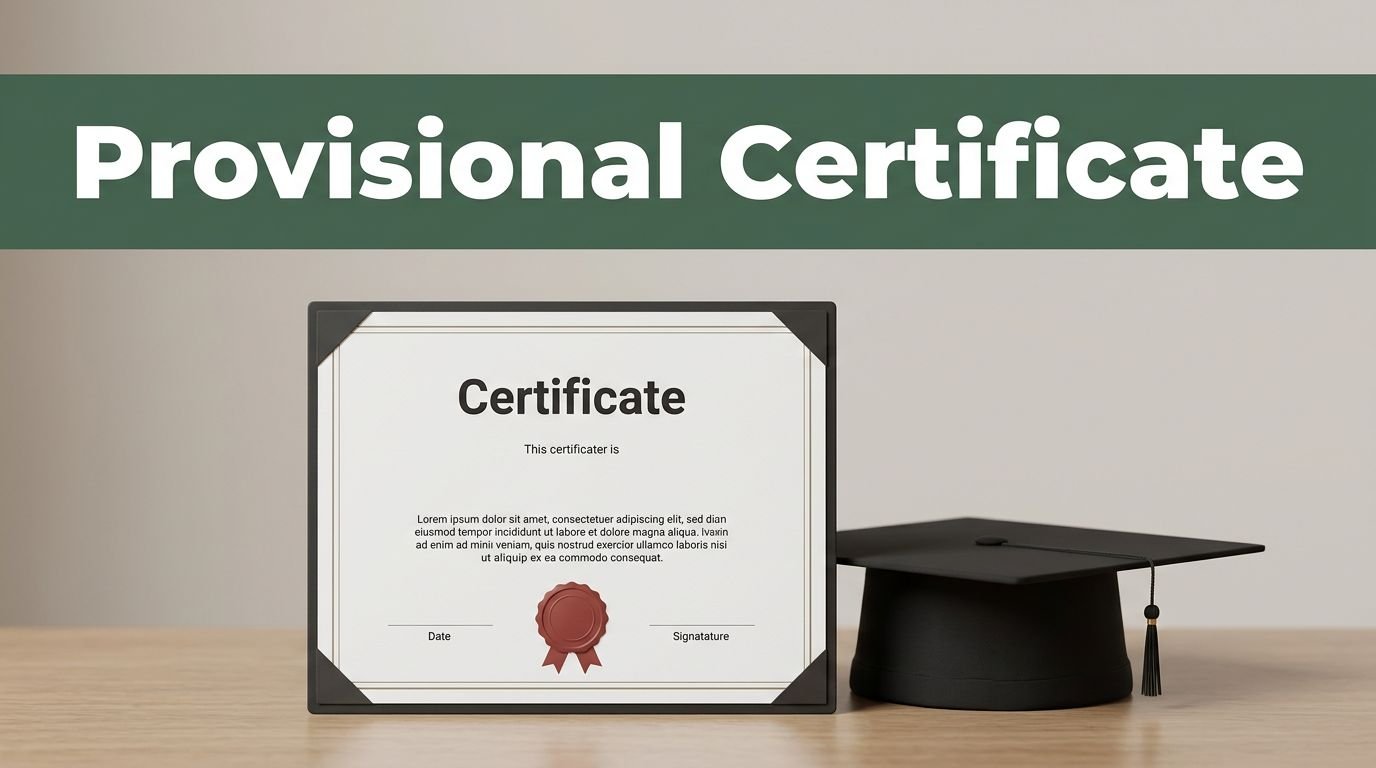
Using a provisional certificate for a scholarship application can feel like a half-packed suitcase. You have proof that you finished your requirements for a bachelor’s degree, but you might be waiting on the final transcript, the official diploma, or a stamped copy.
That is where the confusion in the application process starts. Some scholarship offices accept a provisional certificate as supporting proof, while others require a stricter set of official records. If you understand what this certificate proves, what it leaves out, and how to pair it with the right supporting documents, you can avoid a messy back and forth with committee members.
Key Takeaways
- A provisional certificate usually shows that you have completed your degree requirements or are waiting for the final provisional degree certificate.
- Many scholarships still want official transcripts, not a provisional certificate alone.
- In 2026, several major scholarship programs ask for notarized or certified academic records.
- Your best move is to treat the provisional certificate as supporting proof, not the only file in your application.
- Small details, like stamps, translations, and file names, can decide whether your submission looks complete.
What a Provisional Certificate Tells a Scholarship Committee
A provisional certificate is a temporary academic document issued by higher education institutions when you have completed your required coursework but are still waiting for your final diploma or convocation paperwork. It serves as an official confirmation of your progress, completion, and good standing. If you are enrolled in an educator preparation program, you might find that a teaching certificate is handled with similar procedures during the document verification phase.
That sounds useful, and it is. But scholarship committees usually want more than a document that simply confirms you finished your studies. They often require detailed grades, specific course names, completion dates, and official seals. That is why a provisional certificate can help your application, but it rarely carries the weight of a complete academic record on its own.
If you want a plain-language reference, a provisional certificate guide with samples explains the usual format and why schools issue it.
Think of it as a bridge document. It can move your application forward, but it does not always replace the final record.
For scholarship reviewers, the main question is simple: does this file prove exactly what the program requested? If the answer is not quite clear, they may ask for a transcript, a completion letter, or a certified copy before they can continue with your evaluation.
When It Helps, and When It Falls Short
The safest rule is this: a provisional certificate helps when the scholarship asks for proof of completion, but it falls short when the instructions call for official academic records. Understanding these eligibility requirements is essential, as these two types of documents are not the same.
In 2026, that distinction matters more than ever. The Fulbright Foreign Student Program asks for original academic transcripts with official, notarized stamps, and its instructions specify that incomplete documents will not be considered. Furthermore, some competitive programs require documents to be apostilled or have consular confirmation to verify their authenticity. Harvard financial aid, Yale, Duke Karsh International Scholars Program, and Amherst College all rely on complete academic records too. If you upload only a provisional certificate, your file can look incomplete even when your degree is finished.
Here is a quick comparison you can use while checking your documents.
Situation |
Provisional certificate alone? |
What usually works better |
|---|---|---|
Degree finished, final certificate pending |
Sometimes |
Provisional certificate plus transcript |
Degree still in progress |
Rarely |
Latest transcript or semester record |
Scholarship asks for official transcript |
No |
Official transcript with stamps or seal |
Scholarship asks for proof of completion |
Often |
Standard certificate and completion letter |
Emergency or missing records |
No |
Alternative placement or school letter |
The pattern is clear. The more specific the scholarship request, the less room you have to improvise. If the form says “official transcript,” treat that as the main document. If it says “proof of completion,” your provisional certificate may fit the bill.
Documents You Should Pair With It
A provisional certificate works best when it is paired with the right support files. Whether you are applying for competitive scholarships or seeking tuition assistance, you do not need an overwhelming stack of paperwork. Instead, you need the specific documents that directly address the requirements set by the committee.
A strong application file often includes:
- Official transcript: This provides a detailed record of your subjects, grades, and academic history.
- Certified translation: This is essential if your original documents are not in the language requested by the scholarship or funding provider.
- Completion or graduation letter: Many schools issue this formal confirmation while the final degree certificate is still being processed.
- Notarized or verified copies: These provide the necessary assurance that your documents are genuine.
- Verification of income and income guidelines: If you are applying for programs based on financial need, providing proof of your financial situation ensures you meet all specific income guidelines.
- Residency proof: Providing clear evidence of your residency status can be a requirement for many regional or national awards.

Photo by Kampus Production
If your school uses different terminology for these documents, try to match the wording used in the application portal as closely as possible. While a course completion certificate and a provisional certificate may seem similar, some automated systems or selection committees strictly follow the labels they provided.
Additionally, check whether the program asks for English test scores, identity pages, or other specific documentation. Many international programs require these, and missing a single file can delay the entire review process. The goal is not to flood the portal with unnecessary information, but rather to provide exactly what was requested in the required format.
How to Submit It Without Slowing Your Application
This part is where many applicants lose time. While your temporary scholarship documentation is valid, a messy upload process can create unnecessary hurdles. A clean submission makes your file easier for the committee to review and less likely to be rejected.
- Read the document requirements carefully. If the scholarship asks for a final degree certificate, do not substitute a provisional certificate and hope for the best, as this may result in an incomplete application.
- Check whether the portal allows extra documents. If it does, upload the provisional certificate as support, not as a replacement for mandatory records.
- Combine related pages into one PDF if the system allows it. Put the most important academic record first to ensure visibility.
- Keep scans sharp and complete. Stamps, signatures, dates, and page edges all need to be clearly visible for the reviewer to verify authenticity.
- Use a clear file name. Something like Surname_Transcript.pdf is much easier for an administrator to organize than a generic name like scan_final2new.pdf.
- Watch the deadline clock. If your application process requires a new stamp, a translation, or a background check as part of the formal requirements, request these early. That one delay can cost you the scholarship slot.
A good rule is to think like the reviewer. Can they open the file and understand your academic status in ten seconds? If not, tighten the formatting and ensure your supporting documents are clearly labeled.
Common Mistakes That Hurt Strong Applications
A strong student can still lose points on paperwork throughout the scholarship program application process. The mistakes are often small, but they send the wrong signal to evaluators.
- Sending the provisional certificate instead of the transcript: If the scholarship wants grades, a completion letter will not answer the question.
- Uploading an unofficial screenshot: A cropped phone image looks rushed and can be hard for committees to verify.
- Ignoring translation rules: A document in the wrong language can be treated as incomplete.
- Leaving out stamps or seals: Some programs want notarized or certified records, and missing marks can trigger a rejection.
- Using an old file version: If your university reissued the document, submit the latest version only.
- Waiting too long to ask your school for help: Administrative offices move at their own pace, and deadlines do not care about bureaucratic delays.
When you are stuck, go back to the scholarship instructions and use their exact language. If the portal says official academic records, that usually implies more than a provisional slip. If the requirements align with department of education standards or specific certification assessments, you should ensure your documents explicitly match those labels. Following the exact terminology requested often results in a much better fit for your application.
Frequently Asked Questions
Can I use a provisional certificate if the scholarship specifically asks for an official diploma?
Generally, no. If a scholarship committee explicitly requests an official diploma or final degree certificate, a provisional certificate may be viewed as insufficient or non-compliant. You should contact the scholarship office to confirm if they accept a provisional certificate as a temporary placeholder while your final document is being processed.
Should I upload my provisional certificate if I already have my final transcript?
Yes, it can serve as helpful supplementary documentation. While the official transcript provides your grades, the provisional certificate adds an extra layer of verification confirming your eligibility to graduate. Including both ensures there is no ambiguity regarding your academic standing.
What should I do if my provisional certificate is not in English?
Most international scholarship programs require a certified or notarized English translation for any document not issued in that language. Submitting an original certificate alongside a professional translation prevents the committee from marking your application as incomplete due to language barriers. Always check the specific guidelines of your scholarship to see if they require a particular type of certification for translated documents.
How does a provisional certificate differ from a completion letter?
A provisional certificate is typically a formal document issued by the university registrar following degree completion, whereas a completion letter is often a signed statement from your department head or advisor. While both serve as proof of progress, an official provisional certificate carries more weight with review committees because it is a standard institutional record. Check your scholarship requirements to see if they prefer one specific format over the other.
Conclusion
A provisional certificate serves as a vital bridge to help you navigate the gap between completing your studies and receiving your final degree documentation. While this document effectively demonstrates your academic progress, it is important to remember that it does not always replace the comprehensive records requested by a scholarship committee.
When you treat your provisional certificate as essential supporting evidence, pair it with official transcripts, and ensure it aligns perfectly with the specific document requirements of your application, you present a more polished and professional profile. Taking these steps can make a significant difference, helping to keep your application moving forward in the review process rather than getting stalled in a queue. By being proactive and organized, you ensure that your credentials are ready for selection panels to review with confidence.
This post may contain affiliate links. If you make a purchase through these links, I may earn a small commission at no extra cost to you.