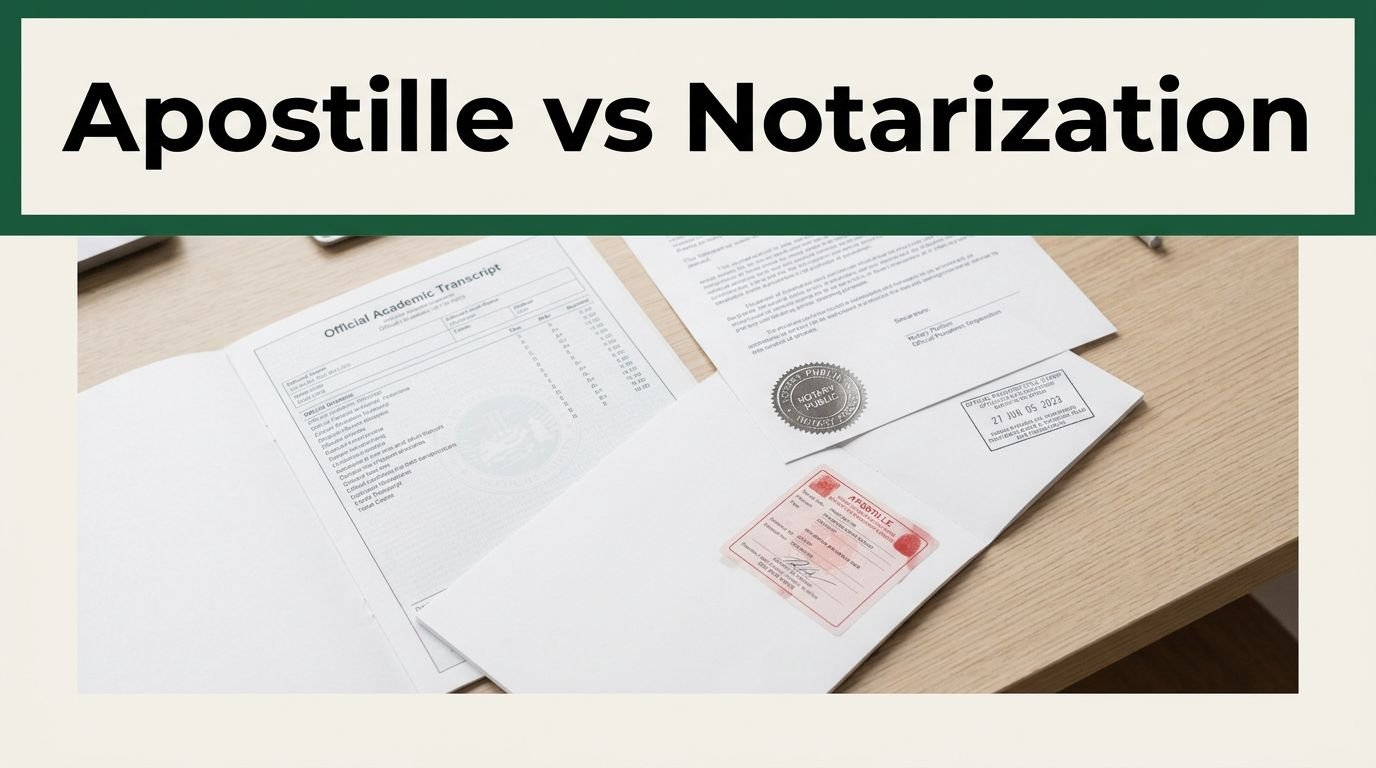
If your scholarship packet is headed overseas, one stamp can save you weeks, and one wrong stamp can waste them. That is why apostille vs notarization trips people up so often. Understanding the difference between these processes and the specific role of a notary public is essential to ensuring your paperwork reaches the admissions committee without delays.
One process confirms a signature, while the other verifies that the first stamp is authentic. This distinction is vital when a school, embassy, or funding body requires your legal documents to be accepted for international use outside the U.S. If you are preparing transcripts, translations, affidavits, or consent forms, the order in which you handle these steps matters more than you think.
Key Takeaways
- A notarial act by a notary public confirms identity and signature, while an apostille verifies the authority of that notary for foreign use.
- An apostille does not replace a notarized document. In fact, the apostille process must always follow the initial notarization.
- Hague member countries typically require an apostille for international recognition. Non-Hague countries often request a more complex authentication and legalization process instead.
- Scholarship papers rarely fail because of the content alone; they often fail because the required seal is incorrect or missing.
- When the instructions are vague, ask the scholarship office or receiving institution for clarification before you file any paperwork.
Why scholarship documents get stuck on the wrong step
You often see scholarship instructions that say “notarized copy,” “certified translation,” or “apostilled diploma” as if those words mean the same thing. They don’t. A notary public checks identity and witnesses a signature, leaving their notarial seal on the document. An apostille then certifies that the notary’s seal and commission are legitimate for use in a foreign country. This sequence is a vital part of the broader authentication process required to give your paperwork legal standing abroad.
That difference matters because scholarship packets are rarely just one paper. You may need a transcript, a degree certificate, a parental consent letter, a bank letter, or a translation. If even one piece is wrong, the whole packet can stall.
PandaDoc has a clear plain-English breakdown in its apostille vs notary guide, and the short version is easy to remember. Under the Hague Convention of 1961, notarization is typically the first step, while an apostille is the international follow-up when the destination requires it.
You also need to think about the destination country, not just the scholarship office. If the receiving country is in the Hague system, an apostille is often the right finish. If it is not, you may need a longer, more complex document authentication route. That is where a lot of students lose time, because they stop at the notary desk and think the job is done.
Apostille vs notarization: a simple side-by-side
Before you spend money on seals, it helps to see the two side by side.
Feature |
Notarization |
Apostille |
|---|---|---|
What it does |
Verifies identity and witness signature |
Ensures legal validity for international use |
Who issues it |
Notary public |
Secretary of State or U.S. Department of State |
When you use it |
For documents that need a valid signature record |
For documents headed to Hague Convention countries, such as a power of attorney |
Order |
First |
Second |
What it does not do |
It does not make a document internationally accepted |
It does not replace the notary stamp |
The National Notary Association’s apostille basics are a useful reference if you want the paper trail explained without legal jargon.
If the document never got notarized, there is nothing for the apostille office to certify in the notarized document.
That one detail is where a lot of students get caught. They pay for translation, rush the mailing, and then learn they skipped the step that makes the rest of it valid.
Which scholarship papers usually need which seal
Not every scholarship document needs the same treatment. The specific document type, the destination country, and the requirements of the receiving office all play a role in the process.
Transcripts and diplomas
Official transcripts, diplomas, and birth certificates often require the most verification. These public documents frequently need certified copies from the issuing institution or government agency. Some schools will issue these directly, while others may require you to provide a notarized copy or a letter from the registrar upon request. If you are sending academic or personal records abroad, always verify whether the receiving institution wants the original, a certified copy, or a notarized copy before you begin the process.
If the destination country requires an apostille, the notarized document typically goes to the Secretary of State first to receive state-level authentication. For federal documents, such as an FBI background check, the process shifts to the U.S. Department of State instead.
Translations and support letters
If your scholarship packet includes a translation, the notarized part is usually the translator’s affidavit rather than the source document itself. This distinction is vital when you are submitting a translated transcript or diploma.
Other common support documents, such as a power of attorney, parental consent forms, residency statements, and financial declarations, frequently require notarization because they rely on a person’s sworn signature. Once you have a valid notarized document, the question of an apostille arises if the destination country requests it for legal validation.
In practice, this means the translation, the notarized signature, and the destination country requirements must all align perfectly. If any single piece of the verification process is incorrect, your entire scholarship application packet may be delayed.
The order matters more than people think
You do not want to guess your way through this. The safest route is to work backward from the scholarship office or the receiving country.
- Read the document instructions carefully and look for the exact words, such as notarized, apostilled, certified copy, or authenticated.
- Make sure you have the right version of the paper, whether that is an original, a certified copy, or a translated affidavit.
- Get the notarization first.
- Send the notarized document to the right office for the authentication process, which is usually handled by the Secretary of State for state documents or the U.S. Department of State for federal ones.
- Leave time for mailing, corrections, and any extra legalization if the country is outside the Hague Convention system.
Following these steps precisely is the best way to ensure the legal validity of your paperwork well before your scholarship deadline.
Fees also vary throughout this process. Notary charges for your notarized document are usually modest, but apostille fees can differ significantly by state. California lists $20 per apostille, and Washington, DC lists $65 for its service. That kind of spread is why you should check the exact office before you budget for your application expenses.
Common mistakes that can cost you a deadline
A few mistakes show up again and again, and they are easy to avoid once you know them.
- You stop at notarization when the destination country wants an apostille.
- You send a photocopy when the office requires an original or certified copy.
- You wait too long to handle translations, which turns your notary appointment into a bottleneck.
- You send state-level paperwork to a federal office, or federal documents to the wrong state office.
- You skip the necessary embassy legalization or consular legalization for a country that does not participate in the Hague Convention.
That last point is a critical detail. An apostille is not a universal pass. If the foreign country does not recognize the Hague process, you must complete a full chain of document authentication. This ensures your public documents are legally recognized for international use. Always verify the specific requirements of your destination to avoid delays, as the apostille process only applies to nations that are members of the Hague Convention.
Frequently Asked Questions
Can I get an apostille on a document that hasn’t been notarized?
No, you cannot. An apostille functions by authenticating the seal and signature of a notary public, so the document must be properly notarized first to provide the necessary legal foundation for the apostille.
Does every country accept an apostille for scholarship documents?
Only countries that are members of the Hague Convention typically accept an apostille. If your destination country is a non-Hague member, you will likely need to undergo a more complex process known as embassy or consular legalization.
Is an apostille the same thing as a certified copy?
No, they serve different purposes. A certified copy confirms that a document is a true reproduction of the original, while an apostille is an international certification that verifies the legitimacy of the notary’s signature and seal for use abroad.
Where should I go to get my documents apostilled?
This depends on the type of document you have. State-issued documents like birth certificates or notarized affidavits are typically apostilled by the Secretary of State in the state where they were issued, while federal documents require processing through the U.S. Department of State.
Conclusion
Scholarship paperwork becomes much more manageable when you treat these seals as a required sequence rather than an optional choice. Proper notarization proves the authenticity of a signature, while an apostille verifies that notarization for international use in member countries.
When preparing your legal documents, starting with the destination country’s specific rules and working backward will save you time, money, and significant last-minute stress. Mastering the apostille vs notarization distinction is vital for any student applying abroad. Ultimately, gaining a clear understanding of this authentication process is the key to ensuring your application packet moves forward rather than sitting in a stack, helping you secure the scholarship success you deserve.
This post may contain affiliate links. If you make a purchase through these links, I may earn a small commission at no extra cost to you.