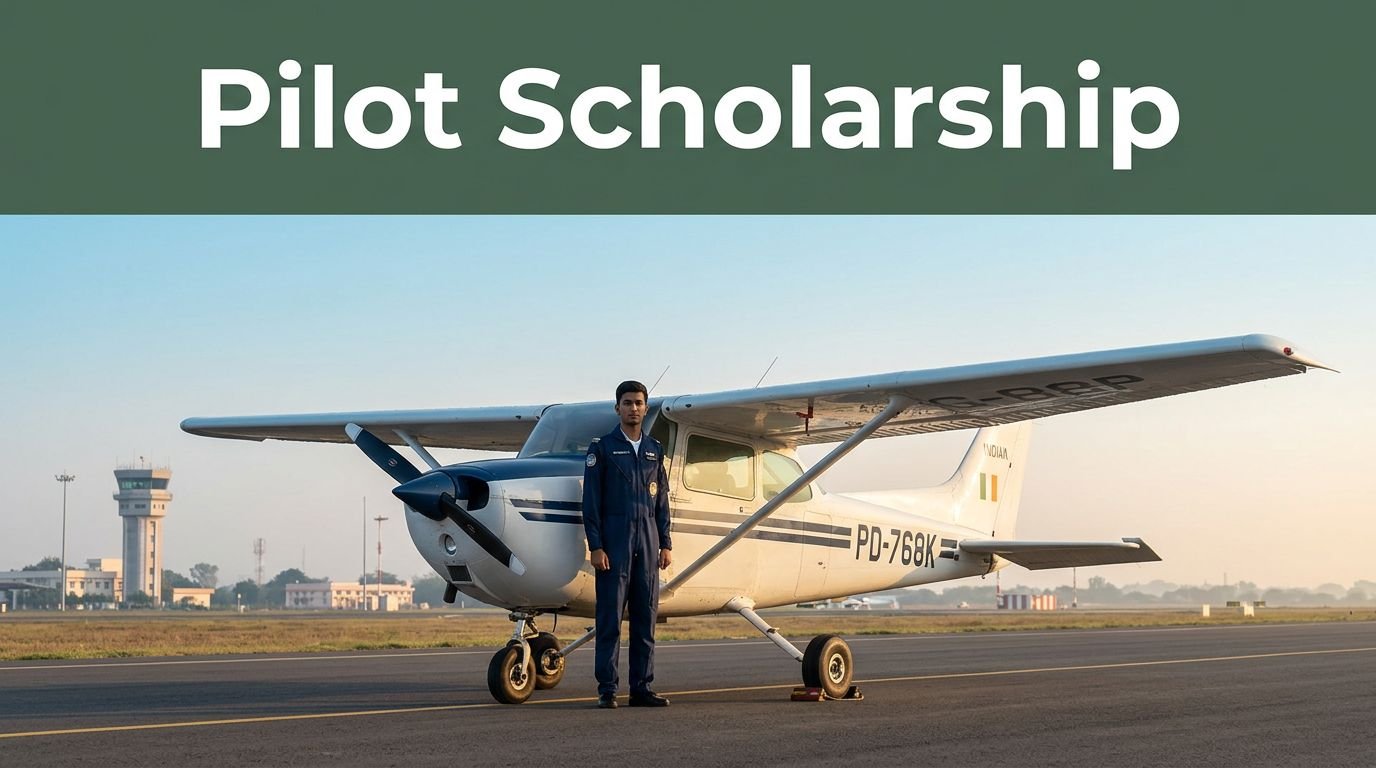
You’ve probably looked at the price tag of flight school in India and felt that familiar knot in your stomach. It is expensive, and for most people, those costs create a massive barrier before you even get near a cockpit.
The good news is that you don’t have to bankroll your entire flight education alone. A pilot training scholarship in India can bridge that gap, turning a distant dream into a realistic career path.
Keep reading to learn how to identify the right financial aid programs and what you need to do to land them.
Understanding the Costs of Becoming a Pilot in India
Flight training in India is expensive. Before you hunt for a pilot training scholarship in India, you need to look at the total bill. Most flight schools operate on a pay-as-you-go model, but the sticker price often shocks newcomers. Between ground school, flying hours, and licensing fees, the costs add up quickly.
Breaking Down the Flight School Price Tag
The biggest chunk of your budget goes to flight hours. To get your Commercial Pilot License (CPL), you need 200 hours of flying time. Schools charge by the hour, and rates depend on the type of aircraft used for training. You will also face costs for simulator sessions, landing charges, and instructor fees.
Beyond the actual flying, you have several fixed expenses to manage:
- Ground classes for your exams (Air Navigation, Meteorology, Air Regulations, and Technical).
- DGCA examination fees for every single paper you attempt.
- Medical assessments at approved centers, which you must repeat periodically.
- Radio Telephony (RTR) licensing and training fees.
- Uniforms, headsets, and navigation charts that you are required to buy yourself.
Don’t forget the hidden costs of living near an airfield. Many flight schools are located away from major cities, meaning you have to factor in housing, food, and local transportation for the 18 to 24 months it takes to finish your training.
Why Scholarships Matter More Than Ever
When you add these figures together, you are usually looking at a total investment of 40 to 60 lakhs, or sometimes more. This massive financial demand is exactly why finding a pilot training scholarship in India is worth the effort. It isn’t just about saving cash. These programs often provide a structure for your training, and in some cases, they link directly to airline cadet programs that help secure your job placement after graduation.
Most students pay for these costs through a combination of personal savings and educational loans. If you rely on a loan, remember that you are also paying interest on top of that base price. A scholarship effectively lowers your principal amount, which makes the repayment process much easier once you start working as a junior first officer.
Where to Find the Best Pilot Training Scholarship in India
Finding funding for aviation training isn’t just about scouring the internet for a single jackpot. It’s about piecing together different sources, from government grants to airline-led partnerships. If you know where to look, you can significantly lower the barrier to entry. While a comprehensive pilot training scholarship in India is rare, several financial avenues exist to help you fund your flight hours.
Government Initiatives and Financial Grants
Public funding for aviation is limited, but it shouldn’t be ignored. The Ministry of Civil Aviation and various state governments occasionally roll out schemes aimed at promoting aerospace education for students from specific demographics or backgrounds. Most of these programs focus on financial aid for candidates who have already cleared their entrance hurdles.
Look into the following areas for potential support:
- Check the websites of state-run flying clubs or aviation academies, as these entities sometimes receive subsidies that translate into lower training costs for local residents.
- Research the Social Justice and Empowerment departments in your home state, as they frequently manage scholarships for students from underrepresented communities who want to pursue specialized technical training.
- Monitor announcements from the Directorate General of Civil Aviation (DGCA) for any vocational training incentives that might apply to current aviation students.
These programs often have rigid criteria. You usually need to prove your academic merit and financial need simultaneously. Keep your documentation—including your Class 10 and 12 mark sheets and any proof of domicile—organized and ready to submit at a moment’s notice.
Airline-Sponsored Cadet Pilot Programs
Think of these as the gold standard for financing your career. Major Indian airlines, like IndiGo or Air India, offer cadet programs where they partner with specific flight schools. These aren’t traditional scholarships, but they function as a form of financial support because they provide a structured path to a job.
How it usually works:
- You apply directly to the airline.
- If you pass the selection process, the airline helps facilitate your training.
- Some programs include deferred payment plans or partner with banks to offer students favorable interest rates on educational loans.
The real value here is the employment guarantee. Once you finish your training and obtain your license, you are already slotted for a cockpit position. This arrangement reduces the uncertainty that typically plagues flight students. You are paying for training, yes, but you are paying for a direct trajectory into an airline career.
Private Foundations and Aviation Clubs
Beyond the big institutions, don’t overlook smaller, private entities. Many local flying clubs or non-profit foundations exist solely to support the next generation of aviators. These organizations might not have massive budgets, but they often provide merit-based aid that can cover the cost of a few crucial flight hours or licensing exams.
Start your search locally:
- Visit the flying clubs in your state to ask if they offer internal grants or tuition discounts for high-performing students.
- Look for aviation-focused alumni groups or private trusts that provide educational support for students in technical fields.
- Network with active pilots who might know of private foundations that quietly support aviation enthusiasts.
These opportunities are rarely advertised on big job boards. You have to be proactive and reach out to these groups directly. A well-written email explaining your passion and your plan to succeed can sometimes open doors that large, national programs would keep firmly shut.
How to Prepare a Winning Scholarship Application
Securing a pilot training scholarship in India is a competitive process that demands more than just good grades. You are essentially competing against other passionate individuals who all have the same goal of sitting in the left seat of an airliner. Your application needs to prove you have the grit to handle the intense training and the long-term dedication to sustain a career in the cockpit. Committees look for candidates who understand that flying is a profession, not just a hobby.
Highlighting Your Passion and Determination
Your essay or interview is your best chance to show the committee who you are beyond your academic transcripts. They already know you have met the minimum requirements, so stop repeating your resume. Instead, focus on the “why” behind your ambition. Did a specific experience or flight change your perspective on life? Mention it.
If you lack flight hours, show your interest through aviation-related activities. Have you volunteered at an airfield? Do you spend your free time studying meteorology or flight manuals? These actions prove your interest is genuine and not just a passing phase. When you write your essay, stay honest. Avoid cliches about “having wanted to fly since I was a child.” Use concrete examples of how you have already started working toward your goal, even without official funding.
In an interview, maintain a balance between confidence and humility. You must show that you know how difficult pilot training is, yet remain ready to face the challenge head-on. If you encounter a question about your biggest weakness, answer it by explaining how you are actively fixing it. This demonstrates a professional mindset, which is exactly what a scholarship board wants to see.
Organizing Your Documents and Deadlines
The most qualified candidate can lose a scholarship simply by missing a deadline or submitting an incomplete form. Managing the administrative side of a pilot training scholarship in India is a test of your organizational skills, which is a trait every pilot must possess. Start by building a master folder for your application materials.
Create a checklist to track every requirement, and update it as you progress. You should include these items in your physical or digital file:
- Certified copies of your Class 10 and 12 mark sheets.
- Medical fitness reports, specifically your Class 1 or Class 2 medical certificates.
- Updated letters of recommendation from teachers, flight instructors, or employers.
- A current resume tailored for aviation, emphasizing any leadership roles.
- Proof of financial need, such as income certificates or tax returns.
Do not wait until the week before the deadline to request letters of recommendation. Give your references at least two weeks of notice, and provide them with a brief summary of why you are applying for this specific scholarship. If you need to send a follow-up email to check on a document, do it politely and early.
Treat this application process as your first professional assignment. If you can manage a complex list of deadlines and paperwork now, the board will trust that you can manage the complex checklists you will face in a real cockpit later. Being proactive here separates the serious applicants from the ones who are just testing their luck.
Key Eligibility Criteria You Must Meet
You cannot simply walk into a flight school and ask for funding. Every pilot training scholarship in India comes with a strict checklist of requirements. Committees use these criteria to filter thousands of applicants down to a handful of serious contenders. If you do not meet these basics, you are wasting your time and theirs.
Academic and Medical Prerequisites
Your educational background is the first thing a scholarship board looks at. You need to have finished your Class 12 exams with Physics and Mathematics as your core subjects. If you did not take these, you are ineligible for a standard Commercial Pilot License in India, which means no scholarship will touch your application. Board members want to see consistent marks, particularly in those two specific subjects, because they indicate you have the mental capacity to handle the technical ground school subjects.
Medical fitness is the second gatekeeper. You must hold a valid Class 2 medical certificate at a minimum, though having a Class 1 medical certificate already in hand makes your application much stronger. Aviation is a physically demanding career. If you have vision issues, hearing loss, or chronic medical conditions that prevent you from passing a DGCA medical exam, you will not get a scholarship. Do not try to hide a medical history because aviation medical records are tracked.
Age Limits and Residency Requirements
Most programs set a strict age window. You usually need to be at least 17 years old to start training and under 30 to qualify for many competitive scholarships. Some airline-linked programs are even more rigid, often preferring candidates between 18 and 25. Being outside this range does not mean you cannot fly, but it does mean you will likely have to fund your own training without institutional help.
Residency is equally important. You often need to be an Indian citizen with a valid Aadhaar card and proof of domicile in the specific state or region if you are applying for government-run grants. These grants exist to support local talent, not to provide blanket funding for everyone. Check the specific residency rules for every scholarship before you begin writing your essay.
Demonstrating Financial Need and Merit
A scholarship is not just about your grades or your flying aptitude. It is about proving that without this money, you genuinely cannot afford the training. You will need to provide concrete evidence of your financial situation. This includes your parents’ income tax returns, salary certificates, or affidavits of income.
Do not view this as a request for charity. The board is making a business investment in your future. They want to see that you have a plan to manage the remaining costs that the scholarship does not cover. If you can show you have already saved a small portion of the fees or have secured a partial education loan, you appear much more reliable.
Use this table to organize your documentation before you start the application process:
Document Type |
Purpose |
|---|---|
Class 10 and 12 mark sheets |
Proves academic eligibility |
Class 1 or 2 medical report |
Confirms physical fitness |
Income certificate |
Validates financial need |
Identity proof |
Confirms Indian citizenship |
Letters of recommendation |
Validates character and motivation |
When you have these documents ready, your application becomes much more credible. You demonstrate to the board that you are organized, honest, and ready for the realities of professional aviation. If you are missing any of these, stop and get them sorted before you submit a single application.
Conclusion
Landing a pilot training scholarship in India is rarely a matter of luck. It is a grind that rewards the organized, the persistent, and the prepared. If you treat your application with the same precision as a pre-flight check, you give yourself a real shot at cutting down those massive costs.
Don’t wait for the perfect moment to start looking. The programs that exist today can shift or close without much notice, so get your paperwork in order and stay active in your search. Finding the right financial support is often the only thing standing between keeping your dream on the ground and actually getting into the cockpit.
You have the roadmap. Now, go put in the work to make your career in the sky a reality.
This post may contain affiliate links. If you make a purchase through these links, I may earn a small commission at no extra cost to you.