
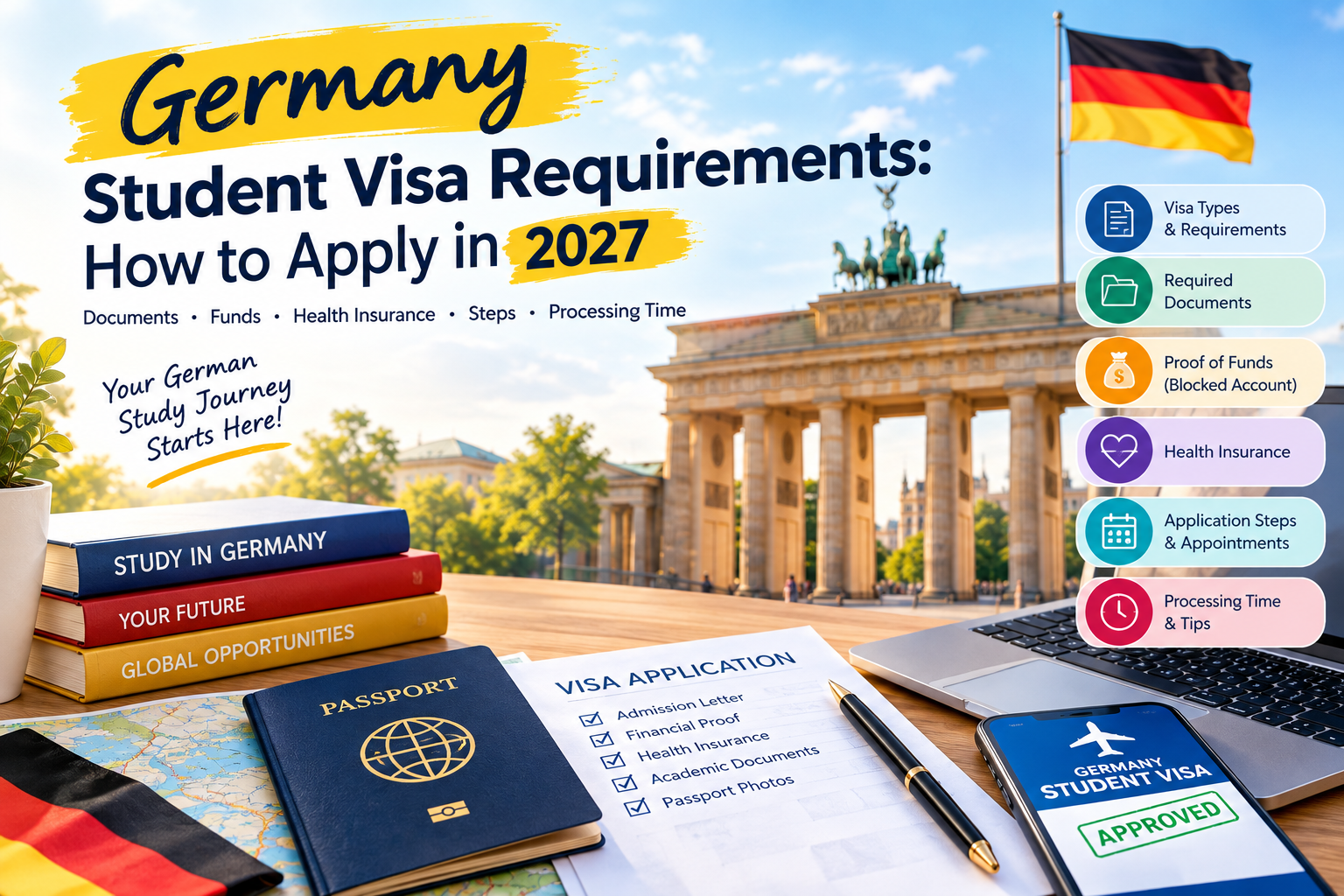
Getting admission to study in a German university is an important milestone, but it is not the final step for many international students. If you are from a country whose citizens need a visa to study in Germany, you must also prepare a student visa application that meets the relevant German immigration requirements.
The process involves more than submitting your admission letter. You may need to demonstrate that you can finance your studies, provide academic and language documents, arrange health insurance, and attend an appointment with the responsible German mission.
In this article we’ll explain the Germany student visa requirements for 2027, the documents to prepare, how a blocked account works, how to apply, and what to do after your visa is approved.
Visa procedures, financial thresholds and document checklists can change. Use this article as a planning guide and confirm the latest requirements with the German mission responsible for your application before submitting your documents.
Who Needs a Student Visa for Germany?
Whether you need a visa depends on your citizenship and the rules applicable to your planned stay.
Students from EU countries, Iceland, Liechtenstein, Norway and Switzerland generally do not need an entry visa to study in Germany. Citizens of certain other countries may also be able to enter without a prior student visa and complete the required residence formalities after arrival.
Many other international students must obtain the appropriate visa before travelling to Germany for their studies.
If you are applying from Nigeria, for example, you should follow the current student visa instructions issued by the German mission responsible for your application.
Avoid the mistake of assuming that another student’s procedure applies to you. Always check the official German student visa information and the instructions of the responsible German embassy or consulate.
Which Type of German Student Visa Should You Apply For?
Before preparing your documents, identify the visa category that matches your current situation.
1. Visa for University Studies
This is the usual route for applicants who have secured admission to a recognised German higher education institution and intend to study there.
Depending on your programme, you may need to provide an admission letter, academic records, proof of language proficiency and evidence that you can support yourself financially.
2. Visa for Seeking a Place in Higher Education
Some applicants have not yet secured a university place but want to travel to Germany to seek admission or complete an eligible preparatory step.
Germany provides a separate visa route for seeking a place in higher education, subject to specific requirements. Applicants may need to demonstrate an appropriate school-leaving qualification, relevant language proficiency and sufficient financial resources.
This route is not identical to a standard student visa. Check the current conditions carefully before applying.
3. Visa for Preparatory Studies
If your academic qualifications require you to complete a preparatory course, such as a Studienkolleg programme, you may need a visa category appropriate to your preparatory studies.
The documents you need will depend on the course, your admission status and the applicable rules.
If you are still determining whether your qualifications meet German university entry standards, read our guide to German university admission requirements for international students.
Documents for Germany Student Visa Requirements in 2027
The exact document checklist is determined by the responsible German mission. The following list is a preparation guide, not a replacement for the official checklist.
1. Valid Passport
Prepare a valid passport that meets the applicable requirements. You may also need copies of the passport’s identification page and previous visas, depending on the checklist.
Check your passport’s validity early. Replacing an expired or nearly expired passport close to your appointment can disrupt your plans.
2. Completed Visa Application Form
Complete the application using the procedure specified by the responsible German mission.
Germany is expanding the use of its Consular Services Portal for online visa applications, but the available process can depend on the country and application category. Follow the instructions for your location rather than assuming that every applicant uses the same portal.
Review your information carefully before submitting it.
3. University Admission Letter
For a standard study visa, you will generally need evidence that you have been admitted to a recognised German higher education institution.
Your admission letter should identify the programme and provide the information requested by the mission. If your admission is conditional, check whether the letter and any additional documents satisfy the visa checklist.
If you have not received an admission letter, know whether you qualify for a different visa category rather than applying under the wrong route.
4. Academic Certificates and Transcripts
Prepare the academic documents required for your application. These may include:
- Secondary school certificates and examination results.
- University transcripts.
- Bachelor’s degree certificate for postgraduate applicants.
- Evidence of completed preparatory studies, where relevant.
- Other records specified by the university or visa authority.
You should also confirm whether an APS certificate is required in your circumstances. APS verification applies to certain applicants based on their academic background and the relevant procedure; it is not a universal requirement for every student worldwide.
Our guide to the APS certificate for Germany explains how to check whether this verification process applies to you.
5. Proof of Language Proficiency
You may need to demonstrate proficiency in the language of instruction for your chosen programme.
For an English-taught course, the university may require an accepted English-language test or other approved evidence. For a German-taught programme, you may need a recognised German-language qualification.
Sometimes, the university’s admission letter confirms that you have met the language requirement. In other cases, the mission may request separate evidence.
Do not assume that a particular language certificate is accepted for every university or visa application. Check both the programme’s admission rules and the visa checklist.
If you are considering English-taught degrees, explore our guide to English-taught universities in Germany.
6. Proof of Financial Resources
You must generally show that you can cover your living expenses in Germany.
Accepted forms of evidence may include:
- A blocked account with the required amount.
- An eligible scholarship covering the relevant expenses.
- A formal declaration of commitment from a qualified sponsor in Germany.
- Another form of financial evidence accepted under the applicable rules.
The mission determines which evidence is acceptable for your case. A simple bank transfer receipt may not be sufficient when the checklist requires an official blocked-account confirmation.
7. Curriculum Vitae and Motivation Letter
Most German missions require a CV and a signed letter of motivation explaining your planned studies, reasons for choosing the programme and future plans.
Prepare these documents carefully if they appear on your checklist. Your statements should be accurate and consistent with your academic history, admission documents and intended course.
8. Health Insurance Evidence
Check what insurance evidence is required at the visa stage and what coverage you must arrange before travelling or enrolling.
Requirements may differ according to your age, programme, insurance status and intended arrival date. Do not assume that a travel insurance policy automatically meets every requirement for student residence in Germany.
9. Photographs, Copies and Additional Documents
Depending on the mission’s instructions, you may also need biometric photographs, copies of documents, proof of payment, a courier envelope or other supporting records.
Applicants who are minors may face additional requirements involving parental consent and identity documents.
Before your appointment, download the latest checklist from the German mission responsible for your application. Submit documents in the specified order and format, and do not leave out items simply because another applicant was not asked to provide them.
How Much Money Do I Need for a German Student Visa?
One of the most important parts of a student visa application is proving that you can finance your stay.
Germany updates the financial threshold used for student visa applications. According to the official Make it in Germany guidance, the amount for a full year of student living costs is €11,904 in 2026, equivalent to €992 per month.
Because this article is intended for the 2027 application cycle, applicants should confirm the amount applicable when they apply. Do not rely on the 2026 figure as a guaranteed 2027 requirement.
The amount required for your visa is also not necessarily the full cost of studying in Germany. You may need to budget separately for tuition fees, semester contributions, travel, accommodation deposits, visa expenses and other initial costs.
Can I Use a Scholarship Instead of a Blocked Account?
Yes, an eligible scholarship can serve as proof of financial resources, subject to the applicable rules and the amount and duration of funding it provides.
Your scholarship documentation should clearly establish the funding awarded and the period it covers. If it does not cover the full amount required, you may need additional financial evidence.
A scholarship is particularly useful because it may reduce the amount of personal savings you need to demonstrate. However, you should not assume that every scholarship letter automatically satisfies the visa requirement.
Can My Sponsor in Germany Support My Application?
In some circumstances, a person living in Germany can provide a formal declaration of commitment, known as a Verpflichtungserklärung.
This is not simply an informal letter from a relative or friend. It must meet the applicable legal and financial requirements.
Check whether this option is accepted for your application and what documents your sponsor must obtain from the competent German authority.
For more information on accepted ways to prove financing, consult the official Federal Foreign Office guidance.
What Is a Blocked Account for Germany?
A blocked account, known in German as a Sperrkonto, is a financial arrangement used by many international students to demonstrate that they have sufficient funds for living expenses.
You deposit the required amount with a provider offering an eligible blocked-account service. The account restricts how much you can withdraw, typically releasing a specified amount each month.
The purpose is to demonstrate that money will remain available to support you during your stay.
How to Open a Blocked Account
The general process is as follows:
- Confirm the required amount. Check the current threshold and the rules for your visa category.
- Compare eligible providers. Review service fees, transfer costs, refund conditions and customer support.
- Open the account. Follow the provider’s identity-verification and application procedures.
- Transfer the funds. Allow time for international transfers and account processing.
- Obtain official confirmation. Make sure the document satisfies the visa authority’s requirements, including the required amount and monthly withdrawal details where applicable.
- Submit the evidence. Include the confirmation in your visa application as instructed.
Do not open an account solely because an online advertisement promises fast approval. Confirm that the provider’s documentation meets the requirements of the responsible German mission.
You can read the Federal Foreign Office’s blocked-account guidance before selecting a provider.
How to Apply for a Germany Student Visa in 2027
Once you have identified the correct visa category, follow these steps to organise your application.
Step 1: Secure Admission to a German University
For a standard student visa, begin by obtaining admission to a recognised institution.
If you have not yet applied to a university, start with our step-by-step guide to applying to German universities.
Check your programme’s start date, enrolment conditions and any outstanding requirements before planning your visa timeline.
Step 2: Check the Requirements for Your Country
Visit the official website of the German embassy or consulate responsible for your place of residence.
Read the student visa checklist, application procedure, payment instructions and appointment rules. Requirements can differ between missions, so use the instructions that apply to your application rather than a checklist published for another country.
Step 3: Prepare Your Academic and Supporting Documents
Collect your passport, admission letter, academic records, language evidence and other required documents.
Arrange any translations, certifications or additional verification requested by the relevant authorities. If you need an APS certificate, plan for that process early enough to avoid delaying your visa application.
Step 4: Arrange Proof of Financial Resources
Decide which accepted funding method applies to you. This might be a blocked account, an eligible scholarship or a formal declaration of commitment.
Check the required amount and the exact type of confirmation that must be submitted. If you are using a scholarship, make sure its coverage and duration are documented clearly.
Step 5: Complete the Visa Application
Follow the mission’s current procedure, which may involve the Consular Services Portal or another specified application route.
Enter accurate information and check that the details match your passport, academic documents and admission letter.
Step 6: Book and Attend Your Appointment
Where an appointment is required, follow the official booking procedure and allow enough time to obtain a suitable date.
Bring all required documents in the specified format, including originals and copies where requested. Be prepared to provide biometrics, answer questions or submit additional information according to the procedure.
Step 7: Pay the Visa Fee
Check the current fee and payment method on the responsible mission’s official website.
The standard national visa fee is generally €75, but the amount you pay in local currency, applicable exemptions and payment arrangements should be confirmed with the mission before your appointment.
Keep your payment receipt if one is issued or required.
Step 8: Wait for the Decision
After submitting your application, monitor your email and any official application-tracking channel provided.
The authority may request additional documents or further verification. Respond promptly and follow only official instructions.
Avoid making non-refundable travel arrangements before you have the necessary visa approval.
Step 9: Prepare for Travel and Enrolment
Once your visa is approved, review its validity dates, entry conditions and any instructions supplied with the decision.
Arrange your travel, accommodation and health insurance, and prepare for enrolment at your university. After arrival, you may need to complete local registration formalities and apply for the appropriate residence permit before your visa or authorised stay expires.
How Long Does a German Student Visa Take?
There is no single processing time that applies to every German student visa application.
The Federal Foreign Office explains that student visa processing can take several weeks and, in individual cases, even months. The timeline may depend on the application, document checks, the responsible authorities and the workload at the relevant mission.
To avoid unnecessary delays:
- Start preparing your application as soon as your study plans become clear.
- Check appointment availability early.
- Submit a complete and consistent set of documents.
- Respond quickly to requests for additional evidence.
- Leave enough time between your visa application and the programme’s start date.
Do not assume that paying an agent or contacting a general help desk will speed up a decision. Follow the official process and use the published contact channels for legitimate enquiries.
Why Might a German Student Visa Application Be Delayed or Refused?
A delay does not necessarily mean that your application will be refused. However, incomplete documentation or unresolved questions can complicate the process.
Potential problems include:
Insufficient proof of funds: The submitted evidence may not demonstrate the required amount or may not meet the mission’s rules.
Missing documents: An incomplete checklist can lead to requests for additional information or other delays.
Inconsistent academic information: Differences between your application, CV, transcripts and admission letter may require clarification.
Unclear study plans: Your documents should accurately explain your intended programme and why you plan to pursue it.
Unverified qualifications: Some applicants may need additional academic-document verification under the applicable procedure.
Language evidence that does not meet the requirements: A certificate may not be accepted for the programme or application in question.
Late application planning: Appointment availability and processing times may leave too little time before the programme begins.
The responsible authority makes the final decision. If your application is refused, read the written decision carefully and follow the current instructions for any available review or further application process.
Germany Student Visa Application Checklist for 2027
Use this checklist as a starting point, then compare it with the official checklist for your country and visa category.
- I have confirmed whether I need an entry visa.
- I have identified the correct visa category.
- I have checked the current requirements of the responsible German mission.
- I have secured university admission, where required.
- My passport is valid and meets the applicable conditions.
- My academic certificates and transcripts are ready.
- I have confirmed whether APS verification applies to me.
- I have prepared the required language evidence.
- I have arranged acceptable proof of financial resources.
- I have checked health insurance requirements.
- I have completed the required application form or online procedure.
- I have checked appointment availability and the visa fee.
- I have prepared the requested originals, copies and photographs.
- I have left sufficient time for processing.
- I know what to do after arrival in Germany.
Frequently Asked Questions
1. Can I apply for a German student visa without an admission letter?
A standard study visa generally requires admission to a recognised higher education institution. However, Germany has a separate visa route for eligible applicants who are seeking a place in higher education. Check the conditions for that route before applying.
2. Is a blocked account compulsory for every student?
No. A blocked account is one accepted way to demonstrate financial resources, but eligible scholarships and formal declarations of commitment may also be accepted. The appropriate option depends on your circumstances and the current visa rules.
3. How much money should I put in my blocked account for 2027?
Confirm the required amount with the responsible German mission when you apply. The official general guidance lists €11,904 for a full year in 2026, but applicants should not assume this will be the 2027 threshold.
4. Can I work in Germany while studying?
International students with the relevant residence status may work subject to the applicable legal limits and conditions. Check the current rules before relying on employment income to finance your studies. You should also meet the visa’s financial requirements without assuming that you will immediately find a job after arrival.
5. Do I need IELTS for a German student visa?
Not every student needs IELTS specifically. Your university may accept other forms of language evidence, depending on the programme. However, you must meet the applicable language requirements and provide the evidence requested by the university and visa authority.
6. Can I travel to Germany on a tourist visa and change it to a student visa?
Do not rely on this strategy. Germany’s official guidance warns that a tourist visa generally cannot be converted into a student visa later. If your purpose is to study, check the correct visa route before travelling.
7. Can I apply for a German student visa from Nigeria?
Nigerian applicants should follow the current instructions issued by the German mission responsible for their application. Check the official German missions in Nigeria website for student visa requirements, application procedures and updates.
8. Does a student visa guarantee my residence permit?
No. A visa allows you to enter Germany under its stated conditions, but you may need to complete further formalities after arrival, including obtaining a residence permit where required. Follow the instructions supplied by the visa authority and the local foreigners authority.
Plan Your German Student Visa Early
Applying for a German student visa involves several connected steps: securing admission, checking your academic documents, proving your financial resources, preparing the required evidence and following the responsible mission’s application procedure.
Start early, keep your documents consistent and confirm the current rules for your country. Most importantly, do not rely on outdated financial thresholds or a document checklist intended for another applicant category.
With careful planning, you can reduce avoidable delays and prepare more confidently for the next stage of your studies in Germany.