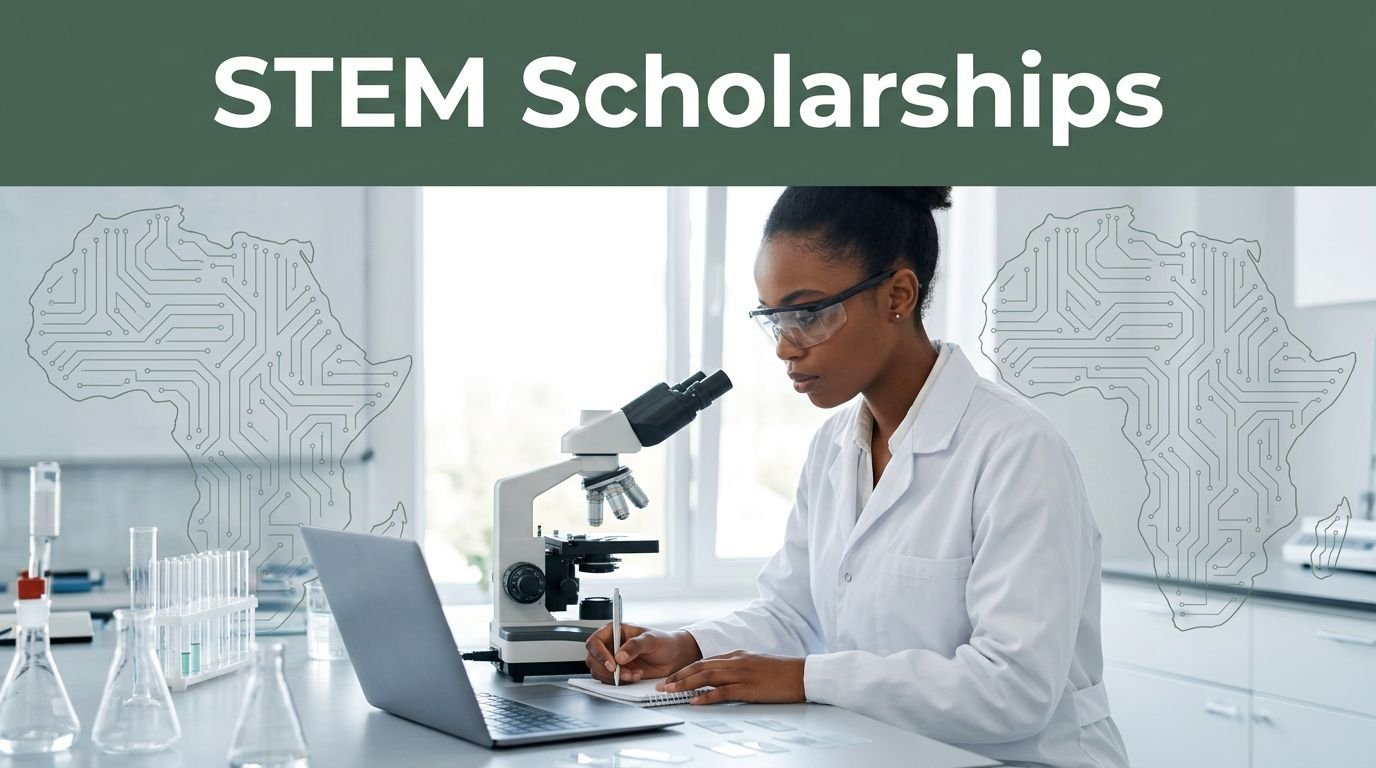
For many African students, STEM scholarships are the difference between a promising academic path and a degree left unfinished. These awards cover study in science, technology, engineering, and math, and they range from local university support to international programs in the UK, US, Canada, Europe, and across Africa.
The competition is strong, and many programs ask for high grades, clear financial need, and polished application materials. Still, the path is reachable, especially for students who match the right criteria and apply early.
We can sort through the main scholarship types, where to find them, and what it takes to stand out when the funding is tight.
What makes STEM scholarships different from other aid programs?
STEM scholarships are built around a specific need: they support study in science, technology, engineering, and mathematics because those fields feed research, industry, and public services. That focus changes how funding is designed, who qualifies, and what the money covers.
For African students, this often means the award is tied to a bigger goal than tuition alone. Funders want more engineers, lab researchers, health specialists, software talent, and energy experts. In practice, that makes STEM aid more targeted, more competitive, and often more generous than general scholarships.
Why STEM fields attract more targeted funding
Donors, universities, companies, and foundations put money into STEM because the results are easy to measure and hard to ignore. A trained engineer can help build roads, water systems, and clean-energy projects. A biology student can move into public health or agriculture. A computer science graduate can fill urgent skills gaps in tech and data work.
That is why STEM support often comes with a clear purpose. A funder may want to back innovation, improve healthcare, strengthen food systems, or grow digital skills. The U.S. National Science Foundation, for example, frames its S-STEM program around helping talented, low-income students enter promising STEM careers, which shows how closely these awards are linked to workforce needs and academic success (NSF S-STEM program).
For African applicants, this focus creates both pressure and opportunity. The pressure comes from stronger competition and stricter eligibility rules. The opportunity comes from the fact that many funders see African STEM talent as high-value, especially in areas such as energy access, agriculture, medicine, and software development. Programs often look for students who can return home and apply their skills where shortages are real.
The main types of STEM scholarships we can apply for
STEM scholarships do not all work the same way. Some pay for an entire degree, while others cover one cost only. Some are open to any strong applicant, while others target a narrow group, such as women in engineering or students from a specific country.
A simple comparison helps show the difference:
Scholarship type |
Typical coverage |
Common focus |
|---|---|---|
Undergraduate STEM awards |
Tuition, sometimes books or housing |
First degree study in science or engineering |
Master’s STEM awards |
Tuition, living costs, travel, research fees |
Advanced study and job-ready skills |
PhD STEM awards |
Tuition, stipends, research funding |
Research, lab work, and teaching support |
Women-only STEM awards |
Varies by program |
Increasing female access in male-dominated fields |
Country-specific awards |
Full or partial support |
Students from selected nations or regions |
Partial awards |
One or two study costs |
Tuition help, travel, or equipment costs |
Full awards |
Broad coverage |
Tuition, living costs, and more |
Undergraduate scholarships often help with the largest barrier first, which is tuition. Master’s and PhD awards are more likely to include living costs, research grants, travel, and equipment support, because advanced study usually depends on lab access, data collection, and time away from full-time work.
Women-only awards matter too, especially in engineering, computing, and physics. These programs try to close a gap that has lasted for years. Country-specific awards are also common, because funders may want to support talent in a defined region or strengthen ties with a particular African country.
A STEM scholarship may look generous on paper, but the real value depends on what it covers, tuition only, or the full cost of study and research.
Full funding is the most complete option. It usually covers tuition and fees, and it may also include housing, a monthly stipend, travel, visa costs, health insurance, and research expenses. Partial funding can still help a great deal, but it often leaves a student with a balance to cover through family support, work, or another award.
Many of the best STEM scholarships for African students are built this way because the expense profile is different from other aid programs. A chemistry student needs lab access. An engineering student may need software, tools, or field travel. A PhD student may need conference funds or data collection support. Those extra costs explain why STEM aid is often more detailed than general academic funding.
In short, STEM scholarships are not just school grants with a science label. They are usually tied to skills shortages, research needs, and national development goals, which makes them one of the most structured forms of scholarship support available.
How we can find trustworthy STEM scholarships without wasting time
The fastest scholarship search is usually the most disciplined one. We start with sources that have something to lose if they publish bad information, then we ignore the rest until they prove useful.
That means looking at places where scholarship rules are published clearly, updated often, and tied to a real institution. It also means reading each opportunity like a contract, not a headline. A scholarship that sounds generous but hides the basics is rarely worth the effort.
The best places to search first
We save the most time by beginning with the sources that are least likely to mislead us. University scholarship pages are often the best first stop, because they usually list exact eligibility rules, funding details, and contact information in one place. If a university has a strong STEM department, its financial aid or graduate study page often reveals awards before they appear on broad search sites.
Official government and embassy pages come next, especially for students applying across borders. These pages tend to explain nationality limits, visa-linked funding, and country-specific awards with less confusion than general scholarship directories. Professional bodies, foundations, and discipline groups are also useful, since they often support narrow fields like engineering, data science, medicine, or environmental science.
We also use trusted scholarship databases, but with a clear filter. A database is only useful when it names the sponsor, links to the original listing, and avoids vague claims. For example, broad scholarship platforms can help with discovery, but the final check should always happen on the sponsor’s own page.
A few sources are worth treating as anchors rather than noise. The UNCF scholarship listings are useful for structured STEM awards, while WAAW Foundation’s scholarship information is especially relevant for African women in STEM. For broader scanning, Scholarships360 STEM listings can help us spot patterns, then verify them elsewhere.
How to judge whether a scholarship is worth applying for
A good scholarship should answer basic questions without making us dig. If the eligibility rules are clear, the deadline is fixed, and the sponsor is named, the opportunity deserves a closer look. If any of those details are missing, we usually spend more time chasing the listing than applying to it.
The first check is fit. We read the nationality limits, degree level, STEM subject list, and academic requirements before we touch the form. A scholarship for “science students” may sound broad, but it may exclude our field, our country, or our level of study.
Then we check coverage. Some awards pay tuition only, while others include living costs, travel, lab fees, or research support. That difference matters because a partial award can still leave a student short on rent, books, or visa costs.
It also helps to review the documents early. Most genuine awards ask for a transcript, references, a personal statement, proof of identity, and sometimes proof of financial need. If the required materials are unclear, the scholarship may be poorly managed or copied from somewhere else.
Any scholarship that asks for a fee to apply, or promises guaranteed funding, deserves immediate caution.
The red flags are usually plain once we slow down. Vague sponsor names, weak contact details, copied text, requests for bank details, and pressure to act “today” all point to poor quality or fraud. A real funder does not need panic to attract applicants.
Smart search habits that save time and improve results
Good search habits matter as much as good sources. We can cut hours from the process by using exact terms instead of broad ones. Searches like “engineering scholarship”, “women in STEM”, “graduate science funding”, or “biology scholarship for African students” are far more useful than generic searches for “student aid”.
We also search by country and discipline together. That gives us sharper results, such as “UK engineering scholarship for African students” or “Canada master’s chemistry scholarship”. The more specific the search, the fewer false leads we need to sort through.
A simple tracking system helps too. We keep one spreadsheet with the scholarship name, sponsor, deadline, country, field, funding level, and status. That way, we can compare options at a glance and avoid re-checking the same listing again and again.
A small table keeps the process tidy:
What to track |
Why it matters |
|---|---|
Deadline |
Stops us from wasting time on expired awards |
Country eligibility |
Filters out ineligible programs fast |
STEM field |
Confirms the scholarship fits our subject |
Funding coverage |
Shows whether it pays tuition, living costs, or both |
Required documents |
Helps us prepare before we apply |
Alerts help too. We set email alerts on scholarship pages, university sites, and search engines, then review them once or twice a week. That keeps us ahead of deadlines without turning the search into a full-time job.
The final habit is simple, but powerful. We save the best opportunities, verify them on the official page, and move on quickly when something does not fit. That keeps the search focused, and in scholarship hunting, focus is often the difference between progress and noise.
Which scholarships fit different African students best?
The best STEM scholarships for African students depend on the level of study, the country of origin, and the destination. A strong undergraduate applicant with limited funds needs a very different award from a PhD candidate with research plans and leadership experience.
That is why the smartest search starts with fit. Some scholarships pay for first degrees, some are built for master’s and doctoral study, and some are tied to specific countries or regions. The right match can save time and raise the odds of success.
Undergraduate options for students starting in STEM
Undergraduate awards are usually the best fit for students who have strong grades but little money for tuition, books, or lab costs. These scholarships often look for academic promise, clear financial need, and a real interest in science, technology, engineering, or math.
One of the clearest examples is the WAAW Foundation Scholarship, which supports African women pursuing STEM degrees at undergraduate level. It fits students who are early in their studies and need targeted help to stay enrolled, especially in fields where women are still underrepresented. The scholarship page on WAAW Foundation’s scholarship information gives a good sense of the kind of support these awards provide.
Local and university-based awards matter just as much. Many universities in Africa publish merit awards for engineering, computer science, medicine, and natural science students. Private foundations and companies also fund first-degree students, usually because they want to back future talent before costs become too high.
We also see a clear pattern in these awards:
- Best for high achievers with low income: merit-plus-need scholarships
- Best for women in STEM: gender-focused awards such as WAAW
- Best for students staying close to home: local university and foundation grants
- Best for early planning: awards that begin before admission is fully confirmed
A simple rule helps here. If the student is just starting a STEM degree, then the strongest scholarships are often the ones that pay tuition first and ask for solid grades, not research experience.
Graduate scholarships for master’s and PhD study
Graduate funding is a different field altogether. At this level, scholarship committees usually care less about school clubs and more about leadership, research potential, and academic record. They want to see a clear study plan and a reason the degree matters.
The Commonwealth Scholarships are a major option for students from Commonwealth countries, and many routes support study in the UK. Some schemes also include distance learning, which can help students who need to remain at home while studying. The official Commonwealth Scholarship guidance lists several award types and shows how widely these programs reach.
The Beit Trust Scholarships fit students from Malawi, Zambia, and Zimbabwe. They support master’s and PhD study in the UK, Ireland, and South Africa, which makes them especially useful for students who want a strong international degree but still need a scholarship tied to a defined route.
The Mandela Rhodes Scholarships are different again. They are tied to South Africa and support honours or master’s study. They also place heavy weight on leadership and character, not only grades. That makes them a strong fit for students whose academic record is matched by community work or campus leadership.
A quick comparison shows the differences more clearly:
Scholarship |
Best fit |
Study destination |
Level |
|---|---|---|---|
Commonwealth Scholarships |
Commonwealth applicants with strong academic plans |
UK and selected partners |
Master’s, some distance learning routes |
Beit Trust Scholarships |
Students from Malawi, Zambia, Zimbabwe |
UK, Ireland, South Africa |
Master’s and PhD |
Mandela Rhodes Scholarships |
High-potential African leaders |
South Africa |
Honours and master’s |
These awards are competitive, but they reward different strengths. A student with a powerful research proposal may fit one scholarship better, while a student with proven leadership may fit another. That is why we match the profile before we match the form.
Graduate scholarships often look for more than grades. They want evidence that the applicant can lead, research, and finish well.
Country-based and region-based awards we should not overlook
National and regional awards are often the easiest to miss, yet they can be some of the best fits. They usually come with tighter eligibility rules, but that same narrow focus can improve the odds for local applicants.
For Nigerian students, the Jim Ovia Scholarship is a well-known undergraduate option. It supports students studying in Nigeria, which makes it useful for those who want local funding without leaving home. For Kenyan students, ACCESS Kenya offers partial scholarships for undergraduate study at accredited universities in Kenya, which helps students who need tuition support but can cover part of the cost themselves.
Many other African countries also have funding through:
- Ministry programs, especially for priority fields like engineering, health, and ICT
- University scholarships, which may reward grades, entrance scores, or financial need
- Private-sector funding, often linked to banks, telecom companies, energy firms, or large foundations
A country-by-country comparison can help us sort the field faster:
Country or region |
Example award |
Typical level |
Common funding source |
|---|---|---|---|
Nigeria |
Jim Ovia Scholarship |
Undergraduate |
Private foundation |
Kenya |
ACCESS Kenya |
Undergraduate |
Education support program |
Malawi, Zambia, Zimbabwe |
Beit Trust Scholarships |
Master’s and PhD |
Trust-funded award |
South Africa |
Mandela Rhodes Scholarships |
Honours and master’s |
Regional leadership program |
Pan-African |
WAAW Foundation Scholarships |
Undergraduate |
Nonprofit foundation |
These country-based awards matter because they often align with local tuition levels, admission systems, and study needs. For many students, that makes them a more realistic path than highly global scholarships with broad applicant pools.
The strongest strategy is usually a mixed one. We look at international awards, then add country-specific and university-based options. That gives students a better chance of finding funding that fits both their background and their budget.
What most STEM scholarship applications ask for
Most STEM scholarship forms look different on the surface, but the core demands are usually the same. They want evidence of academic strength, a clear reason for choosing science or technology, and a credible case for funding support. For STEM scholarships for African students, that often means the committee is reading for both ability and purpose.
The strongest applications usually answer a simple set of questions fast: Can this student handle the work? Do they care about the field for a real reason? Will the award make a difference? Those answers matter as much as grades, because scholarship panels are funding future scientists, engineers, and researchers, not just students with neat paperwork.
Grades, course choices, and proof of STEM interest
Strong marks in math and science usually sit at the center of the application. Many scholarships also want a specific GPA or an equivalent academic standard, so the transcript is often the first filter. If the grade threshold is high, the rest of the file may never get a full reading.
Course choice matters too. A student who has taken physics, chemistry, biology, computer science, advanced mathematics, or technical subjects gives the committee a clearer picture of readiness. Lab work, coding projects, field research, science fairs, and club activity all help show that the interest is genuine, not just written in the essay.
That proof does not need to look dramatic. A school lab project, a coding portfolio, or a small research report can carry weight when it shows effort and focus. Scholarship officers often look for consistency over flash, because consistency is what predicts success in a demanding STEM program.
A few common signs of strong academic fit include:
- High marks in math and science subjects
- Relevant coursework linked to the chosen STEM field
- Lab or practical work that shows hands-on skill
- Coding, research, or project experience
- A transcript that meets the stated GPA or equivalent standard
A good STEM application does not hide the transcript. It uses it as proof of readiness.
Essays, references, and personal statements that stand out
Scholarship essays usually carry more weight than students expect. Committees want clear goals, discipline, service, and a realistic reason for choosing STEM. They also want to see whether the applicant understands the field well enough to stay with it when the work gets hard.
The best personal statements are specific. A weak one says, “I like science.” A stronger one explains what problem drew the applicant in, what subject they want to study, and how the degree connects to a future role. That link matters because scholarship panels often back students who can name a path, even if the path changes later.
Writing style matters too. Clear, honest language is stronger than big claims. A short story about a school project, a local problem, or a family experience can work well if it leads to a believable STEM goal.
Recommendation letters can tip the balance. Teachers, professors, mentors, and supervisors can confirm discipline, curiosity, and follow-through in ways the student cannot. A strong reference is more useful than a generic praise letter, because it gives the committee a second view of the applicant’s work habits and potential.
For a useful reference point on what sponsors often ask for, the MPOWER Financing STEM scholarship guidance shows how often academic records and application quality sit side by side. That pattern appears across many international awards.
Financial need, leadership, and community service
Grades matter, but many scholarships also weigh family income, service work, leadership, and employment history. For African applicants in particular, financial need often plays a major role. A committee may be trying to support students who have the ability to succeed but not the money to stay enrolled.
Leadership does not need to mean president of a large club. It can mean leading a study group, starting a small science project, helping younger students, or taking responsibility in a community setting. Work experience can help too, especially when it shows discipline, time management, or support for family expenses.
Community service is another common signal. Scholarship teams often want students who will return skills to their communities, whether through healthcare, teaching, engineering, agriculture, or software. That does not mean every applicant must be a public figure. It means the award is more likely to go to someone who shows a pattern of use, not just a record of grades.
A practical way to think about it is this: many programs look for well-rounded candidates, not perfect ones. A strong transcript, a solid essay, and a few real examples of service or leadership often beat a polished file with no depth.
Some award pages make this balance clear. The UNM STEM scholarship database shows how academic standards and supporting documents often sit alongside eligibility rules. The message across the sector is consistent, the best STEM scholarship applications read like evidence, not advertising.
How we can build a stronger application from the start
A strong scholarship file rarely appears at the last minute. It starts with fit, then grows through a clear story, clean records, and early preparation. For STEM scholarships for African students, that order matters because many applicants are screened out before an essay is even read.
We get better results when we treat the application as a package. Each part should support the next one. The scholarship choice should match the student. The story should match the record. The documents should match the deadline.
Choosing the right scholarship before writing anything
We save time by reading every rule before we write a single paragraph. Eligibility pages usually tell us whether a scholarship fits the student’s country, level of study, field, and financial profile. If those details do not line up, the application is already weak.
That is why we prioritize awards with the best chance of success first. A student with strong grades but limited research experience may fit an undergraduate or taught master’s award better than a research-heavy PhD scheme. A woman in engineering may be better matched to a targeted program than a broad general award. A local scholarship may also beat an international one if the funding rules are more realistic.
A simple order helps:
- Match the basic rules so there is no wasted effort.
- Check the funding level to see whether the award truly solves the financial gap.
- Review the competitiveness by looking at who the scholarship is built for.
- Prefer the clearest fit over the most famous name.
A scholarship with a tight match is usually worth more than a bigger award with poor odds.
This approach also reduces false starts. When the scholarship fits the profile, the essay, references, and documents have a stronger base. That is why the best applications begin with selection, not writing.
Writing a focused STEM story that feels authentic
The strongest scholarship essays usually follow a simple path: problem, motivation, action, and goal. That structure keeps the story clear and stops it from drifting into generic praise. It also helps the committee see how the student moved from interest to purpose.
Specific details matter more than broad claims. “I like biology” says very little. A short account of a school lab project, a coding task, a broken water system, or a family health challenge says much more. The essay should sound real because real experience is easier to trust.
We also connect the subject to future use. A student who wants to study engineering might link the degree to transport, housing, or clean energy in Africa. A computer science applicant might point to local data gaps, software access, or digital services. That kind of link gives the application shape.
A strong essay often answers four points clearly:
- What problem caught the student’s attention
- Why STEM is the right path
- What work has already been done
- How the scholarship will help long-term goals
The best writing stays simple. Short sentences work well here because they keep the story direct. A committee should be able to follow the journey without re-reading each line.
Organizing documents early so deadlines do not become a problem
Paperwork often decides whether an application gets seen at all. Transcripts, ID or passport copies, proof of citizenship, test scores if needed, financial records, CVs, and certificates should all be gathered early. If a scholarship asks for recommendation letters or admission proof, those should sit in the same folder too.
Incomplete files are one of the easiest reasons applications get rejected. Missing one document can cancel weeks of work. Even when a scholarship allows late uploads, a weak file creates doubt about how carefully the rest was prepared.
A practical system keeps this under control:
- Transcripts and certificates in one folder
- Identity documents in another
- Test scores and financial records in a third
- Essay drafts and final copies saved separately
- Reference contacts listed with deadlines and reminders
We also check file names, scan quality, and document dates before submission. A blurred transcript or expired passport copy can cause avoidable delays. For international awards, that small mistake can be enough to lose the chance entirely.
Trusted scholarship databases can help with early planning, but the sponsor’s own page should always confirm the final requirements. A clear example is the NSF S-STEM program page, which shows how detailed some STEM awards can be about eligibility and application rules. The lesson is simple, strong applications are built on accuracy long before the deadline arrives.
A neat file is not cosmetic. It is proof that the applicant can follow instructions and finish the job.
When we start early, choose carefully, write with purpose, and keep every record in order, the application feels coherent. That coherence matters because scholarship panels often read for signs of discipline as much as signs of talent.
Common mistakes that quietly ruin strong applications
Strong grades and a solid field choice can still fall apart at the last step. In scholarship work, small errors often do more damage than weak academics, because they make a good profile look careless, rushed, or irrelevant.
We see the same pattern again and again with STEM scholarships for African students. The applicant has real promise, but the file misses a deadline, ignores a rule, or reads like it came from a template. Those mistakes do not always look dramatic, yet they can end the review before it starts.
Missing deadlines or submitting weak files
Deadlines are unforgiving, and international ones create extra risk because time zones do not match. A form due at midnight in London may close hours earlier than expected in Lagos, Nairobi, Accra, or Johannesburg. We always check the sponsor’s local time, not our own.
A late file is usually treated as a lost file. Missing signatures, blank sections, poor scans, or the wrong format can have the same effect, even when the student is otherwise qualified. Many committees reject incomplete files without a second look, because they have no time to chase missing documents.
Sloppy formatting also hurts more than people think. A transcript that is hard to read, a statement with broken spacing, or a filename that says “final_final2” does not inspire confidence. If the application looks disordered, the reviewer may assume the work behind it is disordered too.
A strong profile can still fail when the file looks unfinished.
We keep the submission simple and clean:
- upload the right version of every document
- sign every form that asks for a signature
- check scan quality before sending
- submit early enough to absorb technical problems
- confirm the deadline in the sponsor’s time zone
Applying for awards that do not match the applicant profile
Many students lose time by applying everywhere instead of applying well. A scholarship with a country restriction, gender rule, degree-level limit, or field requirement is not a near miss, it is a mismatch.
A student from Ghana should not spend hours on a program open only to Kenyan nationals. A first-year undergraduate should not chase a master’s award. A computer science applicant should not ignore a scholarship reserved for chemistry or engineering. These details are usually plain on the official page, yet they get skipped in the rush to apply.
We also see applicants overlook basic filters like age limits, residency rules, or whether the award covers full-time study only. That kind of mistake wastes energy and can crowd out better-fit opportunities. The Prodigy Finance guide on scholarship mistakes is a useful reminder that fit comes before effort, and that the fastest way to improve odds is to stop applying where the rules do not match.
A quick check keeps the search focused:
- Country rules: open to the applicant’s nationality or study location
- Gender rules: open to all applicants or a defined group
- Academic level: undergraduate, master’s, or PhD
- Field restrictions: STEM subject matches the scholarship list
Writing essays that sound copied or too generic
Generic essays drain trust fast. When every sentence sounds broad, repeated, or lifted from a template, the application stops feeling personal. Phrases like “I have always loved science” or “I want to make a difference” say very little unless they are tied to a real story.
The same problem appears when students copy structure without substance. A committee can spot vague goals, recycled lines, and empty praise. It wants evidence, not slogans. A short account of a school project, a lab result, a coding task, or a local problem gives the essay weight because it shows lived experience.
We also need a clear future plan. The best essays connect past work to the next step, whether that means public health, renewable energy, software, agriculture, or research. That link tells the reviewer the applicant knows why the scholarship matters and how the degree fits into a larger path.
An effective essay usually sounds specific in three places:
- the problem that shaped the interest
- the achievement that proves effort
- the study plan that follows the award
One final comparison helps. A weak essay says, “I am passionate about STEM and want to succeed.” A stronger one says, “Our school science club built a low-cost water filter, and I want to study chemical engineering so I can improve water treatment in my region.” The second version feels real because it is rooted in action, not polish.
Where success usually comes from in competitive scholarship pools
In crowded scholarship pools, success rarely comes from one dramatic detail. It usually comes from a file that feels steady, credible, and well matched to the award. Committees read for signs that the student will handle the course load, finish the degree, and use the support well.
That is why the strongest applicants often look familiar on paper, even when their stories are different. They show consistent grades, real activity outside class, and a clear reason for studying STEM. They also apply with care, which matters more than many students realize.
Showing academic strength and consistency
Scholarship panels notice patterns before they notice polish. A transcript with steady performance in math, science, and technical subjects tells them the student can cope with demanding work. Improvement matters too, because an upward grade trend often shows discipline and maturity.
Excellence still matters, of course. Yet a student who started modestly and kept improving can still be a strong contender, especially when the record shows serious engagement with STEM subjects. That might mean advanced coursework, lab work, coding projects, or strong results in practical assessments.
For many awards, committees are looking for evidence that the applicant has already entered the habit of academic work. The NSF S-STEM program is a clear example of how funders connect academic talent with future success in STEM fields. The logic is simple, strong grades are easier to trust when they are backed by consistent effort.
A few signals usually carry weight:
- Steady marks in core STEM subjects
- Visible improvement over time
- Strong performance in advanced or relevant courses
- Serious participation in labs, projects, or competitions
A perfect transcript helps, but a record of upward growth can still separate an applicant from the crowd.
Proving leadership, service, and initiative
Academic results open the door, but leadership and service often decide who moves forward. Clubs, tutoring, volunteer work, science fairs, and community projects show that the student does more than collect grades. They show initiative, and initiative is hard to fake.
Internships and research exposure matter for the same reason. They tell reviewers that the applicant has tested their interest in a real setting and stayed engaged when the work became practical. Even a short placement can help if it shows discipline, teamwork, or curiosity.
Scholarship committees also pay attention to how students use their skills around other people. Tutoring younger students, helping at a science event, or joining a local outreach project can all signal maturity. These are small experiences on paper, but they often carry real weight in competitive pools.
A strong application usually gives reviewers something beyond the transcript to hold onto. It shows that the student is already building habits that fit a STEM career, not waiting for the scholarship to start behaving like one.
Applying widely but staying selective
Volume matters, but only up to a point. A student who applies to too few scholarships limits the chances of success. A student who applies to everything wastes time on bad fits and weakens every file.
The better approach is to apply broadly within a clear lane. That means choosing several solid matches, then giving each one real attention. A manageable target, often around 10 to 15 strong applications, usually works better than a pile of random submissions.
A simple filter keeps the search disciplined:
- We keep only scholarships that match the degree level, field, and eligibility rules.
- We give priority to awards with a strong fit, good coverage, or an approaching deadline.
- We reuse core materials where possible, then adapt them to each sponsor.
- We skip awards that miss hard requirements, no matter how attractive they look.
This balance matters because scholarship committees can tell when an application was sent out in bulk. A tailored file reads like a serious case for support. A rushed one reads like a gamble.
In competitive pools, the winning edge usually comes from fit, timing, and preparation, not noise. That is why the most successful applications tend to look calm, specific, and complete, while the weakest ones look like they were assembled in a hurry.
A short FAQ on STEM scholarships for African students
We often see the same questions come up when families and students start searching for funding. The answers are usually straightforward, but the details matter because scholarship rules vary by country, degree level, and subject. A careful read can save weeks of wasted effort.
Are there fully funded STEM scholarships for African students?
Yes, fully funded STEM scholarships do exist for African students. Some cover tuition, living costs, travel, insurance, and research support, while others pay only part of the bill.
The strongest full awards are usually found at the postgraduate level, especially for master’s and PhD study. Programs such as Australia Awards Scholarships and other major international schemes often include broad support, but eligibility is strict and competition is high. Many smaller awards are partial, so we always check whether the offer covers books, housing, lab fees, or just tuition.
Can African women find scholarships made just for STEM?
Yes. Many scholarships are designed for women in science, technology, engineering, and math, especially in engineering, computing, and the physical sciences. These awards matter because they help close access gaps that have kept too many women out of technical fields.
Some programs are broad, while others are tightly focused on women from Africa or women studying abroad. The MPOWER Women in STEM Scholarships are a clear example of a women-focused award that fits this pattern. We also see many university and foundation programs that back women in lab-based subjects, data science, and engineering because the need is still large.
Do STEM scholarships prefer certain countries or universities?
Some do, and some do not. A number of scholarships are open across Africa, the Commonwealth, or a wider international pool, while others are limited to specific countries, schools, or partner institutions.
That distinction matters because a scholarship can look generous but still be closed to most applicants. For example, some awards only accept students from selected African countries, while others require admission to a named university or a partner program. The safest approach is to check the sponsor’s page first, then confirm whether the scholarship is tied to a region, institution, or field. General directories can help with discovery, but the official source always has the final word, such as Top Universities’ African scholarship guidance.
What should we check before applying?
We usually check four things first: eligibility, coverage, deadline, and document list. If any one of those is unclear, the scholarship deserves a closer look before time is spent on the form.
A quick pre-check keeps the search clean:
- Eligibility: country, degree level, and STEM field
- Coverage: tuition only, or full support
- Deadline: exact date and time zone
- Documents: transcript, references, essay, and proof of identity
A scholarship that fits the profile is worth far more than one that only sounds impressive.
Are postgraduate STEM scholarships easier to find than undergraduate ones?
Postgraduate awards are often easier to find, but they are not easier to win. Many funders prefer master’s and PhD students because they can support research, teaching, and specialist training more directly.
Undergraduate funding is still available, especially through universities, nonprofits, and country-based schemes. The difference is that undergraduate awards tend to be smaller and more local, while postgraduate awards are more likely to include living costs and travel. For many African students, the best strategy is to search both, then match the scholarship to the level of study rather than chasing the biggest name.
Conclusion
The pattern across these STEM scholarships for African students is clear. The best awards go to applicants who match the rules, prepare early, and present a focused academic purpose.
That pattern holds at both undergraduate and graduate level. Strong opportunities exist in Africa and abroad, but the advantage usually comes from careful selection, clean documents, and a case for study that feels specific rather than vague.
We see the same lesson at every stage of the search. In a crowded field, disciplined applications and a clear fit with the scholarship criteria usually matter more than a famous name.
This post may contain affiliate links. If you make a purchase through these links, I may earn a small commission at no extra cost to you.