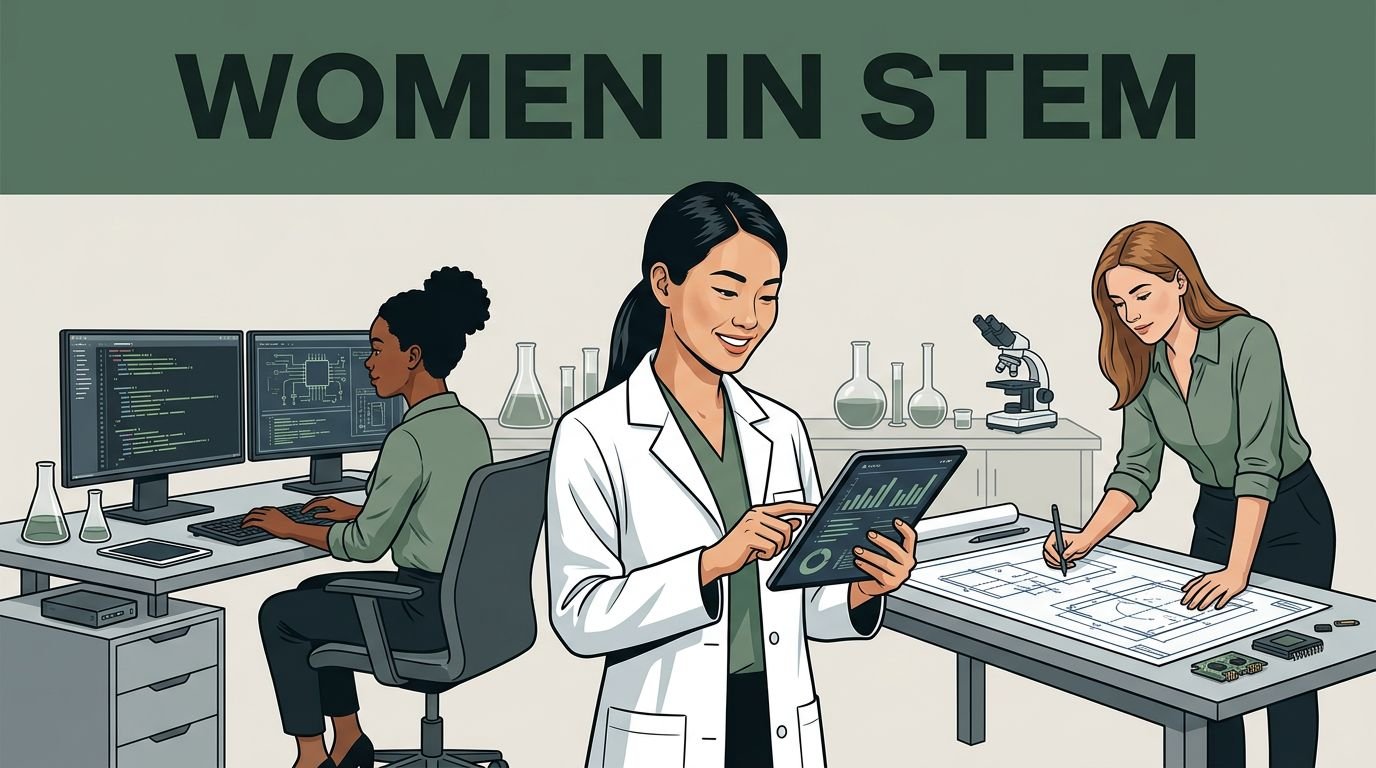
Women are still underrepresented across many STEM fields, and the gap is widest where the payoffs often run highest, in engineering, computer science, and research. Global data show that women earn about 35% of STEM degrees, a share that has barely moved in about a decade, while women in the U.S. earn only about 26% of engineering degrees and 23% of computer science degrees. That makes a STEM scholarship for females more than financial aid, it is one of the clearest ways we can widen access to study paths that still do not feel equally open to everyone.
We use the term to mean scholarships reserved for women, girls, and sometimes gender-diverse applicants who are pursuing science, technology, engineering, mathematics, or closely related subjects. Some awards cover full tuition, while others pay for books, lab costs, housing, travel, mentoring, or a mix of those expenses. Because the rules differ so much, we need to look past the headline award amount and read the eligibility details with care.
The search can feel messy at first, especially when opportunities come from universities, private foundations, tech firms, professional societies, and government programs in different countries. Some scholarships are merit-based, some focus on financial need, and others are tied to a field, a region, or a stage of study such as high school, undergraduate, graduate, or doctoral level. Application reviewers usually look for academic fit, clear goals, proof of need when required, strong references, and a record of interest in STEM through coursework, projects, clubs, internships, or community work.
The strongest applications usually show more than grades, they show direction, commitment, and a clear reason that the award matters.
In the sections that follow, we will sort the main scholarship types, show where to find real opportunities in the U.S., UK, Canada, Europe, Africa, Asia, and Latin America, and break down how selection committees judge applications. We will also cover common mistakes, practical ways to improve an application, and the questions readers ask most often before they apply.
What Makes a STEM Scholarship for Women Different?
A STEM scholarship for women is often built around access, not just achievement. The award may still reward strong grades, but it usually also looks at the barriers women face in science, technology, engineering, and math, along with the stage of study and the applicant’s background.
That wider lens changes how these scholarships are designed. Some are meant to widen the pipeline early. Others are meant to keep women in the field once coursework, lab work, fees, or career breaks start to bite.
Who these scholarships are meant to support
These awards often target more than one group at once. A single scholarship may be open to high school seniors planning a STEM degree, undergraduates already in a programme, or master’s and PhD students doing advanced study.
Many also include women returning to education after time away. That can mean mothers re-entering academia, career changers moving into tech, or students who paused study because of work or family demands.
International students are another common group, especially in scholarships tied to global universities or private sponsors. Some programmes also give extra attention to applicants from low-income backgrounds, first-generation students, and women from communities that are underrepresented in STEM. For a useful example of how these eligibility rules are written, MPOWER’s women in STEM scholarship page shows how international and DACA students can fit into a single award.
Many women-in-STEM awards are built to close gaps in access, not only to reward academic strength.
The result is a scholarship pool that feels broader than a standard merit award. It often reflects who has been left out of the field and who needs the most support to stay in it.
What scholarship committees usually look for
Selection teams still want proof that the applicant can handle the work. Grades matter, especially in maths, science, computing, and engineering modules. A strong subject record tells them the applicant is ready for a demanding course load.
They also look for a clear field of study. An applicant for biomedical engineering, for example, will usually be judged differently from someone applying for computer science or physics, because the award may be tied to one discipline.
Other common review points include:
- Leadership through clubs, student groups, peer mentoring, or project work
- Community service that shows commitment beyond the classroom
- Essays that sound clear, focused, and personal
- Recommendations that confirm ability, character, and persistence
- Financial need when the scholarship requires it
A strong application usually connects those parts into one story. It shows academic fit, a serious interest in STEM, and a reason the funding matters now. Guidance from scholarship databases such as Bold.org’s women in STEM listings reflects the same pattern, because most committees want evidence, not vague ambition.
How STEM scholarships for women are not all the same
The label sounds simple, but the awards vary a lot in practice. A general STEM scholarship may accept students across science, technology, engineering, and maths, while an engineering scholarship may narrow the field to mechanical, civil, electrical, or similar branches.
Computer science awards often focus on coding, data, software, AI, or cybersecurity. Research scholarships may care less about broad merit and more about lab experience, research plans, or academic supervision. Country-specific programmes can add another layer, since they may limit applicants by nationality, residence, immigration status, or study location.
Here is a quick comparison:
Scholarship type |
Main focus |
Typical differences |
|---|---|---|
General STEM awards |
Broad science and maths study |
Wider eligibility, less subject-specific |
Engineering awards |
Engineering disciplines |
Often tied to accredited programmes |
Computer science awards |
Computing and software fields |
May value coding, projects, or internships |
Research scholarships |
Advanced study or research plans |
Often aimed at master’s or PhD students |
Country-specific programmes |
Local or regional applicants |
May include residence, citizenship, or country rules |
These differences matter because the best fit is rarely the biggest award. It is the one that matches the applicant’s stage, subject, and eligibility rules most closely.
The Main Types of Scholarships We Can Look For
When we sort STEM funding by type, the field becomes much easier to read. Some awards cast a wide net across science and maths, while others narrow their focus to one subject, one level of study, or one region. That matters, because the best match is often the one that fits both the student profile and the application rules.
We also see a clear pattern in how these awards are built. Many women-in-STEM scholarships now ask for more than grades, and they often look for leadership, research interest, or a strong reason for choosing the field. The most useful way to search is to group awards by purpose, then compare eligibility, funding level, and study stage.
General STEM scholarships open across multiple fields
General STEM scholarships are the broadest option. They usually accept women studying science, technology, engineering, or mathematics, without limiting the award to one subject area. That makes them useful for students who are still deciding between paths, or for those whose degree sits at the edge of several disciplines.
These awards often come from universities, professional associations, private foundations, and scholarship platforms. Some are created to widen access for women in higher education, while others are part of a wider diversity or inclusion fund. Programmes like the Women in STEM scholarships from MPOWER Financing show how broad awards can support women across different STEM degrees while still setting clear study and enrolment rules.
General awards are often the easiest place to begin because the field is wider. Still, broad eligibility does not mean easy competition. Applications usually need a strong academic record, a clear interest in STEM, and evidence that the student will stay in the field.
Field-specific awards for engineering, computer science, and math
Some scholarships focus on one discipline, and that narrower scope can help a lot. A civil engineering award, for example, may not attract the same crowd as a general STEM fund. The same is true for software engineering, data science, biology, physics, and mathematics.
These scholarships are often easier to target because the applicant pool is smaller and more defined. Reviewers know exactly what they want, so the best applications speak directly to that subject. A computer science scholarship may value coding projects or internships, while a maths award may look for strong grades in advanced coursework.
A focused search also helps us avoid wasted effort. If the degree path is already fixed, there is no reason to chase broad awards that do not fit. The strongest matches usually come from scholarships written around the exact major on the application form.
Graduate, research, and postgraduate opportunities
Graduate funding works differently from undergraduate support. Master’s, PhD, and research scholarships often care as much about academic direction as they do about grades. They want to see a serious topic, a clear research interest, and evidence that the applicant can contribute to the field.
These awards may cover tuition, living costs, or both. In research-heavy programmes, funding can also include lab access, project support, or travel tied to the study. That makes them especially important for students who cannot self-fund advanced study.
Selection panels usually look for a strong record, but they also look ahead. They want to know what the research could lead to, who it could help, and why the applicant is the right person to do it. For students at this stage, the competition is sharper, but the funding can also be more substantial.
Graduate scholarships often fund both the project and the person behind it, so the research plan matters as much as the transcript.
Need-based and merit-based scholarships
These two terms sound similar, but they reward different things.
Need-based scholarships focus on money. They support students who can show financial pressure, limited family income, or other barriers to paying for study. Merit-based scholarships focus on achievement. They usually reward grades, test scores, research work, leadership, or other signs of high performance.
A quick guide helps show the difference:
- Need-based awards work well when funding is the main barrier and the application asks for financial documents.
- Merit-based awards fit students with strong academic records, clear results, or standout achievements.
- Mixed awards combine both, so they look at performance and financial need together.
Some of the best STEM scholarships for females use a mixed model because it gives a fuller picture of the applicant. That approach is common in awards aimed at broadening access without lowering standards. It also helps explain why a strong personal statement can matter just as much as a transcript.
International and region-specific scholarships
Many women in STEM apply across borders, so geography matters. Some scholarships only accept applicants from selected nations, while others are open to international students anywhere in the world. A few also target students studying in a specific country, even if they are not citizens there.
These regional rules can be strict, but they can also reduce competition. A programme aimed at students from one region may be far less crowded than a global scholarship. At the same time, global awards can offer more flexibility for women studying abroad or moving between countries for university.
That is why eligibility checks come first. Nationality, residency, visa status, and place of study can all shape the outcome. Lists of international women-in-STEM funding, such as TopUniversities’ global scholarship guide, show how widely these awards are spread across countries and study systems.
For students outside their home country, the most useful scholarships usually combine three things: a clear subject match, a realistic location rule, and funding that actually covers the cost of studying abroad.
Where We Find Real Scholarship Opportunities Without Wasting Time
The best scholarship searches start close to the source. That means university pages, official bodies, and trusted nonprofit programs, not random lists that recycle old links. For a STEM scholarship for females, that approach saves time because the most reliable awards are often written around a school, a department, or a professional field.
We also get a cleaner read on eligibility when we go straight to the issuer. Deadlines change, requirements shift, and some awards only open to certain years of study, nationalities, or departments. A direct source removes guesswork, which matters when the pool of real opportunities is already crowded.
University financial aid pages and department websites
University financial aid pages are often the first place we check because they hold the most precise information. A school can have general women-in-STEM support, but the department itself may offer the stronger award, especially in engineering, computing, life sciences, or maths.
Department websites usually list awards that never appear on broad scholarship directories. These can include faculty-funded bursaries, alumni prizes, lab grants, and subject-specific scholarships for current students. In many cases, the award is only open to applicants in one course, one faculty, or one year group, which makes it easier to qualify if the fit is right.
We also find better detail there. The page often explains whether funding covers tuition, fieldwork, lab costs, or living expenses. It may also show whether the scholarship renews each year or needs a fresh application. That kind of detail matters more than a headline amount.
The most useful scholarship pages are usually the least flashy. They tell us exactly who can apply, what counts, and when the window closes.
To save time, we scan for a few signals:
- Current year deadlines instead of archived notices
- Named eligibility rules tied to course, level, or department
- Clear contact details for the financial aid team
- Instructions for current and incoming students
- Funding notes that explain what the award actually pays for
Professional organizations, foundations, and nonprofit groups
Professional bodies are another strong source because they often run recurring scholarship programmes. Engineering societies, women-in-tech groups, and subject associations know where talent shortages are most visible, so they tend to fund students who are already studying in those areas.
These groups often publish awards year after year, which makes them easier to track. For example, societies linked to computing, civil engineering, chemistry, physics, or data science may offer prizes, bursaries, conference support, or full scholarship awards. Some are aimed at undergraduates, while others support postgraduate study or returners.
Nonprofit groups and education foundations also matter here. They often focus on access, diversity, and underrepresented groups, which makes them a natural fit for women in STEM. The U.S. Department of Education’s YOU Belong in STEM initiative is a useful signpost for this wider support network, even when a specific scholarship sits with a school or partner organisation.
We usually get the best results when we search by discipline and membership group together. A student in electrical engineering, for example, may find more useful awards through a professional society than through a general scholarship portal. The same goes for women in software, biotech, or mathematics, where associations often keep a steady scholarship calendar.
Trusted scholarship databases and official government portals
Large scholarship databases can help us cast a wider net, but they work best when we treat them as a starting point, not the final word. A database may list the opportunity, but the official source confirms the real rules. That is where we verify deadlines, study level, citizenship or residency limits, and whether the award is still open.
Government portals are especially useful because they usually host the most stable information. In the United States, official education pages and national scholarship sites can point to programmes with direct funding or institutional partners. In other countries, ministry pages, public research councils, and national scholarship offices do the same job.
For science and engineering students, the Barry Goldwater Scholarship and Excellence in Education is a good example of a formal programme with clear rules and a defined academic focus. It shows why official pages matter so much, since the award targets a specific stage of study and a specific research path.
A careful search usually follows a simple pattern:
- Find the listing in a trusted database.
- Open the official scholarship page.
- Read the latest eligibility and deadline rules.
- Check whether the award is still active.
- Save the official page, not just the listing.
That extra step prevents wasted applications. It also stops us from chasing scholarships that have changed scope, closed early, or moved to a new provider.
How to spot fake or low-quality scholarship listings
Fake or low-quality listings tend to leave a trail. The biggest warning sign is any request for an application fee, processing fee, or payment before review. Real scholarships do not ask applicants to pay first.
We also watch for vague language. If the listing says almost nothing about eligibility, study level, deadline, or documents required, it usually lacks substance. Broken contact details, generic email accounts, and missing physical addresses are also bad signs.
A few other red flags stand out quickly:
- Promises that sound too good to be true
- Automatic wins or guaranteed awards
- Pressure to act fast without time to review
- Requests for bank details or sensitive personal data too early
- No clear record of the sponsor, winner history, or official terms
When a listing feels thin, we compare it against the organisation’s own site and look for matching dates and rules. If the information does not line up, we move on. In scholarship searches, caution is not hesitation, it is part of the method.
How We Build a Strong Application That Stands Out
A strong application rarely comes from one impressive line on a transcript. It comes from fit, timing, and a clear story that holds together from the first eligibility check to the final upload. For a stem scholarship for females, reviewers usually want to see more than ambition. They want proof that the applicant belongs in the field and has a plan for what comes next.
That means every part of the file has to work. The academic record should match the scholarship level. The essay should sound specific, not generic. The documents should be complete, clean, and ready before the deadline pressure starts to build.
Check eligibility before spending time on the essay
We always begin with the rules. A strong essay is wasted if the applicant does not meet the basic conditions, and many scholarships are strict about that first filter.
The key checks are usually simple, but they matter. We look at residency rules, because some awards only accept citizens, residents, or students studying in a certain country. We also check the field requirement, since a scholarship may cover engineering, computer science, or broader STEM study, but not every science course.
Then we confirm the GPA minimum, the degree level, and the gender criteria. Some awards are open only to women, while others include women and gender-diverse applicants. Age limits can also appear, especially in early-career or youth programmes. Nationality rules matter just as much, because some scholarships are tied to specific regions or passport holders.
A fast eligibility review keeps the search focused. It also prevents disappointment later, when a strong application still gets removed for one missed condition. Scholarship pages such as Bold.org’s women in STEM listings show how often these details shape who can actually apply.
Gather transcripts, recommendations, and proof of achievements
Once the scholarship fits, we collect the paper trail. Transcripts, recommendation letters, proof of enrollment, and certificates of achievement often take longer than expected, so early preparation helps a great deal.
International students may need extra steps. Some schools ask for certified copies, while others want official translations of transcripts or grade reports. A document that looks complete in one country may still need stamping, notarisation, or a translated version before it counts.
We keep the core materials ready in one place:
- Academic transcripts from every relevant school or university
- Recommendation letters from teachers, tutors, lecturers, or supervisors
- Certificates and awards that show leadership, research, volunteering, or competition results
- Proof of identity or residency when the scholarship asks for it
- Language test results if the programme needs them
A good file feels organised before the application even opens. When documents sit ready in advance, we avoid last-minute stress and reduce the chance of missing a small but important requirement.
Write an essay that shows purpose, not just grades
The best scholarship essays sound like a person with direction. They explain why STEM matters, what the applicant has done, and where the work is heading.
We keep the story simple. A clear reason for choosing the field works better than broad praise for science or technology. A short example of a project, class, internship, club, or challenge gives the essay shape. Then we connect that experience to a future goal, such as research, engineering, software, healthcare, or teaching.
The impact matters too. Reviewers want to know what the applicant hopes to contribute, whether that means building better tools, solving local problems, or helping more women enter the field. A good essay does not try to sound grand. It sounds honest, focused, and real.
A strong essay reads like a map, with the past, present, and future pointing in the same direction.
A simple structure often works well:
- Start with a clear reason for choosing STEM.
- Share one experience that shaped that choice.
- Connect the scholarship to a specific academic or career goal.
- End with the difference the applicant hopes to make.
That kind of writing gives the application a human centre. It also helps the reviewer remember the applicant after many similar files blur together.
Submit before the deadline and double-check every detail
Timing can decide the outcome as much as merit. A polished application sent late is still a missed opportunity, and many strong candidates lose out because of small errors that feel minor at the time.
We always leave room for review. File names should be clean, formats should match the instructions, and every attachment should open correctly. If a scholarship asks for PDF files, we send PDFs. If it asks for a word limit, we stay inside it. If it requests a reference form rather than a letter, we use the exact format.
Proofreading matters just as much. Names, dates, course titles, and contact details should match across every document. Even one mismatch can slow down processing or make the application look careless.
Many winners lose out because of small errors, not weak potential. A missing signature, a broken upload, or one skipped question can undo a strong file. The safest applications are the ones that arrive complete, tidy, and on time, with nothing left for the reviewer to guess.
Country-Specific Options We Should Not Overlook
Scholarship searches get better when we stop treating every country as the same market. In practice, a STEM scholarship for females often depends on where the applicant studies, where she lives, or which passport she holds. That makes country-specific funding worth a closer look, because many of the strongest awards sit in national systems, regional partnerships, or university networks that do not show up in broad searches.
We also see clear patterns by region. North America has a dense mix of university awards and nonprofit support. The UK and parts of Europe lean more toward competitive, deadline-driven postgraduate funding. In Africa, Asia, and Latin America, many programmes connect to development goals, public universities, or study-abroad links. Those differences shape both the search and the strategy.
Women in STEM funding in the United States and Canada
In the United States and Canada, women in STEM can usually find awards through universities, professional associations, and nonprofit groups. Many schools run their own funding rounds for engineering, computing, maths, and science students, and those awards often sit inside department pages rather than broad scholarship databases. Professional groups also play a major role, especially in fields with a short supply of women and a strong labour market.
Nonprofit funding is just as important. Some programmes are designed for domestic students, while others open the door to international applicants who are studying in the U.S. or Canada on valid visas. MPOWER Financing’s women in STEM scholarships is one example of that wider reach, since it supports female international students in North America.
A useful North American search usually includes:
- University awards tied to specific majors or faculties
- Nonprofit grants for women entering or returning to STEM
- Professional association scholarships in engineering, computing, and science
- Awards open to domestic and international students, depending on the sponsor
These opportunities often reward strong academic records, but they also look for leadership, community work, and a clear reason for studying STEM. The strongest files often come from applicants who match the sponsor’s mission as closely as the subject itself.
Scholarships for women studying in the United Kingdom and Europe
The UK and Europe offer a different mix. We often find university funding, government-backed awards, and postgraduate support that sits inside larger mobility or access schemes. Many of these programmes are built for master’s and doctoral study, which makes them especially useful for women who want advanced training in science, technology, engineering, or maths.
Competition is usually tight. Deadlines matter a great deal, and many awards close early or require extra documents, such as references, academic plans, or proof of residency. That is why timing and document quality can shape the outcome as much as grades.
The regional picture is broad, but the rules stay strict. Some awards target students from certain countries, while others focus on women from low-income or underrepresented backgrounds. The TopUniversities guide to women in STEM scholarships shows how widely these awards appear across Europe and the UK, but the common thread is still the same, a narrow window and a detailed application.
A few features come up often:
- University funding for specific departments or research groups
- Government-backed awards tied to national education or research goals
- Postgraduate support for master’s and PhD students
- Strict deadlines that leave little room for late applications
In the UK and much of Europe, the best awards usually reward preparation as much as performance.
Opportunities across Africa, Asia, and Latin America
Across Africa, Asia, and Latin America, many STEM scholarships for women are tied to development goals, public universities, or international partnerships. That link matters because these awards often support fields that local economies need most, such as teaching, healthcare technology, engineering, agriculture, and computer science.
We also see study-abroad programmes built through bilateral agreements, foreign ministries, and partner universities. Those awards can support women who study at home or move abroad for part of their degree. In some cases, the scholarship is attached to a public university seat, which makes it more accessible than a private-school award.
The strongest opportunities in these regions often come from three channels:
- Public universities with country-based scholarship quotas or fee relief
- International partnerships between local institutions and overseas sponsors
- Development-linked awards aimed at skills, research, or workforce growth
These programmes matter because they widen access without stripping away local context. They often value service, academic promise, and the chance that a graduate will contribute to a national or regional need. That makes them especially relevant for women who want to study STEM in a way that connects education with long-term opportunity.
Across all regions, the pattern is clear, country-specific awards are not side options. They are often the most realistic route to funding, especially when the scholarship is built around the exact place, subject, and stage of study that the applicant already has in mind.
Common Mistakes That Cost Strong Candidates the Award
Even strong applicants lose scholarships for avoidable reasons. The file looks promising, the grades are there, and the goals are clear, but one missed instruction can push the application out of the running. In women-in-STEM funding, where competition is already tight, small mistakes often matter more than people expect.
The pattern is consistent across universities, foundations, and private sponsors. Committees do not usually spend long fixing incomplete files or guessing what the applicant meant. They move on to the next submission.
Missing details that the committee asked for
Incomplete forms are one of the fastest ways to lose an award. A missing signature, an unanswered question, or an unlabeled attachment can make a strong profile look careless. Late submissions usually fail for the same reason, because many scholarship systems close automatically when the deadline passes.
Weak documents cause just as much damage. A blurry transcript, an old recommendation letter, or a personal statement with no clear structure can weaken the whole file. When a scholarship asks for a word limit or a specific format, we need to follow it exactly. A polished essay in the wrong layout still counts as a miss.
A simple check helps avoid the most common errors:
- Incomplete forms leave reviewers without the full picture.
- Late submissions are often rejected without review.
- Weak or unclear documents make it hard to verify achievements.
- Word limit violations signal that instructions were ignored.
- Formatting mistakes can make an otherwise solid file look rushed.
Scholarship panels rarely have time to chase missing pieces, so the safest application is the one that arrives complete the first time.
Using a generic essay for every application
A one-size-fits-all essay weakens the case fast. Sponsors want to see a real fit between the applicant and the award, not a recycled statement that could go anywhere. A STEM scholarship for females often has a clear purpose, such as widening access in engineering, encouraging women in computing, or supporting research in a specific field.
When the essay stays vague, the reviewer has no reason to remember it. A generic paragraph about liking science does not show fit, and it does not show interest in that sponsor’s mission. The stronger approach is specific, grounded, and direct.
We get better results when the essay reflects the exact scholarship. That means mentioning the subject, the study level, the kind of work planned, and the reason the award matters now. For a useful benchmark, Bold.org’s women in STEM scholarship listings show how varied these awards can be, which is exactly why one essay rarely fits all of them.
A better essay usually does three things well:
- It explains why the student chose the field.
- It connects past work to future goals.
- It shows why that specific scholarship fits the plan.
Generic writing sounds safe, but it rarely stands out. Specific writing gives the committee something real to trust.
Ignoring smaller awards that have better odds
Big national programmes get most of the attention, but they are not always the best option. Less famous scholarships, department awards, local women-in-STEM grants, and smaller foundation funds can be easier to win because fewer people apply. The award may be smaller, yet the odds are often much better.
This mistake happens when students chase only the headline names. A major scholarship can look exciting, but the applicant pool is crowded and the screening is strict. By contrast, a department prize or local professional grant may suit the same student and have far less competition.
We see the same pattern in scholarship databases and university pages. Smaller awards are often buried in faculty notices, alumni pages, or regional association sites. Fastweb’s overview of women in STEM scholarships for college students reflects that range, because not every useful award comes from a national brand.
The smartest search usually mixes both types:
- Major awards for high-value opportunities
- Department grants for subject-specific support
- Local scholarships with narrower applicant pools
- Women-in-STEM funds from associations and nonprofits
Smaller awards can fill the gap between tuition, books, and living costs. In many cases, they are the difference between a hopeful search and a funded year of study.
What Usually Helps an Application Win
Winning applications rarely rely on a single bright line in a transcript. We usually see a tighter pattern: clear goals, proof of commitment, and a story that connects the scholarship to real study plans. When a STEM scholarship for females draws a large pool, these details help a file feel specific rather than interchangeable.
Selection panels read for fit first, then for substance. They want to know whether the applicant has chosen the field on purpose, whether the record supports that choice, and whether the funding will change the next stage of study. The strongest applications make those answers easy to find.
Showing clear goals in a STEM field
Panels respond well when the applicant can explain why the subject matters and how the education will be used. A vague interest in science is weak. A focused reason, tied to a discipline, a project, or a future role, carries far more weight.
That does not mean the essay has to sound polished or grand. It just needs direction. An applicant who wants to study biomedical engineering because of a family health issue, or computer science because of a long-term interest in software for public services, gives the committee something concrete to work with. The point is to show that the degree is part of a plan, not a placeholder.
A strong statement usually covers three things:
- Why this field matters to her
- What she plans to study within STEM
- How she expects to use the qualification later
When those pieces line up, the application feels credible. Scholarship reviewers often read many similar essays, so a clear link between past interest, current study, and future goals helps the file stay in mind. Guidance from Sallie Mae’s STEM scholarship overview reflects the same pattern, since most awards look for a direct match between the student and the subject.
A scholarship essay gets stronger when it sounds like a plan, not a slogan.
Clear goals also help when the award is competitive. A panel can see that the applicant understands the field and has thought about where it leads. That kind of focus is often what turns a decent application into a serious one.
Proving leadership, service, or problem-solving
Strong grades matter, but they rarely tell the full story. Committees also look for evidence that the applicant has used her skills in real settings, whether through clubs, research, internships, volunteering, mentoring, hackathons, or competitions. These activities show that interest in STEM has moved beyond the classroom.
Leadership does not have to mean holding a formal title. It can look like helping younger students, taking the lead on a group project, or solving a practical problem in a local community. Service can come through tutoring, outreach, peer support, or work that makes STEM feel more accessible to others. Problem-solving often appears in research, lab work, coding projects, design challenges, or competition entries.
A strong profile may include:
- Clubs and societies linked to science, computing, engineering, or maths
- Research work with a teacher, lecturer, or lab team
- Internships that show workplace exposure
- Volunteering that connects STEM to community needs
- Mentoring younger students or peers
- Hackathons and competitions that test skill under pressure
These experiences matter because they show action. A student who built a project, helped a team, or fixed a real issue looks more convincing than one who only states interest. Scholarships aimed at women in STEM often value that kind of evidence because it suggests persistence, initiative, and a willingness to contribute.
The best applications also show growth. Maybe the first project failed, or the first competition was difficult, or the first internship was mostly observation. That still counts if the applicant explains what changed and what was learned. Many winning files, including those highlighted in Scholarships360’s STEM scholarship listings, combine subject interest with proof that the student has already started doing the work.
Applying to a mix of large and small scholarships
A balanced strategy usually works better than chasing only the biggest awards. Large scholarships bring more attention, but they also draw the deepest applicant pools. Smaller awards may look modest, yet they can be easier to win and just as useful when they cover books, fees, travel, or part of tuition.
This matters because scholarship funding often comes in layers. One award might cover a full term of tuition. Another might pay for lab costs or housing. A third could fill the gap that makes the whole plan workable. That is why a mix of large and small awards often beats a narrow search for one major prize.
A practical mix usually includes:
- High-value national or international awards for bigger funding chances
- University or department scholarships with tighter eligibility
- Local foundation or association awards that attract fewer applicants
- Smaller bursaries and grants that can be stacked with other support
The smaller awards matter more than they first appear. A few modest grants can reduce pressure and make a full year of study possible. They also help applicants stay active in the search while waiting for larger decisions.
The strongest funding plans often look ordinary at first, because they rely on volume, fit, and patience.
A broad search also lowers risk. If one major application falls short, smaller wins can still keep momentum going. That approach is especially useful for a stem scholarship for females, since the most competitive awards often require a strong academic record, a focused essay, and a bit of timing luck. A mixed list gives the applicant more than one path forward, and in scholarship work, that kind of spread usually matters more than a single big bet.
A Simple Scholarship Application Checklist
A scholarship file gets easier to manage when we treat it like a process, not a panic. The strongest applications usually come from steady preparation, clean documents, and careful timing, especially when the award is competitive or country-specific.
For a STEM scholarship for females, the basics still matter most. We need the right scholarship, the right proof, and a clear submission trail. Small errors can cost us an award before the committee even reads the essay.
Before the deadline
We start early, because the first stage usually takes the longest. Shortlisting scholarships, checking eligibility, and collecting documents should happen well before the closing date.
A simple early checklist keeps us on track:
- Make a shortlist of awards that match the subject, study level, and country rules.
- Check eligibility carefully, including gender criteria, residency, citizenship, and GPA requirements.
- Request references early, since teachers and supervisors need time to write them well.
- Collect transcripts and any official grade reports, especially if the scholarship asks for sealed or certified copies.
- Confirm deadlines in the official source, not just in a listing.
A good source page should spell out the rules clearly. The Scholarship America application checklist is a practical example of the kind of document list many programs expect. Early preparation gives us room to compare awards instead of rushing into the first open application.
The best scholarship files begin with organisation, not last-minute effort.
During the application
Once we begin the form, we need to keep every answer aligned with the scholarship prompt. Essays should answer the question directly, and every upload should match the requested format, length, and file type.
We usually work through the application in this order:
- Draft the essay before submitting anything.
- Fill in personal and academic details exactly as they appear on official records.
- Upload transcripts, references, and supporting files.
- Review the full application for spelling, date, and name errors.
- Check that every attachment opens correctly.
This stage is where careful reading pays off. If the scholarship asks for a PDF, we send a PDF. If it wants a word limit, we stay inside it. A clear example of this kind of step-by-step approach appears in Fastweb’s scholarship checklist, which reflects the same basic rule, accuracy beats speed.
After submission
After we hit submit, the work is not finished. We save everything, track the confirmation, and stay ready for the next step if the scholarship includes one.
A clean post-submission routine helps us avoid problems later:
- Save copies of every file we sent, including the final essay and uploaded documents.
- Track confirmation emails so we can prove the application went through.
- Watch for follow-up requests in case the sponsor needs extra documents.
- Prepare for interview questions if the scholarship includes a screening stage.
- Check email regularly, including spam or junk folders.
Some scholarships move quickly after the deadline, while others take weeks to reply. Keeping a full record makes it easier to answer follow-up requests without scrambling for missing files. In scholarship work, the paper trail matters as much as the application itself.
Frequently Asked Questions About STEM Scholarships for Women
Questions about eligibility, funding, and academic thresholds come up early in almost every search. That makes sense, because a STEM scholarship for females often looks simple on the surface, then turns out to have country rules, degree rules, and award limits that change from one sponsor to the next. The answers below cover the points that usually matter most.
Can international students apply for women in STEM scholarships?
Many can, but the rules vary sharply by program and country. Some scholarships are open to international students studying abroad, while others are limited to citizens, permanent residents, or students already enrolled at a local university. That difference matters as much as the subject itself.
We usually see the clearest eligibility language on the sponsor’s own page. For example, MPOWER’s women in STEM scholarship page shows how one program can welcome international applicants while still setting strict enrollment rules. Other awards may look similar at first glance, then close the door to anyone without local residency or a specific visa status.
The safest reading is simple. If the scholarship page does not clearly say international students are welcome, we should not assume they are. Country, school, and funding source all shape the final answer.
Do STEM scholarships for women cover full tuition?
Some do, but many do not. A large share of these awards cover part of tuition, a set grant amount, or one category of costs such as books, lab fees, travel, or living expenses. Full tuition awards exist, but they tend to be fewer and more competitive.
A short review of women in STEM scholarship listings shows how common smaller fixed awards are across this field. That is why the award amount should never be the only thing we check. A scholarship that pays $3,000 or $5,000 can still make a real difference if it covers a gap in fees or materials.
We also need to read the fine print on renewability. Some awards are one-time grants, while others can be renewed if the student keeps a required GPA or stays in the same program. The headline amount tells only part of the story.
A full-tuition award is the exception, not the default, so the funding breakdown matters as much as the total figure.
What GPA do most scholarships require?
There is no single GPA rule that covers every award. Requirements differ widely, and not every scholarship has a high cutoff. Some programs ask for a strong academic record, while others focus more on financial need, leadership, or commitment to STEM.
A common pattern is a minimum GPA in the neighborhood of 3.0, but that is not universal. Some highly selective awards expect more, especially for research-heavy or graduate-level funding. Others accept lower GPAs if the applicant shows clear potential, progress, or a strong fit with the scholarship’s purpose.
The key point is to read each program on its own terms. A lower GPA does not automatically remove a candidate from every option, and a high GPA does not guarantee funding. Committees often look at the whole file, including essays, recommendations, and evidence of sustained interest in the field.
How can first-year students or career changers qualify?
Some awards welcome early-stage students, and others are open to women returning to school after time away. That is especially common when the sponsor values potential, persistence, or a clear commitment to entering STEM rather than a long academic track record.
First-year students often qualify through future promise. A strong school record, a clear subject choice, and evidence of interest in science, technology, engineering, or maths can all help. Career changers may qualify through previous work, self-study, volunteering, or a personal statement that explains why the move into STEM matters now.
We also see awards designed for students at the start of their studies or for those re-entering education after a break. In those cases, the application usually needs to show direction more than experience. A concise, focused case can carry real weight, especially when the scholarship is meant to widen access rather than reward a long list of achievements.
For women who are changing course or starting late, the strongest applications usually show three things:
- A clear reason for choosing STEM now
- Evidence of steady interest or preparation
- A realistic academic plan for the next stage of study
That mix often matters more than age, timing, or a traditional path through education.
Conclusion
A strong STEM scholarship for females does more than pay bills. It opens a path into subjects where women are still underrepresented, and it gives promising students a fairer shot at advanced study, lab work, and technical careers.
The pattern across countries is clear. The best awards match the applicant’s stage, subject, and location, while the strongest applications show fit, purpose, and follow-through. Grades still matter, but committees also want evidence of leadership, service, and a real reason to stay in STEM.
We also keep seeing the same practical truth. The biggest scholarship is not always the best target, because smaller university, department, and regional awards can be easier to win and just as useful. That is why a careful search, a clean file, and a specific essay often matter more than a broad, generic approach.
At its best, this kind of funding widens the pipeline and helps more women enter fields that need their talent. It is financial aid, but it is also access, retention, and a steadier route into work that still has room to grow more diverse.
This post may contain affiliate links. If you make a purchase through these links, I may earn a small commission at no extra cost to you.