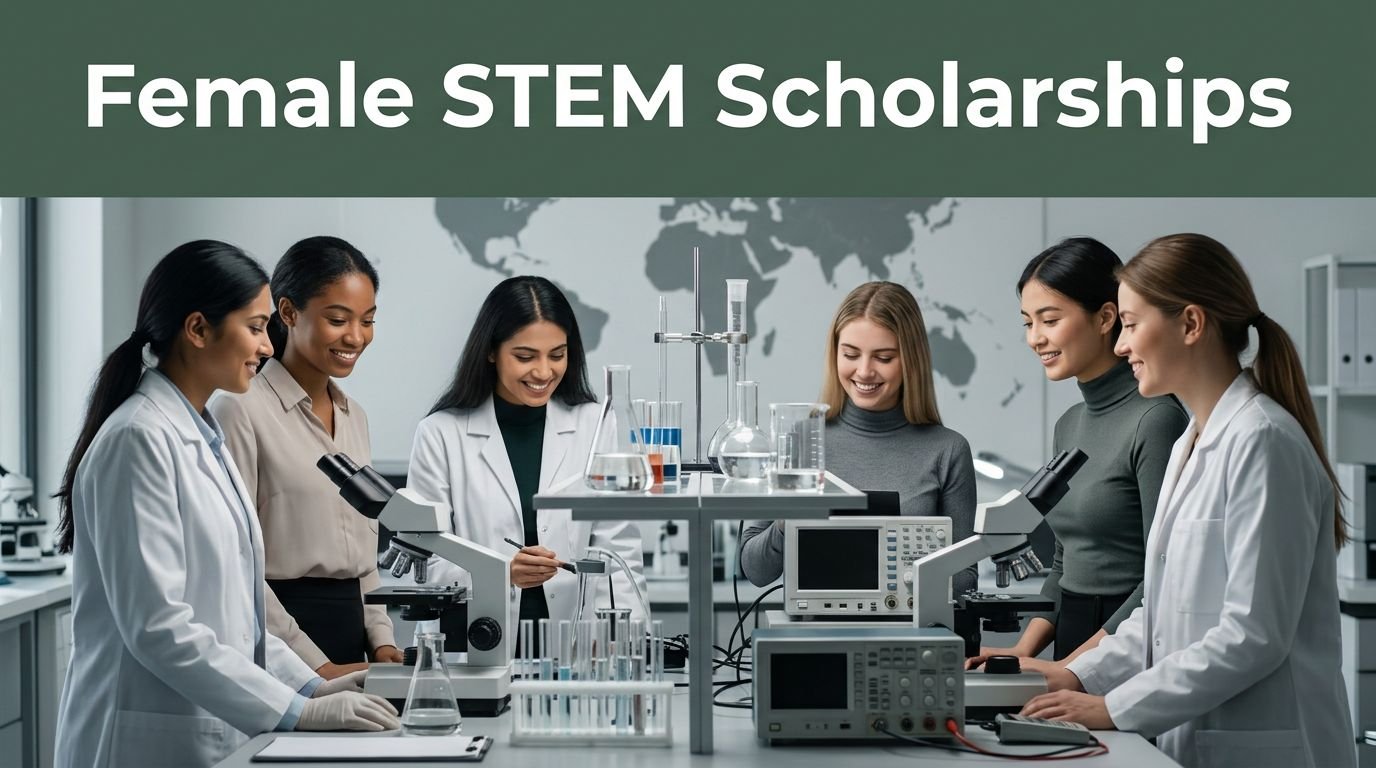
STEM scholarships for females are no longer limited to small tuition awards, and that shift matters. In 2026, many programs also help with living costs, research expenses, leadership training, and even study abroad, which makes them more useful for students who face real barriers to entering science, technology, engineering, and math.
We see these scholarships exist for a clear reason, women are still underrepresented across many STEM fields, and the cost of training can slow that progress. In this guide, we look at the main scholarship types, where to find them, how strong applications are built, and which country-specific options stand out for students around the world.
What makes STEM scholarships for females different from general scholarships
STEM scholarships for females are built with a narrower goal than most general awards. They are meant to support women in science, technology, engineering, and math, where access, representation, and retention still lag behind many other fields. That focus changes who can apply, what counts in an application, and how the money is often awarded.
General scholarships tend to cast a wider net. They may reward grades, financial need, community service, or almost any academic path. Female STEM awards, by contrast, often look for a match between gender identity, subject area, and long-term study plans.
Who these scholarships usually target
These awards often begin with a simple filter: the applicant must be a woman pursuing STEM study. That can include high school seniors planning to enter a STEM degree, undergraduates already enrolled, and graduate students working toward advanced research or professional training.
Many programs also welcome international students, which matters for readers applying across borders. Others focus on women from underrepresented communities, including first-generation students, racial and ethnic minorities, and applicants with low access to local STEM support. A smaller number also open the door to nonbinary or gender-diverse applicants, although the main focus here remains women in STEM.
The target group can get very specific. One scholarship may support young women entering engineering, while another may support mothers returning to school for computer science or public health research. That narrow design is one of the biggest differences from broad academic aid.
What fields are usually covered
The core subjects are easy to spot, but the list is wider than many people expect. Common fields include:
- Biology
- Chemistry
- Math
- Computer science
- Engineering
- Data science
- Environmental science
- Health-related STEM paths
Some awards are broad and accept almost any STEM major. Others are tightly tied to one discipline, such as civil engineering, biotechnology, or software development. That difference matters, because the scholarship rules often follow the needs of the field itself.
A student studying public health data, for example, may fit one award and miss another. Meanwhile, a chemistry major might have access to scholarships that never appear in searches for general women’s scholarships. For a wider view of how these awards are grouped, BestColleges’ women in STEM scholarship list gives a clear snapshot of common subject areas.
How these awards differ from loans and general aid
Scholarships do not need to be repaid, which makes them very different from loans. That is the simplest point, but it has real weight, especially when tuition, lab fees, housing, and books all pile up at once.
They can also work alongside other support. In many cases, a STEM scholarship for females can be stacked with grants or institutional aid, as long as the school’s rules allow it. That means the award may reduce what a student has to borrow, not just what she has to pay.
General aid often spreads across many student groups and funding needs. STEM-focused awards are more selective, but that selectivity can bring stronger fit and better odds for the right applicant. Programs built for women in STEM also tend to value academic direction, field commitment, and future contribution, not just financial need alone.
The main types of women in STEM scholarships
When we sort STEM scholarships for females by type, the differences matter as much as the dollar amount. Some awards reward past academic strength, some are built around financial need, and others care most about research, leadership, or where a student lives.
That mix is useful for applicants because no single profile fits every scholarship. A strong transcript may open one door, while a robotics project, lab placement, or community outreach record opens another. In practice, the best matches often come from knowing which category fits the student story.
Merit-based awards for strong academic records
Merit-based scholarships reward students who have already shown they can handle demanding STEM work. Grades carry the most weight, and some programs also look at test scores, class rank, or other proof of academic performance when those details are part of the application.
Strong transcripts matter, but they rarely tell the full story on their own. Many funders want to see a clear reason for choosing STEM, such as a long interest in coding, engineering, lab science, or applied math. A student who has built a focused academic path usually reads as a better fit than one with marks alone.
These awards often use essays, recommendation letters, or short personal statements to check that fit. A high GPA helps, but the application still needs evidence of direction and purpose.
Need-based scholarships for students with financial barriers
Need-based scholarships are designed to widen access for women who may not otherwise afford a STEM degree. They are especially important in fields where lab fees, equipment, travel, and tuition can stack up quickly.
Most programs ask for some kind of documentation, such as income details, FAFSA-style records, tax forms, or a statement explaining financial hardship. Award sizes vary a lot. Some cover a small portion of costs, while others pay for tuition, fees, or living expenses.
These scholarships often matter most to students balancing work, family, and study. They can turn a degree path that once looked out of reach into something realistic.
Financial need can open the door, but the application still has to show academic intent and a real commitment to STEM.
For readers comparing options, BestColleges’ women in STEM scholarship list is a useful snapshot of how need-based and merit-based awards are commonly grouped.
Research, leadership, and innovation awards
This category often goes beyond grades and looks at what a student has done outside the classroom. Funders may reward lab work, capstone projects, internships, product ideas, startup activity, club leadership, tutoring, or outreach in schools and communities.
That shift matters because many scholarship providers now care about real-world impact. A student who leads a coding club, mentors younger girls in science, or helps build a community health project can stand out quickly. In other words, the work does not need to stay on paper to count.
These awards are a strong fit for applicants with a visible track record of initiative. They often favor students who can show how their STEM work has helped others, solved a problem, or pushed a project forward.
A few common examples include:
- Lab and research awards for students with project or publication experience
- Leadership awards for club officers, peer mentors, or student organizers
- Innovation awards for inventors, founders, and problem-solvers
- Outreach awards for applicants who teach, mentor, or support girls in STEM
Country-specific and international scholarships
Some scholarships are limited to students from certain countries, regions, or schools. Others are open to international applicants and support study in the US, UK, Canada, and beyond. That makes this category especially useful for students applying across borders.
These awards can look simple at first glance, but residency rules matter. Some programs only accept citizens or permanent residents. Others allow global applicants but require a valid visa route, proof of admission, or study at a partner university.
Applicants should scan the small print before spending time on an application. The country rules often decide eligibility before grades or essays even enter the picture. For a broader international overview, the British Council’s women in STEM scholarships guide is a helpful reference point for UK-linked study options.
This category matters most for students comparing opportunities across borders. A scholarship can look generous on paper, but the fine print on residency, visa status, and institution choice often sets the real boundary.
Where to find legitimate STEM scholarships for females
The strongest STEM scholarships for females are often scattered across places that many students overlook. Some sit inside university departments. Others come from professional groups, foundations, or scholarship databases with tight filters.
That matters because the best awards are not always the most visible ones. A program built for women in engineering, computing, or science may have a small applicant pool, but it can also have strict rules. We need to know where those rules live before the deadline passes.
University financial aid pages and department websites
University aid offices list the broad awards, but the best matches often sit deeper in the school site. Engineering, computing, mathematics, and science departments frequently run their own scholarships, research grants, and graduate awards. These can be tied to a lab, a faculty donation, or a specific project area.
That is why a general search rarely tells the full story. A university may hide a strong award inside a department page, a faculty noticeboard, or a graduate school bulletin. Some of the most useful opportunities never reach the main financial aid page at all.
We also see separate awards for different levels of study. An undergraduate engineering bursary may sit beside a PhD research fellowship, while a computing department may post travel money, lab support, or prize scholarships on its own page. The structure is small and local, which makes it easy to miss.
A sensible search usually includes:
- The main financial aid page
- Department scholarship pages
- Graduate school funding pages
- Research lab and centre pages
- Internal student portals and email notices
If a university has a strong STEM faculty, the department pages often matter more than the homepage.
The reason is simple. These awards are often restricted, so schools keep them close to the people who qualify. That makes them less public, but it also makes them easier to trace once we know where to look.
Professional groups, nonprofits, and foundations
Professional groups are one of the most reliable places to find women-in-STEM funding. Many offer scholarships, fellowships, conference grants, and mentoring through groups connected to engineering, computing, math, and science. Their focus is often wider than tuition alone, because they want to build a long-term pipeline into the field.
Groups such as the Society of Women Engineers scholarship program and similar national associations often support students who show field commitment and community involvement. The same pattern appears in many nonprofits and foundations that back women in STEM leadership. These organisations care about more than grades. They often look for mission fit, outreach work, and signs that the applicant will stay active in the field.
That means volunteer work can matter. So can mentoring younger students, running a STEM club, or joining public science projects. In many cases, a scholarship committee wants to see that the applicant is already part of the community the award is meant to grow.
A practical search should cover:
- National engineering and computing associations
- Women-in-science foundations
- Subject-specific societies in math, biotech, and physics
- Local chapters that offer smaller awards
- Employer-backed foundations tied to STEM careers
These sources can be more selective, but they are often well matched to the kind of student they want to support. Their review process usually rewards clear purpose, not polished language alone.
Scholarship databases that help narrow the search
Scholarship databases are useful when the search needs range and speed. They let us sort by gender, major, country, level of study, and award amount, which saves time when the applicant pool is already crowded. For students comparing many options at once, that filtering can make the difference between a vague list and a workable shortlist.
Platforms such as Scholarships.com and Scholarship America are helpful because they organize awards by eligibility and deadline. That makes it easier to separate general scholarships from female-focused STEM awards. The best results usually come from running several searches, then checking each listing against the student profile.
Still, a database listing is only a starting point. Some entries are outdated, duplicated, or copied from older pages. Before applying, we should check whether the award page is current, whether the deadline still applies, and whether the provider has a real contact method, a current application form, and a clear eligibility page.
A quick trust check helps:
- Look for a recent deadline or update
- Confirm the provider has an official website
- Check that eligibility rules are specific
- Avoid listings that ask for payment to apply
- Cross-check the award on the sponsor’s own page
A database can point us toward the right door, but the sponsor’s own site tells us whether that door is actually open. In scholarship search, that final check is what separates a real award from a dead link.
How to qualify and build a stronger application
A strong application for STEM scholarships for females starts long before the essay. We need to clear the eligibility rules, gather evidence early, and tell a story that fits the award. One missing item can stop the application cold, even when the rest looks polished.
Meet the basic eligibility rules first
Every scholarship has a gatekeeper section, and we need to read it carefully. That usually includes nationality, residency, degree level, field of study, GPA requirements, and the deadline. If a program asks for women in undergraduate engineering study in the UK, for example, a graduate applicant in biology will be ruled out before review even starts.
Missing one rule can lead to instant rejection. The committee does not usually make exceptions for strong essays or high test scores. A late submission, the wrong citizenship status, or a GPA below the stated minimum can end the process on the spot.
A quick pre-check helps avoid wasted effort:
- Confirm the country or residency rule
- Match the degree level exactly
- Check that the major fits the listed STEM field
- Compare GPA or grade requirements
- Note the deadline in local time
- Read the fine print on full-time or part-time status
Scholarships with international reach often have extra filters. The MPOWER Women in STEM Scholarship page shows how eligibility can hinge on study status, enrollment level, and gender criteria, so every line matters.
Show a real STEM story, not a generic essay
The best essays sound lived-in. They name the project, the problem, the tools, and the result. A paragraph about “loving science” will fade fast, but a short account of a robotics build, a lab task, or a coding fix feels real.
We should write with clean detail and plain language. A student can mention a mentor who changed how she works, a competition that tested her under pressure, a research question that kept failing, or community work that brought STEM into a local school. Those facts do more than praise ambition. They prove it.
Clarity beats fancy phrasing every time. A committee can trust a direct account of what was done, what was learned, and what came next. The strongest stories sound specific because they are specific.
A useful structure is simple:
- State the challenge
- Show the action taken
- Explain the result
- Link it to future STEM study
That approach also helps when comparing deadlines and application formats on broad scholarship platforms such as Bold.org’s women in STEM listings, where many applicants are competing with similar grades and interests.
Generic praise is easy to skip. Concrete details are harder to ignore.
Collect the right documents early
A complete file often matters as much as the essay itself. Most STEM scholarship applications ask for transcripts, recommendation letters, test scores when needed, a personal statement, a CV, proof of enrollment, and financial documents for need-based awards. International applicants may also need a passport copy, visa records, or certified translations.
Waiting until the deadline week creates avoidable problems. Schools and referees move at their own pace, and some documents take longer than expected. A transcript or translated record can take days, sometimes longer, which is enough to miss a deadline.
We should keep the paperwork list close to hand:
- Academic transcripts
- Recommendation letters
- Standardized test scores, if required
- Personal statement or essay
- CV or résumé
- Proof of enrollment or admission
- Financial documents
- Passport, visa, or translation records, when relevant
Many applications fail for simple admin reasons, not weak talent. The NSHSS application guide reflects a common pattern, missed items, weak formatting, and late submissions do most of the damage.
Make referees and recommenders part of the plan
A good recommendation letter does more than confirm grades. It gives weight to academic promise, leadership, and resilience. The best letters sound specific, with examples that only a real teacher, mentor, or supervisor would know.
We should choose referees who have seen real work up close. A lab supervisor can speak about accuracy and persistence. A professor can describe how a student handles hard material. A mentor from a science club or outreach group can explain leadership in a way that feels grounded.
Generic letters rarely help. A line that says someone is “hard-working and dedicated” is forgettable unless it comes with proof. A better letter names the project, the challenge, and the outcome, then shows how the applicant handled it.
Strong recommenders need time, so we should brief them early. That includes the scholarship name, the deadline, the level of study, and a short note on the qualities the award values most. When the letter matches the scholarship criteria, it reads like part of the same file, not an afterthought.
A simple step-by-step way to apply without missing deadlines
The strongest applications for STEM scholarships for females usually come from process, not luck. We see fewer missed deadlines, fewer incomplete forms, and fewer last-minute errors when the search is treated like a small project with fixed checkpoints.
That matters because scholarship committees rarely make exceptions for avoidable mistakes. A strong profile can still lose out if a transcript is missing, a file name is unclear, or the portal closes before submission. The simplest path is to narrow the list, shape each application to fit, then submit early enough to leave room for error.
Build a shortlist of scholarships that fit the profile
The first filter should be hard and practical. We should sort by field of study, country, award size, eligibility, and deadline, then remove anything that does not match the student profile. That keeps time focused on awards with a real chance of success.
A scholarship for electrical engineering in Canada will not help a biology student in the UK. A large award can also be a poor fit if the applicant misses one residency rule or degree-level requirement. The search becomes much easier when we compare the basics first, not after the essay is written.
A simple shortlist often looks like this:
Checkpoint |
What to confirm |
Why it matters |
|---|---|---|
Field |
STEM subject matches the award |
Prevents wasted effort on the wrong discipline |
Country |
Study location or citizenship fits |
Some awards are country-specific |
Award size |
Tuition, fees, or living costs |
Helps decide if the time spent is worth it |
Eligibility |
Level, gender, residency, GPA |
Stops disqualified applications early |
Deadline |
Local date and time |
Avoids late submission |
We also need to read beyond the headline. Some awards sound broad but only accept women in engineering, while others cover any STEM path but only at one university. The deadline can matter just as much as the amount, because a generous award is useless if the portal closes in three days and no documents are ready.
A short shortlist beats a long, messy one. Three strong matches are worth more than thirty weak leads.
A useful habit is to keep one master tracker with the scholarship name, link, deadline, required documents, and status. That one sheet can save hours of re-checking later.
Tailor each essay and personal statement
Copying one essay for every award weakens the application fast. Reviewers can spot a generic statement almost immediately, especially when the same sentence appears across different scholarships. A stronger approach is to keep one base outline, then reshape the details for each funder.
The structure should stay clear and direct. We usually want to connect three parts: background, goals, and the scholarship mission. That gives the reader a straight line from past experience to future study.
A good draft often follows this shape:
- Start with a focused background moment that explains interest in STEM.
- Show current academic work, projects, or leadership.
- Link those experiences to future study and career goals.
- Close by matching those goals to the scholarship’s purpose.
That structure works because it does not drift. It keeps the reader inside one story, not a list of unrelated achievements. If a scholarship supports women in engineering outreach, the essay should show that kind of interest clearly. If it funds research talent, the personal statement should point to lab work, analysis, or technical problem-solving.
The wording should stay plain. A line about completing a coding project, leading a science club, or helping younger students with math usually says more than a polished paragraph full of broad claims. For applicants comparing many awards, the Sallie STEM scholarships guide is a useful reminder that deadlines and requirements vary from one award to the next, so the essay has to match the form as well as the funder.
A final check helps here too. We should ask whether the essay answers the actual prompt, not just the question we expected. Scholarship committees read for fit, and fit is usually easier to see in a specific, well-matched statement than in a recycled one.
Submit early and check every detail twice
Last-minute submission is where many strong applications fail. Files go missing, uploads time out, portals crash, and small formatting issues appear at the worst possible moment. Early submission cuts that risk because it leaves time to fix what the website, or the applicant, gets wrong.
Common problems are rarely dramatic. More often, they are small but decisive:
- Missing attachments
- Wrong file type
- File names that are vague or messy
- Formatting that breaks on upload
- Essays pasted into the wrong box
- Forms that were saved but not fully submitted
We should treat every application like an evidence file. That means checking the essay, transcript, references, and supporting documents against the scholarship instructions one more time before submission. If a form asks for a PDF and the upload is a Word file, the system may reject it or distort the layout. If a portal asks for a personal statement with a character limit, going over can cut off the final lines.
Two checks are better than one. A quick review catches obvious errors, while a second review catches the details that come with fatigue, like misspelled names, wrong dates, or the wrong scholarship title in the essay header. We should also make sure the file names are clean and easy to recognize, such as Surname_Transcript.pdf or Surname_Essay.pdf, not a string of random numbers.
Last-minute website problems deserve attention too. Pages time out, systems slow down near deadlines, and uploaded files sometimes disappear after refresh. Submitting early gives the student a buffer, and that buffer is often the difference between a clean entry and a missed opportunity. The more crowded the deadline window, the more valuable that buffer becomes.
The final application is usually the one that looks calm from the outside because the real work happened before the clock started running out.
Scholarships by country and study destination
When we compare STEM scholarships for females by country, the pattern changes fast. Some destinations put most of their money into graduate study, while others spread support across undergraduate, master’s, and research routes. The study location also shapes what the award covers, because tuition alone is only part of the bill in many cases.
Country rules matter just as much as field rules. A scholarship may look broad on paper, but eligibility often depends on nationality, residency, visa status, or the university named in the offer. That is why country-based sorting is so useful, especially for students weighing where to study next.
Women in STEM funding in the United States and Canada
The United States and Canada offer many awards that are open to domestic and international students, although the exact rules vary by sponsor. Some programs focus on underrepresented groups, while others are built around graduate study, research, or professional training in areas like engineering, computing, and science.
In both countries, it is common to see support that covers more than tuition. Awards may include living stipends, research funds, travel money, or help with fees and equipment. That matters because STEM study often comes with costs that sit outside the classroom.
Canada also has a strong tradition of research-linked support, especially for students entering graduate programs. In the US, many awards are tied to nonprofit groups, universities, and professional associations that want to widen access for women in technical fields. A useful starting point for global applicants is the Pathways to Science directory for women in STEM, which includes scholarships, fellowships, and research opportunities in one place.
Opportunities in the United Kingdom and Europe
UK and European programs often connect women in STEM with master’s study, research, or exchange pathways. That is especially true for scholarships that are linked to international study, where the award may cover tuition, travel, visa costs, or basic living support.
Many of these opportunities are attached to specific universities or national initiatives. Some are designed for women from particular regions, while others target fields such as engineering, computer science, environmental science, or data-focused study. That narrower design can be useful, because it keeps the applicant pool focused and the funding more closely matched to the course.
The UK also has several well-known routes that support women from lower-income or underrepresented backgrounds. Europe follows a similar pattern, although the structure varies by country. We see more university-specific awards, more exchange-linked funding, and more programs that expect applicants to fit a precise study path. For a broad international overview, TopUniversities’ women in STEM scholarship guide gives a clear snapshot of how these awards are distributed across countries.
In the UK and much of Europe, the name of the university can matter as much as the subject itself.
That means applicants need to check whether the scholarship is tied to one institution, a national scheme, or a partner network. The difference can decide everything, from the application form to the visa route.
Options across Africa, Asia, and Latin America
Across Africa, Asia, and Latin America, women in STEM funding often comes from local foundations, governments, NGOs, and international partners. The goal is usually bigger than one student’s tuition bill. These programs are built to strengthen regional talent pipelines so more women can train, work, and lead in technical fields at home.
Many of these awards are shaped by local needs. Some support women in nursing, agriculture, public health, or data science, while others focus on engineering and technology. A number of programs also fund study abroad, especially when the student is expected to bring that training back into a local school, lab, agency, or startup ecosystem.
Local eligibility rules matter a great deal here. Some scholarships only accept citizens of one country. Others require proof of residence, admission to a named institution, or evidence that the applicant plans to return after study. That is why broad advice is rarely enough. Each award needs a close read.
A practical way to sort these options is to look at the funding source first:
- Government awards often come with residency or service rules
- NGO programs may focus on women from low-income households or rural areas
- Foundation grants can target specific STEM subjects or leadership goals
- International partner schemes often support mobility, research, or graduate study
Many students in these regions also use country-specific study abroad funding to access labs, mentors, or degrees that are harder to find locally. The value is not just the award itself. It is the training network, the contacts, and the chance to enter a field with stronger support.
For students comparing all regions at once, the key is fit. A scholarship in one country may offer stronger living support, while another may provide better research access or a clearer route into a master’s program. The best choice is usually the one that matches both the study plan and the local rules, because those details shape the outcome long before the money lands.
Mistakes that quietly cost applicants their chance
The biggest losses in STEM scholarships for females often happen before a reviewer reaches the final page. A strong academic record can still be weakened by a vague essay, a missed link to the program’s purpose, or a pile of documents assembled too late. These errors do not always look serious on their own, but together they can make an application feel thin, rushed, and easy to pass over.
Sending a weak or unfocused essay
A scholarship essay should show direction. When goals stay vague, reviewers struggle to see how the applicant fits the award or plans to use it. A line about “wanting to study science” says very little. A line about building low-cost water sensors for rural clinics, by contrast, gives the committee a clear path into the applicant’s work.
Specific details also make commitment easier to trust. A general story about liking math since childhood can feel polished but empty, while a focused account of a coding project, lab task, or competition shows how that interest became action. We see the difference fast, one sounds like a summary, the other sounds like evidence.
Reviewers are not looking for a perfect life story. They are looking for a clear reason to believe the applicant will stay in STEM.
A strong essay usually connects one experience to one future goal. That keeps the writing tight and stops it from drifting into broad praise. For women applying to STEM scholarships, that link matters because funders want more than interest, they want visible direction.
Ignoring the scholarship mission or values
Many applicants lose points because they never connect their background to the award’s purpose. A scholarship built around leadership, research, equity, or mentorship needs to see that same thread in the application. When that link is missing, the file can feel generic, even if the applicant is a strong student.
This mistake is common in women in STEM scholarships that support underrepresented groups or first-generation students. A reviewer wants to know whether the applicant understands the mission, not just the money. If the program supports research, the essay should mention lab work, analysis, or curiosity that led to inquiry. If it supports equity, the application should show outreach, mentoring, or a clear effort to widen access for others.
A useful test is simple. Does the application sound like it could fit any scholarship, or does it clearly belong to this one? The best answers are built around the second option.
We can also see this in award pages that state their focus openly, such as Bold.org’s women in STEM scholarships. The mission is right there, so the application should echo it with equal clarity.
Waiting too long to gather documents
Late paperwork causes more damage than many applicants expect. Transcripts, recommendation letters, proof of enrollment, and financial records all take time to collect, and delays often turn into rushed files. Once that happens, small mistakes start to pile up.
A last-minute request for a referee also weakens the letter itself. Someone asked the night before a deadline has little room to write with care, and the result often feels flat or incomplete. The same problem appears with transcripts and other school records, which may take longer than expected if a registrar’s office is busy.
Simple planning avoids most of this trouble. We do better when we keep one folder for every scholarship and gather the basic documents early. That way, the final application is about fit and quality, not panic.
A short preparation list helps keep things in order:
- Request transcripts early
- Ask referees at least a few weeks ahead
- Save documents in the correct file type
- Check whether translations or scans are required
- Keep a master list of deadlines and required items
The applications that reach review in good shape usually look calm because the work started well before the deadline. For many applicants, that quiet discipline matters as much as grades or test scores.
What helps women in STEM win more often
Women who win more often in STEM scholarship rounds usually do a few things well. They submit complete files, tell a clear story, and show proof that their interest in science or technology has already taken shape. Reviewers notice that mix fast, because it feels grounded instead of padded.
The pattern is consistent across many programs for STEM scholarships for females. Strong grades matter, but so do project depth, purpose, and careful record-keeping. In other words, the best applications read like a coherent academic path, not a pile of unrelated achievements.
Show depth, not just activity
A few meaningful projects usually speak louder than a long list of shallow ones. We see this in applications every cycle. A student who has completed an internship, entered a science fair, built a coding project, worked in a lab, and supported outreach already has a stronger case than someone who only lists clubs.
Depth gives reviewers something real to evaluate. It shows that the applicant has stayed with a task, handled setbacks, and learned from the process. That is especially useful in STEM, where persistence often matters as much as raw ability.
The strongest applications often draw from work such as:
- Internships that show exposure to real workplaces
- Science fairs that prove problem-solving under pressure
- Coding projects that show technical skill and follow-through
- Lab work that reflects accuracy and patience
- Outreach that shows commitment to helping others enter STEM
A small number of strong examples also makes the essay easier to read. Instead of trying to cover everything, we can focus on the experiences that changed how the student thinks or works. That gives the application shape, and shape is what many weaker submissions lack.
Connect STEM study to a larger purpose
Reviewers respond well to applicants who can explain why their work matters beyond the classroom. A student who wants to build better health tools for rural clinics, improve clean energy systems, or support girls in local schools gives the committee a reason to remember the file. The idea does not need to sound grand. It just needs to be practical.
Concrete goals help most. A future engineer can talk about safer housing, stronger transport systems, or lower-cost materials. A computer science applicant can point to better data tools, more secure systems, or software that solves a real access problem. A biology student can link study to medical research, public health, or food systems.
That kind of framing also fits the mission of many awards for women in STEM. Some funders want to back students who will strengthen a field. Others want applicants who will return skills to a community. When the statement connects study to a real outcome, the application feels sharper and more credible.
A useful source of women-in-STEM scholarship guidance is Online Master Degrees’ scholarship resource, which shows how often awards look for both academic promise and a clear direction of purpose. That same logic appears across many scholarship forms, even when the wording changes.
Reviewers often remember the applicant who explains a problem she wants to solve, not the one who only says she likes science.
Keep a record of every award and deadline
A simple tracker can save an application before it falls apart. Deadlines, essay prompts, reference requests, and portal links all pile up fast, especially when students apply to several scholarships at once. A spreadsheet keeps the work visible.
We usually want one place that tracks each award, the due date, the required documents, and the submission status. That removes guesswork and helps avoid duplicated effort. It also makes it easier to spot which applications need attention first.
A basic tracker can include:
Scholarship name |
Deadline |
Required items |
Status |
|---|---|---|---|
Award 1 |
12 March |
Essay, transcript, reference |
In progress |
Award 2 |
25 March |
Essay, CV, proof of enrollment |
Ready to submit |
Award 3 |
1 April |
Financial form, transcript |
Waiting on documents |
This kind of record is simple, but it works. It stops a missed deadline from becoming a lost opportunity, and it gives the applicant a clear view of what still needs to be done. For women competing in STEM scholarship rounds, that quiet organisation often matters more than people expect.
The same habit also helps with smaller details, such as essay prompts, file names, and recommendation timing. When every award sits in one place, the application process feels less like a scramble and more like a sequence with a finish line.
Frequently asked questions about STEM scholarships for females
The same questions come up again and again because the rules vary so much from one award to the next. Some scholarships are open to a wide range of students, while others draw hard lines around citizenship, degree level, GPA, or field of study. The answers below cover the patterns we see most often across STEM scholarships for females.
Who can apply for women in STEM scholarships?
Most women in STEM scholarships are open to applicants who identify as female and are studying, or plan to study, a STEM subject. That usually means science, technology, engineering, or math, but the list often includes health sciences, data, and related technical fields as well.
Eligibility usually depends on a few basic factors:
- Degree level, some awards are for high school seniors, others for undergraduates, and others for graduate students
- Field of study, the major must fit the scholarship’s STEM definition
- Enrollment status, many awards require admission or full-time study
- Academic standing, some ask for a minimum GPA, while others do not
- Location or citizenship, some are local, some are national, and some are open globally
Undergraduate scholarships usually focus on students entering college or already enrolled in a bachelor’s program. Graduate awards often ask for a stronger research record, a clear career plan, or proof of advanced study in a specific STEM area. International options can be more flexible on nationality, but they often add rules about visas, partner schools, or where the student must study.
Can international students qualify?
Yes, many programs are open to international students, especially those designed to widen access to STEM education. That said, the rules still matter. Some awards accept global applicants only if they hold a valid student visa, study permit, or admission to a named institution.
Others are limited to citizens or permanent residents of one country. In practice, that means two scholarships with the same subject focus can have very different access rules. A student may qualify for one and be shut out of the next, even when the subject and grades look similar.
A quick example appears in many online listings, including STEM scholarships, where international eligibility depends on the sponsor’s own conditions. The safest move is to read the residency and visa section before spending time on essays or references.
Do these scholarships cover more than tuition?
Some do, and that is becoming more common. Tuition-only awards still exist, but newer programs often stretch further because STEM students face extra costs beyond class fees. Books, software, lab equipment, travel, housing, and research costs can add up fast.
We often see broader packages that include:
- Living costs, for housing or daily expenses
- Travel support, for conferences, fieldwork, or study abroad
- Research funding, for materials, lab access, or project costs
- Leadership support, such as mentoring, networking, or development grants
These wider awards are especially useful for graduate students and applicants in research-heavy subjects. They can reduce the pressure to take on extra work and make it easier to stay focused on the degree itself.
Can students apply for more than one scholarship at the same time?
Yes, and many students do. In fact, applying to several scholarships at once is often the smartest approach, as long as the rules allow it. Most programs do not mind concurrent applications, but some may limit stacking if two awards cover the same cost.
The real challenge is keeping the process organised. Deadlines can cluster, document requests can overlap, and essay prompts can look similar while asking for different things. A simple tracker helps a lot, especially when one award wants a research statement and another wants a leadership essay.
The main risk is not applying to too many scholarships, it is missing a deadline because the details were not tracked properly.
A few women in STEM scholarship programs also expect applicants to update them if they accept another award. That is why we should read the terms carefully before submitting. Multiple applications are normal, but each one still needs its own rules checked on time.
Conclusion
We see STEM scholarships for females playing a larger role than simple tuition aid. They now help women enter fields where cost, access, and representation have long shaped who stays and who leaves.
The funding picture has widened as well. More awards now reward research, leadership, outreach, and long-term goals, so the strongest applications are no longer built on grades alone. They reflect academic promise, clear purpose, and a record of follow-through.
Careful preparation still separates the strongest candidates from the rest. A matched subject, a clean essay, the right documents, and a clear link to the scholarship mission all matter because reviewers look for fit as much as need.
That is the main shift in the field. The best women in STEM scholarships are now backing students who can show both ability and direction, and that makes the opportunity broader, but also more exacting.
This post may contain affiliate links. If you make a purchase through these links, I may earn a small commission at no extra cost to you.