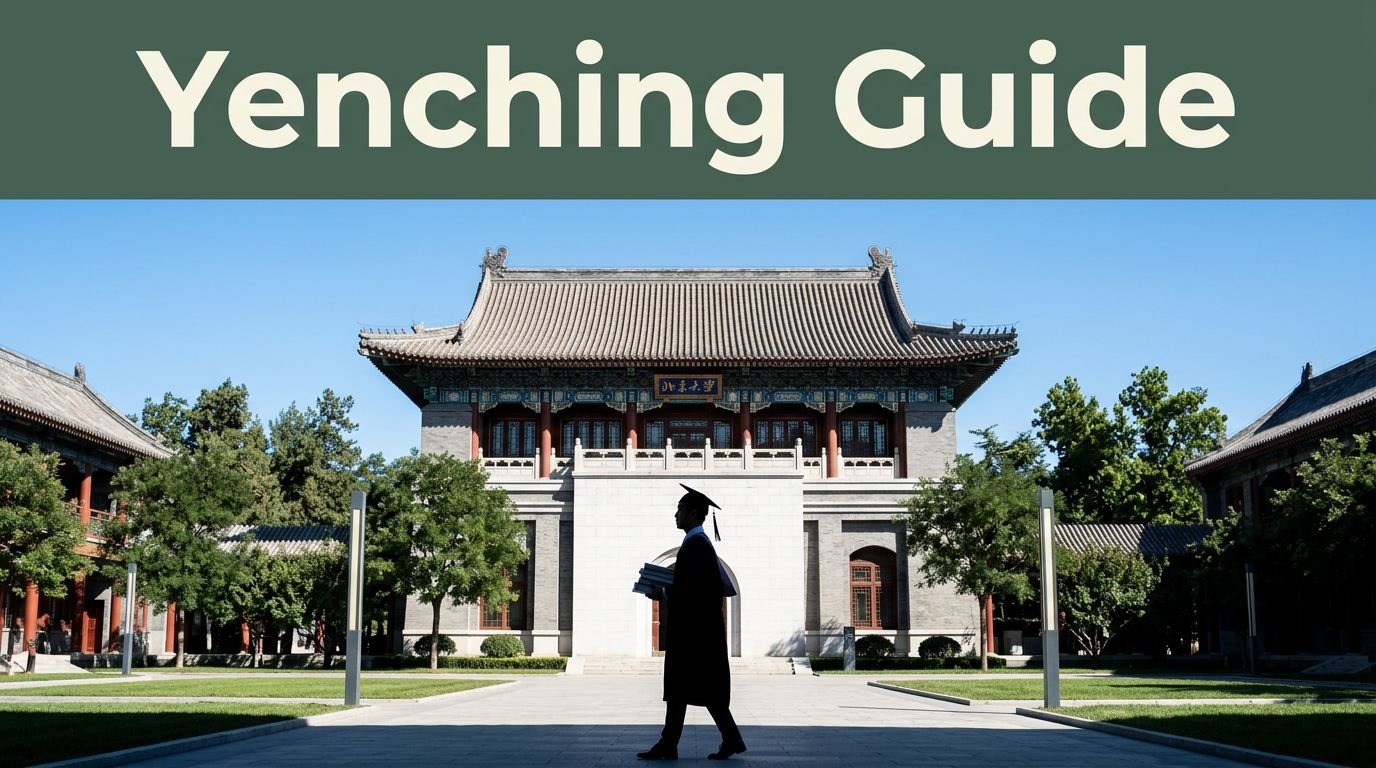
If you are chasing the Yenching Academy Scholarship at Peking University, timing matters as much as talent. In June 2026, the 2026 cycle is already closed, and the official page indicates that the next recruitment update should appear around September.
That means you are not looking at a last-minute form today. Instead, you are looking at the rules that shaped a very selective, fully funded opportunity, allowing you to read the standards clearly and prepare without guessing.
The good news is simple. Once you understand the profile, the essays, and the document set, the whole process stops feeling mysterious.
Key Takeaways
- Stay Aligned with Official Timelines: The Yenching Academy application cycle is highly structured; always prioritize the official Peking University admissions portal over third-party information and prepare to apply well in advance of deadlines.
- Prioritize Academic Focus: The scholarship committee seeks candidates with a clear, specific research interest within the six core China Studies areas, rather than those with broad or unfocused proposals.
- Build a Coherent Narrative: A competitive application connects your personal statement, research interests, and previous accomplishments into a single, cohesive story that explains your specific trajectory.
- Ensure Administrative Precision: Small details—such as meeting the bachelor’s degree date requirement, submitting official transcripts, and securing timely letters of recommendation—are critical to the success of your application.
- Use Extra Time Strategically: If you miss an application window, use the intervening months to improve your English proficiency scores, refine your research proposal, and curate your supporting documents.
Where the 2026 cycle stands now
According to the official admissions page, the academy is no longer accepting applications for the 2026 cohort of international students. If you were waiting to open a fresh form, you have missed that window.
That does not make the guide useless. It makes it useful in a different way. You can still study the criteria, tighten your profile, and get ready for the next round instead of scrambling at the wrong time.

The official page changes first. If the academy says the cycle is closed, trust that before you trust reposted deadlines.
If you are applying through a partner university, keep an eye on campus-level deadlines too. Those can land earlier than the central timeline. Some applicants from Hong Kong, Macao, and Taiwan also need to check whether they must use both the Yenching system and the graduate admissions system of Peking University.
The point is not to panic about the calendar. The point is to stop treating the scholarship like a floating rumor. It has a real process, and the process starts with the Peking University admissions page.
Who the scholarship is really for
The Yenching Academy Scholarship is designed for high-achieving individuals pursuing a prestigious Master’s degree. The program is built for candidates who demonstrate strong academic performance, a commitment to interdisciplinary study, and the potential for global leadership. The committee looks for applicants who do more than just excel in the classroom and collect grades; they want to see evidence of real-world initiative.
Here is the profile the academy is scanning for during the selection process.
What the academy looks for |
What it should look like in your file |
|---|---|
Bachelor’s degree by August 31, 2026 |
You have finished, or will finish, your degree by that date |
Strong academic record |
Your transcript shows steady performance, not a lucky semester |
Interest in China Studies |
Your essays connect China to a specific academic question |
Leadership or service |
You have done work outside class that shows initiative |
English proof or waiver |
You submit an accepted score, or prove you qualify for an exemption |
Applicants should align their academic focus with one of the six core research areas supported by the academy: Economics and Management, Politics and International Relations, Law and Society, History and Archaeology, Literature and Culture, or Philosophy and Religion.
The hard line is the degree date. If you do not meet it, the rest of your file cannot rescue you. That is the kind of detail that looks small until it is not.
The rest is more flexible, but not soft. A good profile is not a pile of activities; it is a clean story. You should be able to explain why your background leads naturally to this program and why this program leads naturally to your next step.
If your application reads like three separate people wrote it, the committee will feel that right away. If it reads like one person with a clear direction, you are in much better shape.
English proficiency and academic proof
Demonstrating your English proficiency is one of the easiest parts of the application to misunderstand, because the rules look simple but still trip many candidates up. The current requirements include IELTS Academic 7.0, TOEFL iBT 100, Cambridge English Advanced 185, CET-6 600, or TEM-4 “良好” or above, unless you qualify for a waiver.
Use the table below as a fast check before you spend money on another test.
Test |
Minimum score |
Waiver note |
|---|---|---|
IELTS Academic |
7.0 |
Standard accepted option |
TOEFL iBT |
100 |
Standard accepted option |
Cambridge English Advanced |
185 |
Standard accepted option |
CET-6 |
600 |
Accepted for relevant applicants |
TEM-4 |
“良好” or above |
Accepted for relevant applicants |
Waiver |
n/a |
May apply if you’re a native English speaker or graduated from an English-taught undergraduate or Master’s degree program |
The waiver for English proficiency matters, but do not treat it like a loose promise. If you qualify, state it clearly and attach the right proof. If you do not qualify, build your schedule around the test early. Waiting until the last week is how strong applicants hand themselves a problem. For HMT applicants navigating the graduate admissions system at Peking University, ensure all documentation is handled with the same level of precision.
Academic proof also needs care. You should provide clean, official transcripts rather than messy screenshots. If your university uses different grading scales, make the transcript as readable as possible and keep every document official.
A bachelor’s degree by August 31, 2026 is still the key gate. If your completion date lands after that, your planning needs to shift to the next cycle.
The documents you should prepare first
Before you write a single polished sentence, gather the whole file in one place. The application asks for more than a form, and the documents tell a large part of the story.
You should expect to prepare these core pieces:
- An online application form.
- A personal statement of up to 750 words.
- A statement of research interest of up to 1,500 words, not counting citations.
- A curriculum vitae.
- Official transcripts.
- A diploma, or an enrollment certificate if you are still studying.
- Two letters of recommendation from full or associate professors in your intended field.
- An English test report, if you need one.
That list is manageable if you start early. It becomes a mess when you leave letters and transcripts for the end.
Ask your referees first, not last. Professors get busy, and they do not always write fast when the deadline hits. If you need an enrollment certificate, request it before your office closes for the week. If you need official transcripts, check whether your university mails them, stamps them, or issues them through a portal.
When the application window opens again, the admissions portal hosted by Peking University is where the file goes. Get your scans, drafts, and test documents ready before you log in. That way you spend your time checking details instead of hunting for files named final_final3.pdf.
How to write the two essays
This is where many strong applicants get tangled. They either write too broadly, or they write like a CV in paragraph form. Neither works.
The personal statement
Your personal statement is capped at 750 words, so every paragraph has to carry weight. You do not need your entire life story. You need a clear arc.
Start with the moments that shaped your academic direction. Then connect those moments to the program. Then show what you bring to the cohort. Keep the tone direct. You are not writing a memoir, and you are not writing a hype reel. A successful personal statement serves as the narrative bridge between your past achievements and your future goals.
A strong essay usually answers three questions without sounding forced. Why this field? Why now? Why you? Use plain language. If you spent time on research, internships, translation, student groups, public service, or independent reading, pick the details that explain your path. Leave out the filler.
The statement of research interest
The research statement is longer, up to 1,500 words excluding citations, so you have room to show real thinking. Use that space well. Don’t write a broad essay about China as if the topic itself is enough.
Choose one focused question. Then show how you would study it. Your topic should be narrow enough to fit a Master’s degree and strong enough to matter. Furthermore, your research proposal should clearly fit within the interdisciplinary study framework that defines the Yenching Academy.
If you can’t state your research question in one sentence, it’s probably too wide.
A good statement usually covers your topic, the question you want to answer, why the question matters, and how the program fits your work. It should also show that you’ve read enough to know the conversation already exists. If you are pursuing a Master’s degree, you do not need to sound grand. You need to sound precise. A clear question beats a dramatic paragraph every time.
How the application usually comes together
The process looks simple on paper, but timing is everything. One missing letter can throw off an otherwise strong file.
- Start with the official Peking University admissions page and confirm the current cycle.
- Check the degree date, test score rule, and any waiver you may claim.
- Draft your personal statement and research interest early.
- Ask your recommenders well before the deadline.
- Upload clean, official documents to the portal.
- Review every file name, date, and score before you submit.
- Save a copy of the final application for your records.
That order matters. You should not write the essays last and hope everything else fits around them. The essays shape the rest of the file.
If your university runs a nomination process or asks for a campus approval step, work backward from that deadline. If you are in Hong Kong, Macao, or Taiwan, double-check whether you need to submit through more than one system. These are the kinds of details that cost people time.
Submit early if you can. Portals get crowded near deadlines, and slow uploads can turn into stress you never needed. Remember that this scholarship covers your tuition fees, so ensuring your application arrives on time is essential to securing your spot in the program.
What reviewers notice fast
A strong application feels controlled. It does not feel stuffed.
The committee can tell when your transcript, essays, and letters point in the same direction. That kind of coherence helps. It tells them you understand your own academic path.
Common mistakes show up fast too:
- Your research topic is so broad it could fill three degrees.
- Your letters praise you in general terms, but never show how they know your work.
- Your personal statement repeats your CV instead of explaining your future direction in China Studies.
- Your English proof is missing, expired, or uploaded in the wrong format.
- Your timeline is sloppy, so the file feels rushed before anyone finishes reading it.
You do not need a perfect life story. You need a clean argument. Why this program, why this topic, why this moment. When those three pieces line up, the application gets easier to read.
Global leadership and service matter here too, but not in a flashy way. You do not need a long list of titles. You need proof that you have contributed somewhere beyond the classroom. That might be research support, organizing work, volunteer projects, peer mentoring, translation, or student leadership. The label matters less than the habit behind it. It is also important to remember that for international students, the program provides a generous living stipend to support your time in Beijing, and the committee looks for candidates who will make the most of that opportunity.
If you missed the 2026 deadline
If you came here hoping to submit an application for the 2026 cycle, stop looking for a hidden route. The application period is closed, and the official Peking University website indicates that recruitment details for international students will likely appear around September.
That is not a loss. It is simply extra time.
Use it to sharpen the parts that matter most:
- Refine your research proposal until the topic sounds specific and well-defined.
- Raise your English score if your current one is borderline.
- Ask for recommendation letters from people who know your work well.
- Clean up your transcript, CV, and enrollment proof.
- Build a clearer academic story around China studies.
If your profile is already strong, this is the moment to make it highly readable for the admissions committee. If it is weak in one area, fix that one area first. You do not need to rebuild everything from scratch.
When the next cycle opens, your job is to move quickly with a file that already makes sense. That is a much better place to be than starting from zero during deadline week.
Frequently Asked Questions
Is it possible to apply for the Yenching Academy scholarship if my bachelor’s degree completion date is after August 31, 2026?
No, you must have completed your bachelor’s degree by that specific date to be eligible for the program. If your graduation falls after this cutoff, you should plan to apply for a future cycle instead.
Do I need to be fluent in Chinese to be considered for this scholarship?
The program is an English-taught master’s degree, so you do not necessarily need to be fluent in Chinese for admission. However, you must provide proof of English proficiency through acceptable test scores, such as IELTS or TOEFL, unless you qualify for an official waiver.
How can I make my research proposal stand out to the committee?
Focus on a specific, narrow research question rather than a broad, sweeping topic. Ensure that your proposal clearly demonstrates that you have engaged with existing academic literature and that your project fits within the academy’s interdisciplinary framework.
What should I do if I am applying through a partner university?
Check your partner university’s internal deadlines, as they are often earlier than the central Yenching Academy timeline. Ensure that you follow any specific nomination or approval processes required by your home institution in addition to the standard application steps.
Conclusion
The biggest mistake is treating the Yenching Academy Scholarship like a form you fill out at the last minute. It is more like a file you build over time, with each document supporting the next one. As a prestigious residential college at Peking University, this program is designed for scholars who want to immerse themselves in rigorous interdisciplinary China Studies.
If you remember only one thing, remember this: the strongest applications are the clearest ones. They meet the degree requirements, show a genuine academic interest in the region, and present essays that sound focused instead of inflated.
Keep the official admissions page and the application portal as your primary reference points. That way, when the next window opens, you are not guessing. You are ready.
This post may contain affiliate links. If you make a purchase through these links, I may earn a small commission at no extra cost to you.