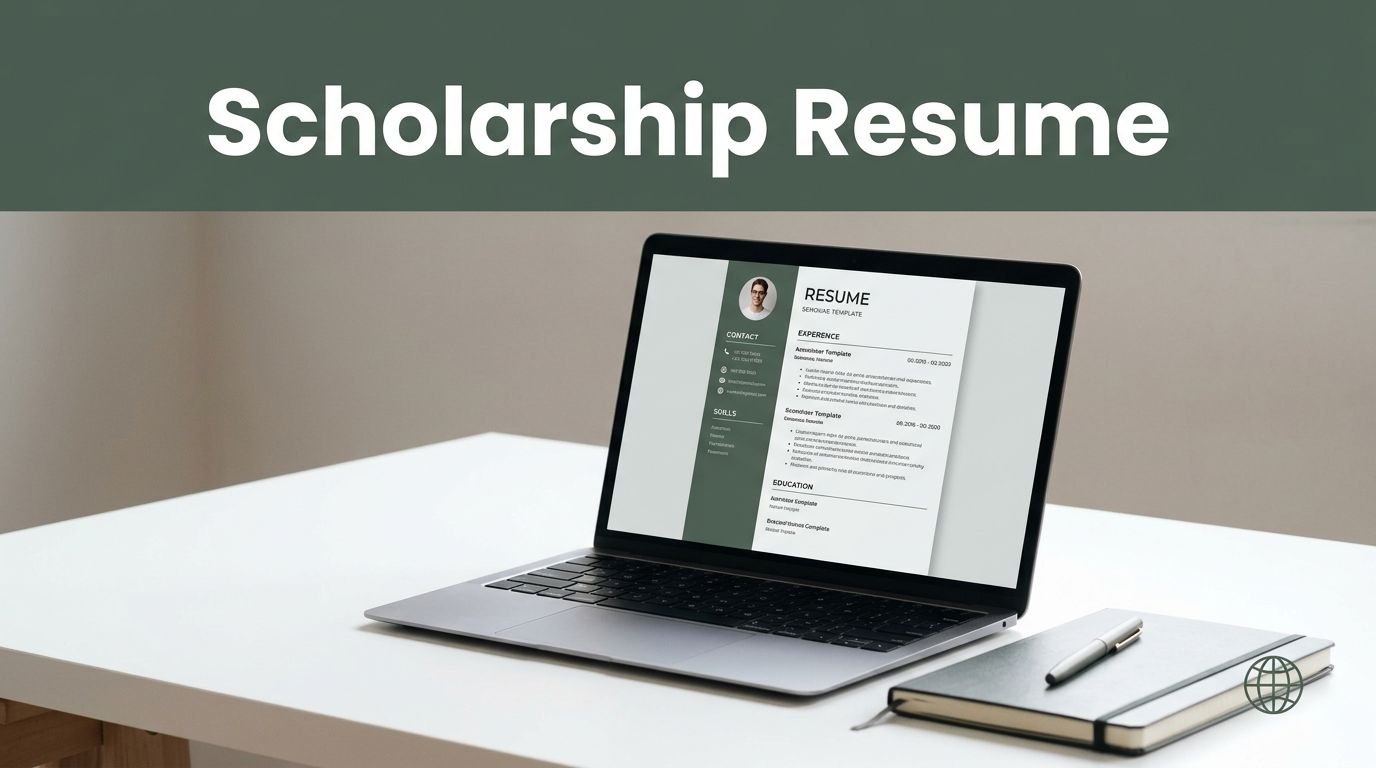
A scholarship committee can scan your resume in under a minute. If the page is cluttered, vague, or stuffed with the wrong details, that minute is gone fast.
A strong scholarship resume does one job well; it shows that you are the perfect fit for the merit-based scholarship, the program, and the country you are applying to. That means you need more than a list of jobs and classes. You need a clean academic story that defines your scholarship CV.
The good news is that the structure is simple once you know what belongs on the page. The trick is making every line earn its place.
Key Takeaways
- Focus on evidence: Treat your resume as a proof sheet rather than a creative document; prioritize concrete academic achievements and quantifiable results over soft claims.
- Prioritize clarity: Use a clean, standardized structure that makes it easy for international reviewers to quickly identify your degree, grades, and research contributions.
- Tailor for fit: Adjust your resume for every application by moving the most relevant sections—such as leadership or research—to the top based on the specific scholarship’s requirements.
- Eliminate clutter: Remove unnecessary personal details and avoid complex formatting that obscures your professional narrative or confuses tracking systems.
What scholarship reviewers notice first
Reviewers look for evidence, not decoration. They want to know what you studied, what you achieved, and why your academic achievements make you a credible candidate for the award.
They also want clarity. International applications often move across grading systems, universities, and formats, so your scholarship resume has to do some of the translation work for them. If they have to guess what your degree means, your page is already doing too much.
That is why your strongest points should appear early. A clear education section, strong academic results, and relevant research or leadership are more persuasive than long paragraphs full of soft claims.
Your professional profile should read like evidence, not decoration.
A scholarship resume is closer to a proof sheet than a job application. If you keep that idea in mind, your choices regarding how to present your background become much easier.
Build the right scholarship resume template before you write
Start with a structure that feels familiar to academic readers. You do not need fancy design choices; you need professional order. When you are looking for a reliable scholarship resume template, focus on these essential sections:
- Contact information
- Education
- Research, thesis, or projects
- Awards, honors, and scholarships
- Work experience and volunteer work
- Extracurricular activities
- Skills and languages
- Publications or presentations, if you have them
For many international applications, education should come first. If you are a recent graduate, that is usually your strongest section. However, if you already have extensive research experience, you can move that section higher to highlight your academic contributions. Keep in mind that requirements may vary for a STEM scholarship, where highlighting specific technical projects or lab work becomes a priority.
Here is a simple way to decide what belongs where:
Section |
What to include |
What to leave out |
|---|---|---|
Contact information |
Name, email, phone, city, LinkedIn or ORCID if useful |
Long home address, casual usernames |
Education |
Degree, university, dates, honors, key modules |
Old schooling that adds no value |
Research or projects |
Thesis title, lab work, capstone, posters |
Broad project names with no result |
Awards and honors |
Scholarships, dean’s list, academic prizes |
Small prizes that do not support your application |
Skills and languages |
Software, lab tools, language levels |
Claims like “excellent” without proof |
Apply these formatting tips to keep your layout clean, ensuring a reviewer can find your degree and credentials in seconds. That is the secret to a successful scholarship resume.

If you are unsure how academic applications differ from general job applications, Indeed’s scholarship resume guide gives a useful side-by-side feel for the basics. The main point is simple, your document should look academic first.
Turn grades and awards into proof
High grades are good. Proof is better.
Do not stop at simply listing your GPA. When you highlight your GPA, add context to help the reader, such as your class rank, honors, or distinctions. If your university uses a grading system that may confuse international reviewers, make the meaning clear in a short, honest way.
Your honors and awards serve as vital indicators of your potential. Likewise, your academic achievements can take many forms, including a thesis, research poster, conference talk, published paper, or a major capstone project. When you list these, use action verbs and focus on quantifiable results to demonstrate your progress. Do not just name the project; explain what you did and show the measurable impact of your work.
Use plain language when you describe each item. “Presented research on water quality at a regional student conference” says more than “Worked on a conference project.” One line shows active contribution, while the other hides your specific involvement.
If your record is still growing, do not panic. Relevant coursework, independent study, volunteer tutoring, and department projects can count as extracurricular activities or research experience to support your case. What matters is fit. A scholarship panel wants to see momentum, not perfection.
The LinkedIn post How to write a scholarship CV that stands out makes the same point in a blunt way: do not rush the writing, and do not bury your strongest material when building your scholarship resume.
Tailor every version to the scholarship
One size rarely fits all, which is why creating a tailored resume for each opportunity is essential.
A university scholarship may prioritize your academic performance and research fit. A government scholarship, however, often looks closer at leadership roles, community service, and your ability to foster positive change in your home country. If you are applying for a STEM scholarship, the reviewers will likely focus on your laboratory skills and technical background. Regardless of the type of award, your professional profile should evolve to meet the specific criteria of the scholarship application.
You need to make deliberate adjustments for each submission. Reorder your honors and awards to bring the most relevant evidence to the top. If the program highlights leadership roles, do not bury that experience near the bottom of the page. If the award emphasizes volunteer work or community service, ensure those achievements are front and center. When you describe your accomplishments, focus on your measurable impact rather than just listing tasks. If the scholarship committee explicitly asks for leadership roles, make sure your specific contributions are clearly defined.
You should also mirror the language of the call for applications without copying it word for word. If the program says it wants academic excellence, highlight specific projects where that excellence appears in your record. If it wants community impact, provide data that proves your success.
For a practical model of how this sounds in real time, a short academic walkthrough like this strong scholarship CV video can help you hear the difference between a flat list and a focused scholarship resume.
The point is not to fake a different background. It is to frame the same background in the right light to show that you are the perfect candidate for that specific opportunity.
Fix the mistakes that sink strong CVs
Many talented candidates lose points on avoidable errors. While your qualifications may be impressive, a poorly presented document often sends the wrong signal to committee members.
Watch for these common problems:
- Too much personal information, especially details the scholarship committee never requested.
- A generic objective statement that could apply to any candidate.
- Long blocks of text that bury your best work experience and professional achievements.
- Missing dates, which make your academic and professional timeline look sloppy.
- Inconsistent formatting, such as mixed fonts, erratic spacing, or clashing bullet styles.
- Over-complicated layouts that cannot be read by applicant tracking systems.
- Claims that sound impressive but lack concrete evidence.
- Spelling errors in university names, degree titles, or countries.
For the best results, follow standard formatting tips to keep your document clean. Avoid using complex graphics or columns that might confuse applicant tracking systems. If you need to explain your motivations in greater detail, do so in a separate cover letter rather than cluttering your resume.
Leave out anything that does not directly support your case. If the scholarship does not ask for a photo, do not include one. If the application does not require details like marital status, religion, or passport information, leave them out unless the instructions explicitly say otherwise. Your scholarship resume should feel professional, concise, and easy to navigate.
Polish the final version before you send it
Your final review matters more than you think. Small errors look significant on a scholarship resume because this document is designed to signal professionalism and care. Whether you have crafted a one-page snapshot of your academic journey or utilized a combination format to highlight extensive research experience, your final draft must be flawless.
Check every date, every degree title, and every institution name for accuracy. Ensure that your terminology is consistent throughout the document. For instance, if you refer to your degree as a Master of Science in one section, do not shorten it elsewhere without a clear reason. Meticulous proofreading is the best way to ensure your document leaves a lasting impression on the committee.

Save the file as a PDF unless the application portal explicitly requests a different format. Use a clean, professional filename that includes your name and the scholarship title. A well-labeled file makes your application easier for committee members to track and reduces the risk of it being misplaced.
If a detail does not help you win the scholarship, it probably does not belong.
Read your scholarship resume out loud one last time before submitting it. If a sentence sounds clumsy when you hear it, it will look just as awkward on the page. By taking these final steps, you ensure that your materials reflect the high standard of work the reviewers expect.
Frequently Asked Questions
How long should a scholarship resume be?
A scholarship resume should ideally be one to two pages long. Keep the information concise and prioritize the most impactful experiences that prove your suitability for the specific award.
Should I include a photo on my scholarship resume?
No, you should not include a photo unless the scholarship application specifically requests one. Following standard professional guidelines keeps your resume clean and ensures it is evaluated based solely on your merits and achievements.
How can I make my grades stand out if the grading system is unique?
Do not just list a number; provide context by including your class rank, academic honors, or a brief, honest explanation of your grading scale. This helps international reviewers understand the significance of your performance without having to guess.
Is it necessary to create a new resume for every scholarship?
Yes, tailoring your resume is essential to show that you are a perfect fit for a specific program. Reordering sections to highlight the skills or experiences the committee values most significantly increases your chances of success.
Conclusion
A strong scholarship resume is clear, specific, and built around evidence. It does not try to sound impressive, but instead shows why you deserve a place in the program.
If you keep the structure tight, highlight your academic achievements where they are easy to find, and adjust each version to the specific scholarship application, you give yourself a real advantage. By ensuring that your scholarship CV is tailored and concise, that first fast scan will work in your favor.
Your goal is simple: make the reviewer’s job easy. When your document achieves that, the rest of your application gets the fair shot it deserves.
This post may contain affiliate links. If you make a purchase through these links, I may earn a small commission at no extra cost to you.