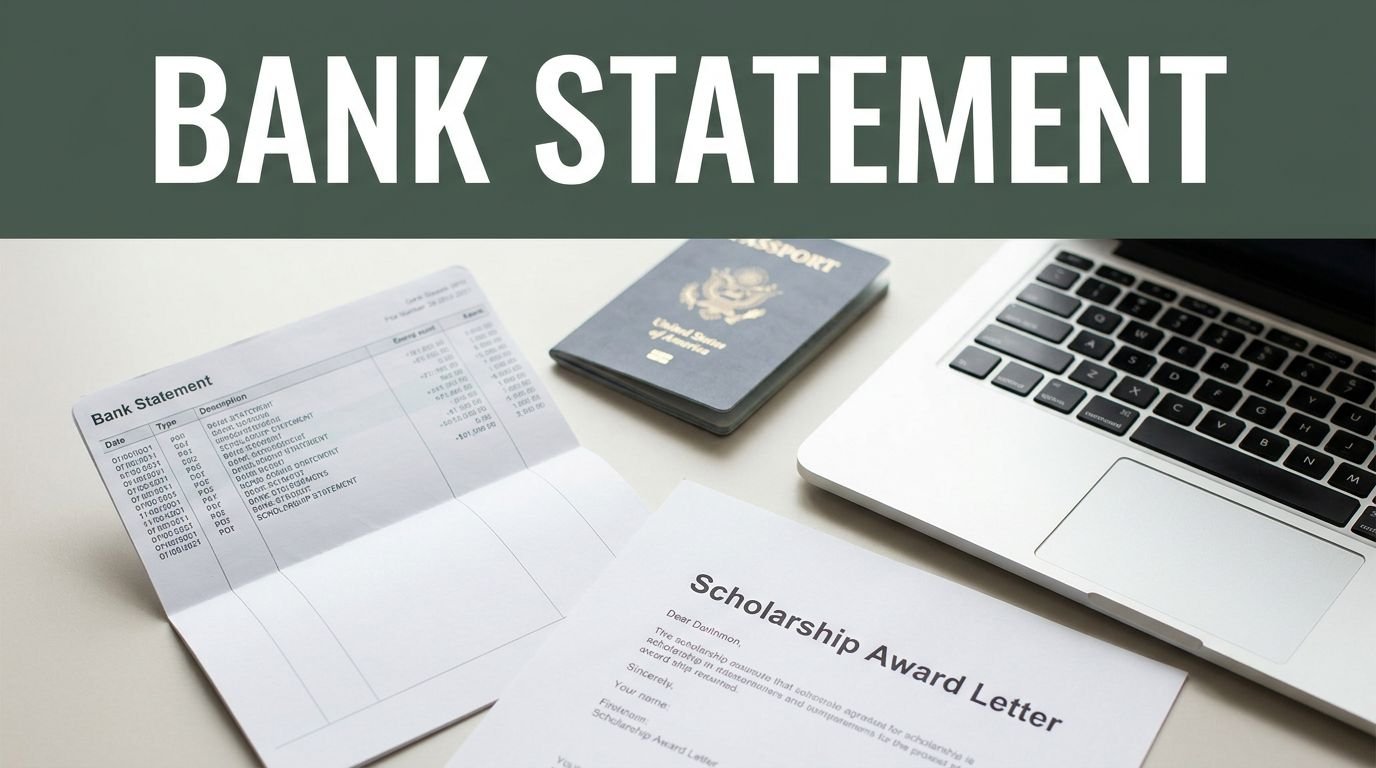
Applying for an international scholarship involves more than submitting grades, essays, and recommendation letters. Many universities, scholarship committees, and immigration offices also request financial documents to confirm that you can cover costs not paid by the award. A bank statement is one of the most common documents used for this purpose.
The exact Bank Statement Requirements for International Scholarship Applications depend on the university, scholarship provider, country, degree level, and funding package. Some organizations request a recent account statement, while others require a separate bank certificate, sponsor letter, or proof of funds for the full academic year. Understanding the usual requirements helps you prepare a complete application and avoid delays caused by missing or unclear financial records.
1. Check Whether a Bank Statement Is Required
Not every scholarship application requires a bank statement. A fully funded scholarship may cover tuition, housing, meals, health insurance, travel, and a monthly allowance, so the provider might not request personal financial records. A partial scholarship usually has different requirements because you may need to prove that you can pay the remaining costs.
You may also need financial documents after receiving a scholarship offer. A university can accept your scholarship application without a bank statement, then request proof of funds before issuing an enrollment certificate, admission confirmation, or immigration document.
Read the financial section of the scholarship instructions carefully. Look for terms such as:
- Proof of financial support
- Proof of funds
- Bank certificate
- Bank statement
- Financial guarantee
- Sponsor declaration
- Evidence of sufficient funds
- Cost-of-attendance documentation
- Funding confirmation
The application form may also ask who will pay your expenses. Your answer can affect the documents you need. A self-funded student may submit a personal bank statement. A student supported by parents may need a parent’s bank statement and a signed sponsorship letter. A government-sponsored student may need an official funding certificate instead of a personal account record.
2. Include the Account Holder’s Full Legal Name
The account holder’s name must be easy to identify on the bank statement. It should match the name on your passport, scholarship application, admission documents, and other financial records.
Small differences can create questions. For example, a passport may show “Maria Elena Santos,” while the bank statement shows “Maria E. Santos.” Some institutions accept common abbreviations, but others may request an explanation or additional identity document.
If the account belongs to a parent, guardian, spouse, employer, or government sponsor, your application should clearly explain that relationship. A statement in another person’s name usually needs a supporting document, such as:
- A signed affidavit of financial support
- A sponsorship letter
- Proof of relationship
- A copy of the sponsor’s passport or national identity card
- A birth certificate for parent sponsorship
- A marriage certificate for spouse sponsorship
- An employer funding letter for corporate sponsorship
Joint accounts can also create questions. If your name appears on the statement with another account holder, the university may request written confirmation that you can use the funds for education. Some institutions accept joint accounts automatically, while others require a separate consent form from the other account holder.
3. Use an Official Bank Statement or Bank Certificate
A bank statement should come directly from the financial institution. It normally includes the bank’s name, logo, account details, transaction information, balance, and statement period. A bank certificate is often shorter and confirms facts such as the account holder’s name, account type, opening date, and current balance.
The document should appear on official bank letterhead or use the bank’s approved electronic format. A typed document created by the applicant isn’t a substitute for a bank-issued record. Screenshots from a mobile banking application may also be rejected because they don’t show enough information to verify the account.
Some banks provide an account balance letter instead of a traditional statement. This letter can meet the requirement if it includes the required information and is signed, stamped, or digitally authenticated by the bank. The wording matters, so the letter should clearly identify the account holder and confirm the available balance.
When instructions mention a “bank statement,” don’t assume that a bank balance screenshot will be accepted. A formal statement or certificate has a stronger chance of meeting document standards because it includes institutional details and an identifiable issue date.
4. Include the Bank’s Contact Information
A complete bank statement usually includes enough information for the scholarship office to verify the document. Common contact details include the bank’s name, branch address, telephone number, website, and official email address.
The bank’s contact information should be printed on the document or included in the official letterhead. A personal email address or an unverified telephone number isn’t suitable for institutional verification.
The statement may also show:
- Branch name and location
- Customer service telephone number
- Bank identification number
- SWIFT or BIC code
- Official website
- Name and position of the authorized bank employee
Not every statement includes all of these details. A SWIFT code is more common in international transfers than in ordinary statements, so its absence doesn’t automatically make a document invalid. The main requirement is that the bank can be identified and contacted through an official channel.
If a bank uses a central verification department, the statement may list that department instead of the local branch. That arrangement is common for online banks and large financial institutions.
5. Check the Statement Date and Validity Period
Most universities want recent financial documents. A common rule is that the statement must be issued within the last three months, although some institutions require a document issued within 30 days. The correct period is always the one stated by the scholarship provider or university.
A statement can show a healthy balance and still be rejected if it’s too old. This often happens when students request financial records early, then submit them months later with an application.
Check these dates before uploading the document:
- Statement issue date
- Statement period
- Date of the latest balance
- Date of the bank official’s signature
- Date of notarization, if required
A statement covering several months may be useful when the institution wants to review account activity. A single-date bank certificate may be enough when the institution only wants proof of the current balance. These are different documents, so read the instructions instead of submitting one in place of the other.
If your financial situation changes before enrollment, the university may request an updated statement. This is common when an admission offer is conditional on proof of funds or when the visa application occurs several months after the scholarship decision.
6. Show the Current Balance in a Recognized Currency
The current balance must be clear and readable. The statement should identify the currency using a symbol, currency code, or written description, such as USD, EUR, GBP, CAD, AUD, or the relevant local currency.
If your account is held in local currency, the university may ask for a conversion into its preferred currency. Don’t replace the original local-currency amount with a personal calculation. Submit the original statement and include a separate conversion where the institution permits it.
Exchange rates change, so the converted amount can vary between the date of the statement and the date of review. Many universities use their own exchange rate or accept a recognized financial source for conversion. The application instructions may specify whether the required amount must be shown in US dollars, euros, or the destination country’s currency.
A multi-currency account can produce more than one balance. Each currency should be identified clearly. If the bank statement combines the balances, the document should show how the total was calculated.
The balance should be available for education-related expenses. A fixed deposit, retirement account, property holding, or investment portfolio may not count as liquid funds unless the institution specifically accepts it. Financial documents need to show not only the amount you own, but also whether you can access the money when tuition and living expenses are due.
7. Compare the Balance With the Required Funding Amount
The required amount is usually based on the costs that remain after scholarships, grants, assistantships, or other confirmed funding are deducted. The calculation can include:
- Tuition and mandatory university fees
- Housing
- Food and daily living costs
- Health insurance
- Books and academic materials
- Local transportation
- International travel
- Student fees
- Costs for accompanying family members
Start with the official cost of attendance published by the university or scholarship provider. A general estimate from a blog or a search result may not match the amount used by the admissions or immigration office.
For example, if the annual cost of attendance is $32,000 and your confirmed scholarship covers $24,000, the remaining amount may be $8,000. A university can still require proof for the full amount if its policy treats the scholarship as conditional or if the award doesn’t cover every listed expense.
The required period also matters. Some institutions ask for one academic year of funding. Others request proof for the full program, especially when the degree is short or the scholarship doesn’t provide full financial support.
A bank statement doesn’t always need to show the entire cost of a multi-year program. Many schools ask for the first year only, then require renewed financial evidence later. The application instructions should state whether the required amount is monthly, annual, or for the complete program.
8. Understand the Difference Between Liquid Assets and Other Property
A bank account balance is usually accepted because cash in an ordinary savings or checking account can be accessed relatively quickly. The same isn’t always true for other assets.
Liquid assets often include:
- Checking account funds
- Savings account funds
- Certificates of deposit that can be withdrawn
- Fixed deposits accepted under the institution’s policy
- Government savings instruments with clear withdrawal terms
Assets that may require additional proof include:
- Real estate
- Land
- Vehicles
- Business ownership
- Retirement funds
- Stocks and mutual funds
- Cryptocurrency
- Long-term investments
- Loans that have been approved but not disbursed
A property valuation doesn’t prove that you have money available for tuition. It shows ownership and estimated value, but selling property can take time and may not produce the stated value.
Investment statements can support a financial application when the university accepts them. They may need to show the account holder’s name, current value, account type, and withdrawal conditions. Some institutions count only a percentage of investment value or exclude investments entirely.
The key distinction is access. A document should show that the funds are real, identifiable, and available during the period covered by the scholarship or enrollment requirement.
9. Meet Signature, Stamp, and Authentication Requirements
Some banks issue statements without a handwritten signature or physical stamp. This is common with electronic documents. Whether that format is accepted depends on the receiving institution.
A traditional paper statement may include:
- An authorized bank employee’s signature
- The employee’s name and job title
- A bank stamp or branch seal
- A document reference number
- A security watermark
- A printed issue date
A digital statement may include a verification code, QR code, electronic signature, secure PDF certificate, or online verification link. These features can be valid if the university accepts electronic documents.
Notarization isn’t automatically required for every bank statement. A scholarship provider may request notarization when the statement is in a foreign language, when a sponsor’s declaration is involved, or when the document will be used for immigration purposes. Other institutions accept a bank-issued document without a notary.
Don’t add a notary stamp to a document simply because it looks more official. Follow the exact instructions because some institutions want the bank’s stamp, while others want a certified translation or notarized copy. These are separate requirements.
10. Prepare Certified Translations When the Statement Isn’t in English
Many international universities accept financial documents only in English or in the official language of the destination country. A statement in another language may need a certified translation.
The translation should normally include:
- The complete text of the original statement
- Bank names and account details
- Account holder’s name
- Currency and balance
- Statement dates
- Translator’s certification
- Translator’s name and contact information
- Translation date
- Signature or professional seal, where required
Don’t translate only the balance and leave the rest of the document in the original language unless the university permits partial translations. Reviewers may need to verify the account holder, bank, dates, and document type.
A certified translator is different from a friend, family member, or general language service. Some institutions accept translations completed by a professional translator, while others require certification by a government-authorized translator, notary, embassy, or approved translation agency.
Submit the original statement and the translation together. If the university portal allows only one upload, combine the files into one PDF in the order requested by the institution.
11. Document Sponsorship by Parents, Guardians, Employers, or Governments
A scholarship committee needs to understand who owns the money and who will pay your expenses. A sponsor’s bank statement by itself may not explain that relationship.
Parent or guardian sponsorship often includes a signed sponsorship letter, proof of family relationship, and a copy of the sponsor’s identity document. The letter can state the sponsor’s full name, relationship to you, amount of support, period of support, and signature.
Employer sponsorship may require:
- An official company funding letter
- Company letterhead
- The sponsor’s job title
- The amount and duration of financial support
- Confirmation that the company will pay tuition or living costs
- Business registration documents, where required
- The authorized signatory’s contact information
Government sponsorship usually relies on an official award letter or financial guarantee from a ministry, scholarship agency, embassy, or public institution. The letter should state the expenses covered and the period of funding. A personal bank statement may not be needed when the government document covers the full requirement.
If your scholarship pays only tuition, your sponsor may still need to prove funds for housing, food, insurance, travel, and other expenses. The financial package should show how every required cost will be covered.
12. Explain Large Deposits and Unusual Account Activity
Some institutions review transaction history, not just the closing balance. They may look for unexplained deposits that appear shortly before the application date.
A large recent deposit isn’t automatically a problem. It can come from a salary payment, property sale, education loan, matured investment, business payment, or family transfer. The issue is whether the source can be explained and documented.
Supporting records can include:
- Sale agreement and payment confirmation
- Salary slips
- Tax records
- Loan approval letter
- Investment maturity statement
- Business income records
- Transfer confirmation
- Sponsor declaration
- Inheritance documentation
A statement with a stable balance over several months may be easier for a reviewer to understand than a single statement showing a sudden increase. Some universities request three to six months of transaction history for this reason.
Don’t alter, crop, edit, or combine bank records in a way that changes the original information. Financial documents can be verified directly with the bank, and inconsistent details can cause a delay or rejection.
13. Follow the Correct Format for Physical and Digital Submission
A scholarship portal may require a PDF, while an embassy or university office may request original paper documents. The submission format is part of the document requirement.
For a digital upload, check the following:
- The PDF opens correctly
- Every page is included
- Text is readable at normal size
- The file meets the portal’s size limit
- The file name is clear
- Pages appear in the correct order
- No personal information is cut off
- Password protection is removed unless requested
- The document hasn’t been edited after issuance
A useful file name can include your surname, document type, and issue date, such as Santos_BankStatement_2025-03-15.pdf. Follow the university’s naming instructions if it provides them.
For physical submission, the office may request an original, a certified copy, or a color photocopy. A scanned copy isn’t always accepted for visa processing or final enrollment. Keep the document flat, clean, and complete, with all pages attached.
Avoid black-and-white scans when the bank stamp, watermark, or security feature is difficult to see without color. A blurry or cropped scan can make a genuine document appear incomplete.
14. Review Common Reasons for Rejection
Bank statements are often rejected for simple document problems rather than an insufficient balance. Common issues include:
- The account holder’s name doesn’t match the application
- The statement is outside the required date range
- The balance is below the stated amount
- The currency isn’t identified
- The bank cannot be verified
- The document is missing a page
- A translation isn’t certified
- The statement is a screenshot
- A sponsor’s relationship isn’t documented
- A joint account lacks permission evidence
- The document appears edited
- A required stamp or signature is missing
- The file format doesn’t meet portal rules
A business account can also cause questions when the application is for personal study. Business funds may not be treated as personal funds unless you provide evidence that the money can legally be used for your education.
An account with a restricted balance may not meet a proof-of-funds requirement either. Funds held under a legal restriction, loan condition, withdrawal penalty, or investment lock-in period may need separate documentation.
15. Confirm the Requirement With the Correct University Office
Scholarship instructions, admission instructions, and visa instructions can use different financial standards. The scholarship office may ask for a sponsor letter, while the admissions office asks for a bank certificate. The immigration authority may apply its own balance and validity rules.
The correct contact depends on the question:
- Scholarship funding questions usually go to the scholarship office
- Enrollment and tuition questions usually go to admissions or student finance
- Visa proof-of-funds questions usually go to the international student office or immigration authority
- Payment questions usually go to the university billing office
Ask about the exact document type, required balance, accepted currencies, statement age, sponsor rules, translation rules, and submission format. Written confirmation can help when instructions are unclear or appear to conflict.
Pending deposits may not count as available funds. A bank statement issued before a transfer clears can show a lower balance than expected, while a statement issued after the deposit may not explain where the money came from. Universities can also request an updated document if the original proof doesn’t cover the enrollment date.
If you need a waiver because funds are held in a fixed deposit, education loan, government payment cycle, or scholarship disbursement schedule, the university may request supplementary proof. This can include a loan approval letter, scholarship award letter, maturity date, or official payment confirmation.
16. Use a Final Bank Statement Checklist
Before submitting your financial documents, check each item against the scholarship instructions. A short review can catch details that are easy to miss after completing a long application.
Your bank statement file should usually include:
- Your full legal name or the sponsor’s full legal name
- A clear bank name and official letterhead
- Account number or permitted identifying details
- Current balance
- Currency
- Issue date
- Statement period, if required
- Bank contact information
- Signature, stamp, or electronic verification feature
- Certified translation, if required
- Sponsor letter, if the account isn’t in your name
- Proof of relationship, if applicable
- Additional funding documents, if the balance doesn’t cover the full amount
Your complete financial file may also include:
- Passport identity page
- Scholarship award letter
- Tuition invoice or cost-of-attendance page
- Affidavit of support
- Employer or government sponsorship letter
- Investment or loan documents
- Health insurance proof
- Documents for accompanying dependents
Keep copies of everything you submit. Save the original PDF, translated version, signed letters, and confirmation emails in one folder. If the university asks for an updated statement, you’ll have a clear record of what was submitted before.
17. Understand Key Financial Terms
The language used in scholarship applications can be confusing, especially when one institution uses “bank certificate” and another uses “financial statement” for different documents.
A bank statement is a record of account activity and balances over a stated period. It can show deposits, withdrawals, account numbers, and the closing balance.
A bank certificate or bank letter is a formal document issued by a bank to confirm account ownership, balance, account opening date, or financial status.
Liquid assets are funds that can normally be accessed and used without selling property or waiting for a long investment term.
Cost of attendance, often shortened to COA, is the estimated total cost of studying for a defined period. It can include tuition, housing, food, transportation, insurance, books, and personal expenses.
An affidavit of support is a signed statement in which a sponsor confirms financial responsibility for a student’s expenses. It may need notarization, depending on the institution and country.
A financial guarantee is an official promise by a government, organization, employer, or sponsor to pay specified education costs.
A certified translation is a translation accompanied by a professional declaration that it accurately reflects the original document.
Knowing these terms helps you compare the scholarship instructions with the documents your bank can issue. It also reduces the chance of uploading a bank balance screenshot when the university actually requested a formal statement.
18. Keep Your Financial Documents Consistent
The strongest application files tell the same financial story across every document. The names, dates, amounts, sponsor details, and funding periods should match wherever they appear.
For example, if your sponsor letter says a parent will pay $15,000 for one academic year, the bank statement should show enough available funds for that commitment. If your scholarship award letter covers tuition only, another document should address living expenses if those costs are part of the required proof.
Check that your passport, application form, bank statement, sponsorship letter, and translated documents use consistent spellings. If your name changed or appears differently because of local naming conventions, include the official document that explains the difference.
Consistency doesn’t mean every document must show the same number. A scholarship may cover tuition, a sponsor may cover living costs, and a personal account may show travel funds. Each amount should have a clear purpose and fit the total funding plan described in your application.
Conclusion
The main Bank Statement Requirements for International Scholarship Applications are clear account ownership, a recent issue date, an identifiable bank, a readable balance, a stated currency, and enough available funds for the costs the scholarship doesn’t cover. Sponsorship letters, certified translations, authentication, and additional financial records may be required when the account belongs to someone else or when the bank statement doesn’t cover the full funding requirement.
Requirements vary by scholarship provider, university, country, and immigration office. Use the official instructions as the final standard, then compare every page of your bank statement with the requested name, date, amount, format, language, and verification details. A complete financial file gives the reviewer a direct answer to one question: who will pay for your education, and where is the money available?
This post may contain affiliate links. If you make a purchase through these links, I may earn a small commission at no extra cost to you.