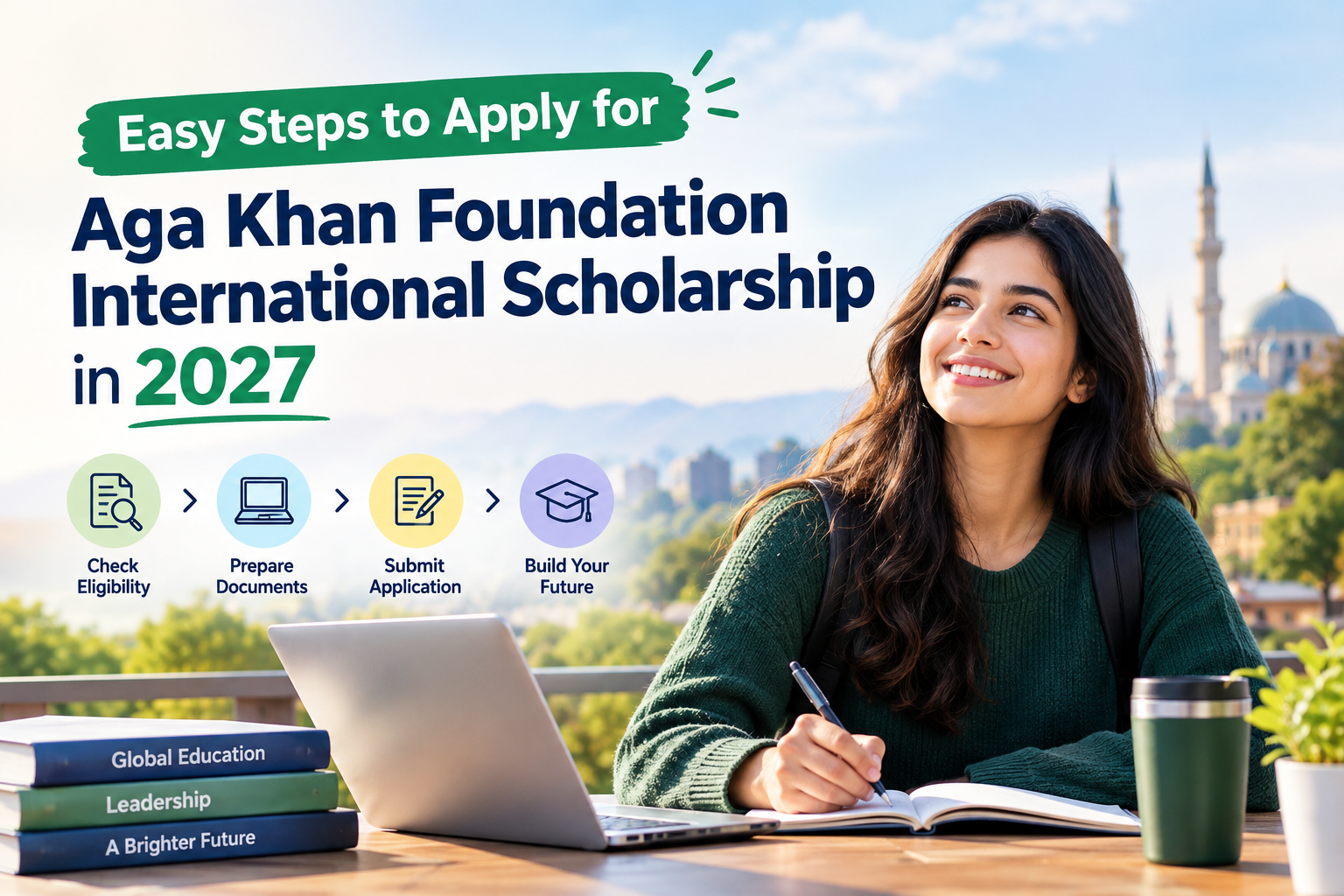
If you are looking for an international scholarship that can help you pay for a postgraduate degree, the Aga Khan Foundation International Scholarship is one opportunity worth understanding as the application cycle for 2027–2028 opens.
But there is an important detail many scholarship articles fail to explain clearly about this scholarship: it is not simply a “fully funded scholarship” that pays every expense without conditions.
The Aga Khan Foundation International Scholarship Programme provides support for postgraduate study, with awards structured as 50% grant and 50% loan. It can cover tuition and living expenses, but the loan portion must eventually be repaid under defined conditions.
Understanding that distinction matters so much as an international student.
If you are considering applying for the Aga Khan Foundation International Scholarship for 2027-2028, this guide will walk you through who can apply, what the scholarship covers, the countries currently eligible, Master’s and PhD requirements, the application process, and what you should do before the next application window opens.
What Is the Aga Khan Foundation International Scholarship?
- Funding Type: 50% grant + 50% loan
- Study Level: Master’s & PhD
- Location: Reputable postgraduate institutions in the US
The Aga Khan Foundation International Scholarship Programme is designed to help outstanding students from selected countries pursue postgraduate education when they do not have sufficient financial resources to fund their studies.
It is particularly relevant to students planning a Master’s degree, although the Foundation also considers applications for PhD study.
The scholarship is competitive and is not intended simply for anyone who wants financial assistance.
Applicants are expected to demonstrate several things, including:
- Strong academic performance
- Genuine financial need
- Admission to a reputable postgraduate institution
- Leadership potential
- Professional, extracurricular, entrepreneurial or volunteer achievements
- A realistic plan for financing the entire period of study
The Foundation also describes the scholarship as a resource of last resort, meaning applicants are expected to explore and secure other sources of funding where possible.
The programme was established in 1969 and has supported more than 1,500 students according to the current official AKDN scholarship page.
Is the Aga Khan Foundation Scholarship Fully Funded?
This is probably the most important question to answer before you apply.
Not in the conventional sense of a 100% grant.
The Aga Khan Foundation structures its awards as:
50% grant + 50% loan.
The scholarship can cover tuition expenses and student living expenses, but approximately half of the award is provided as a loan that must be repaid according to the programme’s terms. A guarantor is also required to co-sign the award agreement.
So, if you are searching specifically for a scholarship where none of the funding has to be repaid, do not treat the Aga Khan Foundation International Scholarship as equivalent to a full grant.
This distinction is worth remembering when comparing it with other international opportunities.
For example, students searching for graduate funding can also explore our guide on how to find free graduate scholarships abroad, which explains how to distinguish genuinely comprehensive funding from scholarships that cover only part of your total study costs.
What does the Aga Khan scholarship cover?
According to the official programme information, the award covers:
- Tuition expenses
- Student living expenses
However, it does not cover every expense connected with studying abroad.
The official programme specifically excludes costs such as:
- International travel
- Clothing
- Furniture
- Living expenses for family members
For PhD students, funding is provided for the first two years, after which students are expected to identify alternative sources of funding. Master’s scholarships can cover the full duration of the degree course, subject to the programme’s conditions.
This is why you should calculate your complete study budget before applying.
Who Can Apply for the Aga Khan Foundation Scholarship?
Eligibility is one of the areas you should check before spending weeks preparing an application.
The current official rules requires applicants to meet several conditions.
You generally need to:
1. Be from an eligible country
The scholarship is not open to every nationality.
The current AKDN scholarship page lists the following countries:
- Afghanistan
- Australia
- Bangladesh
- Egypt
- India
- Kenya
- Kyrgyz Republic
- Madagascar
- Mozambique
- New Zealand
- Pakistan
- Syria
- Tajikistan
- Tanzania
- Uganda
For applicants in countries such as Canada, Portugal and the United States, applications are accepted from people originally from one of the countries listed by the programme. The current programme information also states that the scholarship is not available to students who wish to study in the United Kingdom or Russia.
2. Have a strong academic record
The Foundation expects applicants to demonstrate excellent academic performance.
Your academic record is therefore not something to treat as a minor part of the application.
Before applying, gather your transcripts, degree certificates and other academic documentation so you can clearly demonstrate your previous academic performance.
3. Hold a Bachelor’s degree or equivalent
Applicants must have a Bachelor’s degree or equivalent training or professional experience.
The scholarship is designed for postgraduate study, so you should already have the academic background necessary to enter your intended postgraduate programme.
4. Demonstrate genuine financial need
Financial need is central to Aga Khan International Scholarship
The Foundation does not simply ask whether you would prefer to receive funding.
You need to demonstrate that you genuinely require financial assistance to pursue the programme.
The Foundation also expects applicants to develop a multi-source funding plan covering the years of study.
5. Have admission to a reputable postgraduate institution
You must be admitted to a reputable postgraduate institution that is approved for the Aga Khan Scholarships.
This is an important point because the scholarship application should not be viewed as a substitute for university admission.
You need to think about both processes:
University admission + scholarship funding
Do not assume that receiving the scholarship automatically means you will be admitted to a university.
6. Be starting the first year of your postgraduate programme
The scholarship is intended for students entering the first year of postgraduate study.
If you have already started your postgraduate degree, you are not eligible under the current rules.
7. Show leadership and achievement beyond grades
The Foundation also considers:
- Leadership potential
- Professional experience
- Extracurricular achievements
- Entrepreneurial achievements
- Volunteer contributions
This means your application should not read like a transcript with a personal statement attached.
Think about what you have actually done with your education, skills and opportunities.
If you’re considering the United States can also explore the Fulbright Program for Foreign Students, another major international postgraduate funding programme.
Does the Aga Khan Foundation Scholarship Fund Master’s Degrees?
Yes. Master’s degrees receive priority under the current scholarship rules. The Foundation states that the AKF ISP gives priority to Master’s degree.
The scholarship can support study at reputable postgraduate institutions, and local or regional universities and distance-learning programmes may also be considered where the quality of the scholarship is maintained.
However, part-time programmes and short-term courses are not considered under the current rules.
If you are targeting a Master’s degree for the 2027–2028 application cycle, this makes the scholarship particularly relevant to include in your scholarship research list.
Can PhD Students Apply?
Yes, PhD applicants can be considered, but the scholarship gives priority to Master’s study.
There is another important difference.
For Master’s students, the scholarship can cover the duration of the degree, subject to the award conditions.
For PhD students, the Foundation states that awards are provided for the first two years, after which the student is expected to secure other funding.
If you are preparing for a PhD, do not build your entire financial plan around the assumption that the Aga Khan award will fund your doctorate from beginning to end.
Instead, identify additional funding sources early.
What Does the Aga Khan Foundation Look for in Applicants?
A strong application needs more than good grades to get awarded.
The current eligibility criteria point toward a combination of:
Academic strength + financial need + leadership + experience + realistic funding planning.
That means you should be prepared to explain:
- What you studied
- What you want to study next
- Why the postgraduate programme matters
- What you have achieved so far
- How you have demonstrated leadership
- How your professional or community experience shaped your goals
- Why you require financial assistance
- What other funding sources you have explored
- How you intend to finance any remaining costs
The Foundation’s emphasis on a multi-source funding plan is especially important.
Rather than presenting the scholarship as your only possible source of money, demonstrate that you have seriously investigated other funding options.
How to Apply for the Aga Khan Foundation International Scholarship 2027-2028
The application process is not simply a matter of completing one universal application form and submitting it to a central scholarship portal.
Applications are handled through contacts in countries where the programme operates.
The current official process directs prospective applicants to use the eligibility tool to establish whether they qualify and learn how to contact the relevant local team.
Step 1: Check your eligibility
Start with the official AKDN eligibility information.
Do not begin by writing your personal statement.
First establish:
- Whether your country is eligible
- Whether your degree level is eligible
- Whether your programme qualifies
- Whether you are entering your first year
- Whether you meet the financial-need requirements
- Whether you have or can obtain admission to a suitable institution
Step 2: Identify your postgraduate programme
Know exactly what you intend to study.
You should have a clear idea of:
- University
- Degree
- Field of study
- Programme duration
- Tuition cost
- Living costs
- Start date
- Other available funding
This will make your funding plan much more credible.
Step 3: Apply for university admission
If your target university requires a separate admission application, handle that process early.
Do not wait until the scholarship deadline to discover that the university requires additional documents, references or tests.
Step 4: Build your funding plan
This is especially important for AKF ISP.
Calculate:
Tuition + living expenses + other essential costs − confirmed funding = remaining financial need
Then identify other potential funding sources.
Your goal should be to show that you understand exactly how much money your postgraduate education will require.
Step 5: Prepare your supporting documents
Start assembling your documents well before the application window opens.
Depending on the application instructions for your cycle and local office, you may need documents such as:
- Academic transcripts
- Degree certificate
- University admission documentation
- CV
- Personal statement
- Recommendation letters
- Evidence of professional experience
- Evidence of financial circumstances
- Details of other funding sources
- Programme information
- Identification documents
The exact 2027–2028 requirements should be checked against the official application instructions once the new cycle opens.
Step 6: Contact the relevant local AKF team
The Foundation’s application process is administered through local contacts in eligible countries.
Use the official eligibility process to identify the relevant contact rather than relying on an unofficial email address found on social media or an old scholarship post.
Step 7: Submit before the official deadline
The 2027–2028 deadline has not yet been officially published on the current AKDN page.
The 2026–2027 cycle closed on March 31, 2026. However, you should wait for the official 2027–2028 announcement and follow the deadline and local instructions published for their application location.
Do not rely on an old deadline simply because the date appears on another scholarship website.
When Will the Aga Khan Foundation Scholarship 2027-2028 Open?
The official Aga Khan Development Network currently says that the next application cycle will open in early 2027.
That means you have an important preparation window before applications open.
Rather than waiting until January or February to start everything, use the months before the opening to:
- Research postgraduate programmes.
- Check admission requirements.
- Prepare your academic documents.
- Update your CV.
- Identify potential referees.
- Calculate tuition and living costs.
- Research alternative funding.
- Prepare your personal statement framework.
- Check the official AKDN page regularly.
- Create a deadline tracker.
This is particularly useful because scholarship applications often become stressful when applicants attempt to collect every document at the same time.
If you’re interested in Canada, our guide to university scholarships for international students in Canada can help you investigate other university-based funding opportunities.
FAQs About the Aga Khan Foundation International Scholarship
Is the Aga Khan Foundation International Scholarship fully funded?
It provides substantial postgraduate financial support, including tuition and living expenses, but the award is structured as 50% grant and 50% loan. Therefore, it should not be treated as a 100% non-repayable scholarship.
When will the Aga Khan Foundation Scholarship 2027-2028 open?
The official AKDN page currently says that the next application cycle will open in early 2027. The exact 2027–2028 opening date should be confirmed when the Foundation publishes the new cycle.
What is the deadline for the Aga Khan Foundation Scholarship 2027-2028?
The official 2027–2028 deadline has not yet been published on the current AKDN scholarship page. The previous 2026–2027 cycle closed on March 31, 2026, but applicants should verify the new cycle’s official deadline rather than assuming the previous date will automatically apply.
Does the Aga Khan scholarship cover Master’s degrees?
Yes. The scholarship gives priority to Master’s degree and can provide funding for the duration of the degree, subject to the award conditions.
Does the Aga Khan scholarship cover travel expenses?
No. The current programme specifically states that international travel is not covered.
Is the scholarship available to students from every country?
No. The programme is limited to selected countries, with additional rules for applicants originally from eligible countries who are living in places such as Canada, Portugal or the United States.
Is there an age preference?
Yes. The Foundation states that preference is given to young professionals under 30, although the published eligibility criteria are broader than simply being under 30.
Keep This in Mind While Applying
The Aga Khan Foundation International Scholarship 2027-2028 is an opportunity that deserves serious attention from eligible postgraduate applicants, but it also deserves a careful reading of the fine print.
The most important things to remember are these:
- The programme supports postgraduate education.
- Master’s programmes receive priority.
- PhD applications can also be considered.
- Applicants need genuine financial need.
- Admission to a reputable postgraduate institution is required.
- Leadership, professional and community experience matter.
- The award is structured as 50% grant and 50% loan.
- Tuition and living expenses can be covered under the award.
- Some costs, including international travel and family expenses, are excluded.
- The current 2026–2027 cycle is closed.
- The next cycle is expected to open in early 2027.
- Exact 2027–2028 dates should be confirmed from the official announcement.
Most importantly, start preparing before the application window opens.
If you already know the degree you want, the university you want to attend and the financial gap you need to close, you are in a much better position to respond when the 2027–2028 application cycle officially opens.
And if the Aga Khan Foundation scholarship does not completely meet your funding needs, do not stop there. Continue building a wider scholarship portfolio and compare it with other international, government and university-funded opportunities.
The goal is not simply to find one scholarship. It is to find the funding combination that makes your postgraduate study financially realistic.
Official programme: Aga Khan Foundation International Scholarship Programme — official AKDN page