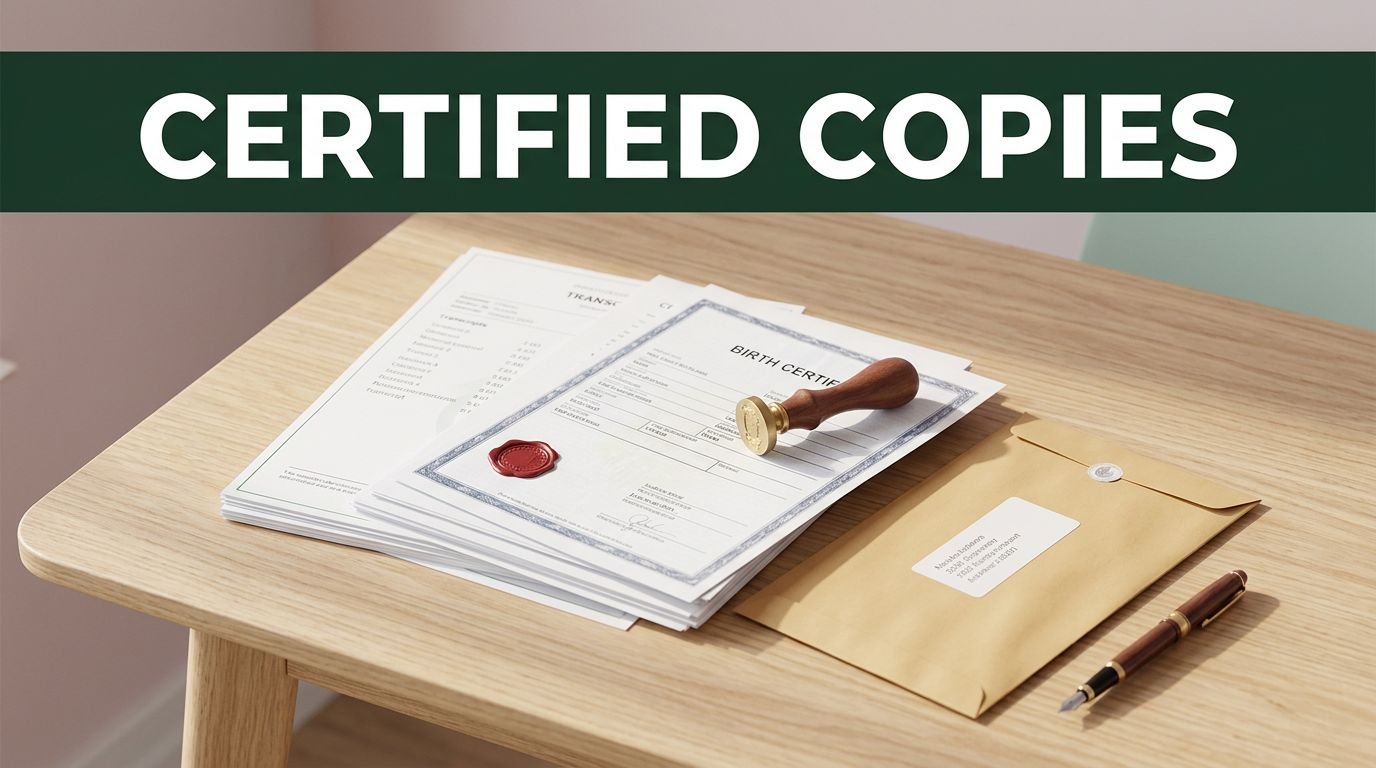
You can lose a scholarship deadline to one missing stamp. That happens more often than you’d think, especially when a school asks for a transcript, ID, or birth record that has to be a certified copy.
When people search for certified copies scholarship applications, they usually want the same answer: who can issue each document, what format counts, and how fast you can get it. If you know where each paper comes from, you save time and avoid sending something that gets bounced back.
Let’s walk through the documents that matter, who should certify them, and the mistakes that trip people up.
Key Takeaways
- Transcripts usually come from the school registrar, not a notary.
- Birth records, citizenship papers, and other government records usually come from the issuing office.
- Scholarship instructions can be picky about sealed envelopes, mailed copies, or authentication.
- International applications may need translation, apostille, or authentication before you submit anything.
- The fastest path is to start with the original custodian of the document.
Know Which Documents Need Official Copies
A certified copy is not just a clean photocopy. It is a copy that the right office says matches the original. For scholarship applications, that usually means proof of education, identity, or legal status.
A quick map helps before you start calling offices.
Document |
Usually issued by |
What to watch for |
|---|---|---|
Academic transcript |
School registrar or records office |
Some schools send it sealed; others mail it directly |
Diploma or degree certificate |
Issuing school |
Ask whether they can certify a copy while the original stays on file |
Birth certificate |
State or county vital records office |
A regular photocopy usually won’t work |
Passport or travel document |
Issuing government office |
Some applications ask for a certified true copy |
Naturalization or citizenship record |
USCIS |
Notaries usually can’t certify it |
If you start with the original custodian, you usually avoid the biggest delay. A notary is not the first stop for transcripts, and for some records, notaries can’t help at all.
For a plain-English breakdown of copy certification rules, the National Notary Association has a helpful guide on how to certify a copy.
Where the Right Office Matters Most
The safest rule is simple: school records come from the school, government records come from the government, and notaries are not a substitute when an official custodian exists.
Academic transcripts are the easiest example. Your school’s registrar or records office usually handles them, and many scholarship programs want them in a sealed envelope. The American Library Association scholarship program is a good example, because it asks for official academic transcripts from your degree-granting schools, not a casual scan attached to an email.
Birth certificates, marriage records, and similar vital records go through the state or county vital records office. If you need a passport copy or travel document copy for an overseas program, many offices ask for a certified true copy, not a standard photocopy. The Government of Canada’s page on certified true copies shows the kind of request some organizations make.
USCIS handles certified copies for naturalization and citizenship records. That matters because these papers often show up in scholarship files for students who need proof of nationality or legal status. If your application includes one of these documents, treat the issuing office as your first stop.
A notary can sometimes help with copy certification, but the rules are narrow and state-specific. The National Notary Association’s guidance makes clear that copy certification is not a free-for-all. If an official issuer exists, that issuer usually wins. That is why a notary stamp on a transcript is usually the wrong answer.
How to Request Certified Copies Without Delays
Getting the right copy is mostly about order. If you rush the steps, you usually pay twice, once in fees and once in lost time.
- Read the scholarship instructions line by line. Look for words like “official transcript,” “sealed envelope,” “certified copy,” or “authenticated document.” Those phrases are not interchangeable.
- Contact the office that issued the record. Ask for the exact version they provide, whether that’s a sealed transcript, a certified true copy, or a mailed official record.
- Confirm the delivery method before you pay. Some offices hand you the copy, some mail it, and some send it only to the scholarship provider.
- Check your name and date of birth. If your ID says one name and your school record says another, fix the mismatch early.
- Ask about processing time and backup options. A same-week request can turn into a two-week wait, especially near deadline season.
- Keep a spare copy and the receipt. If the first copy gets lost, you’ll be glad you didn’t bet everything on one envelope.
Some offices are strict about format. The ALA scholarship program is a good reminder, because it wants official transcripts in a sealed envelope. That’s the kind of rule you can’t fix after the deadline.
If the portal accepts uploads, ask whether it wants a scan of the certified copy or a direct file from the issuing office. A blurry phone photo is not the same thing, and it often gets rejected.
If the office mails the copy directly, ask for tracking or confirmation. That small detail can save you from guessing whether the packet made it out.
Extra Rules for International Scholarship Applications
International forms can add one more layer, and that’s where people get stuck. A document may need to be certified, translated, apostilled, or authenticated. Those are different steps.
The U.S. State Department’s guide to authentication certificate requirements is a good reference when another country wants formal verification. It explains what your document should look like before you send it for authentication. If seals and signatures are required, keep them original.
Don’t ask someone to notarize the original record itself if the receiving office wants authentication. That can create a mess you don’t need.
If a scholarship office wants a translated document, ask whether it wants the translation notarized, the original copied, or both. Translation should be handled carefully, because you don’t want to alter the source document while you are still proving it is genuine.
An apostille is another step some countries use for public documents. If your scholarship asks for one, start early. It can take longer than a normal certified copy, especially if state and federal offices both need to touch the file.
For passport or travel document copies, the Government of Canada’s certified true copies page is a useful example of the language agencies use. It helps you see the difference between a casual copy and one that carries official weight.
If you are applying to a program like NHSC, the document list may include a birth certificate, passport ID page, or naturalization record. That is another reason to read the rules first, because the same paper can be treated differently across programs.
Common Mistakes That Slow You Down
- Sending a regular photocopy when the checklist asks for an official copy.
- Going to a notary first when the registrar or vital records office is the real source.
- Opening a sealed transcript envelope before the scholarship office sees it.
- Ignoring name mismatches across your ID, transcript, and application.
- Waiting until the final week to order documents that need mailing.
Most rejections don’t come from bad grades or weak essays. They come from paperwork that wasn’t quite right.
Conclusion
Certified copies are one of those small details that can make a big difference. Once you know who issued the document in the first place, the rest gets much easier.
Start with the registrar for school records, the vital records office for civil records, and the government office for identity or citizenship papers. Then check whether the scholarship wants a sealed envelope, a certified true copy, or an authenticated document before you send anything.
That habit saves time, lowers stress, and keeps your application moving when everyone else is scrambling.
This post may contain affiliate links. If you make a purchase through these links, I may earn a small commission at no extra cost to you.