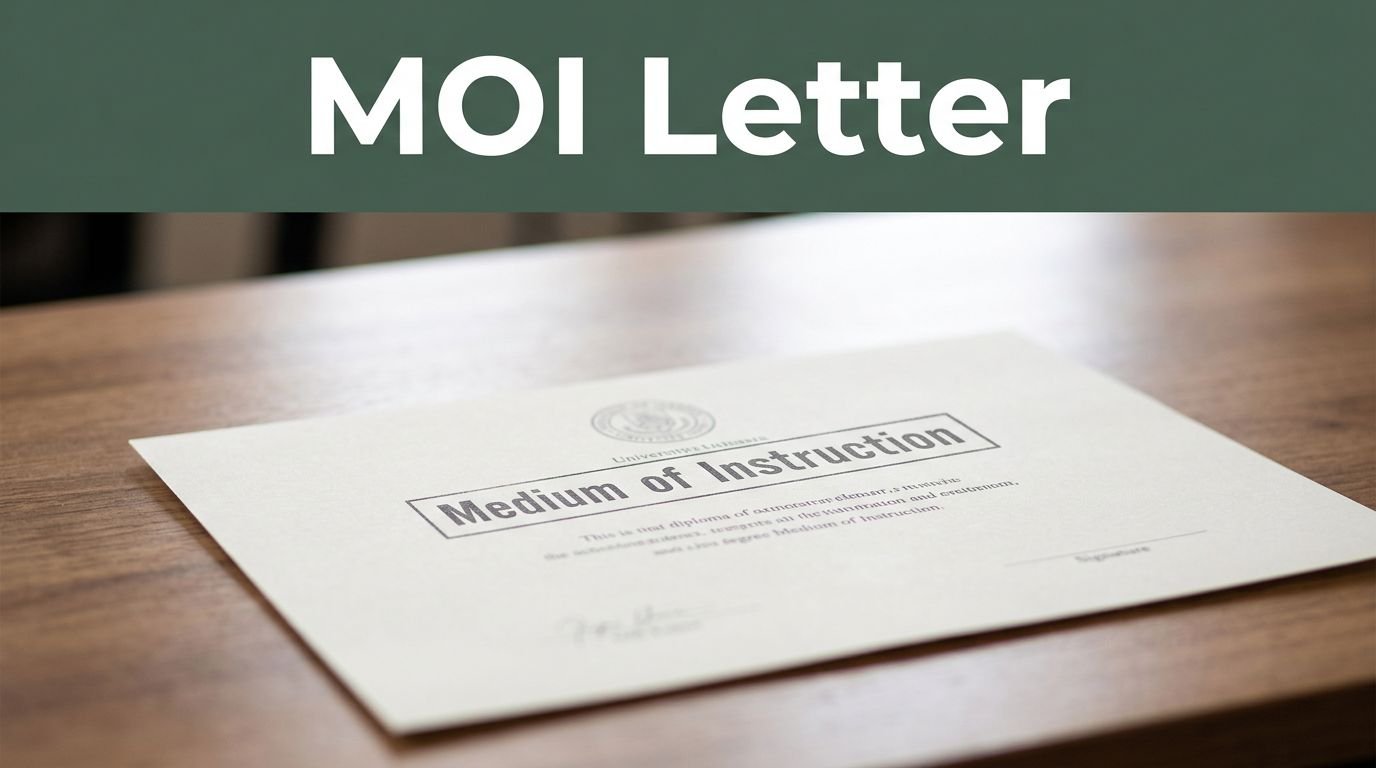
Your scholarship file can look complete and still stall on one small document: the medium of instruction letter. For students planning to study abroad, this letter is a vital component that provides official proof of English proficiency. By clearly documenting that your previous education was conducted in English, this certificate helps many applicants save IELTS exam fees and avoid the stress of additional testing.
The catch is simple. If the letter is vague, unsigned, or issued by the wrong office, the scholarship team may reject it. If you get the wording right, though, it can become one of the easiest parts of your application, effectively clearing a path toward your academic goals.
Key Takeaways
- An MOI certificate provides formal proof that your previous studies were conducted in English.
- Many scholarships accept this document as an IELTS waiver, allowing you to bypass standardized tests like TOEFL, PTE, or Duolingo.
- You can typically request this documentation from the university registrar, records office, or student affairs department.
- The document must be printed on official school letterhead, and it should be properly signed and stamped to ensure its authenticity.
- Always check the specific scholarship requirements first, because not every program accepts the same format for proof of English proficiency.
What a Medium of Instruction Letter Proves
This letter is not a personal statement. It does not explain your goals or ask for funding. It simply confirms a fact, specifically that the medium of instruction in English was utilized throughout your degree, program, or coursework.
That matters because scholarship offices want proof, not guesses. If your application asks for language evidence and you studied in English, this document can fill that gap. While some schools treat it as sufficient on its own, others require it alongside an official transcript or standardized tests like the TOEFL or IELTS. In many cases, it serves as a valuable English proficiency exemption, potentially saving you the time and cost of additional testing during your graduate program application.
If you want to see how this differs from an English proficiency certificate, this guide on English proficiency certificates makes the difference clear. If you are checking sample wording, this MOI overview gives a useful reference point too.

A good letter usually includes your name, program, attendance dates, and a statement that teaching and assessment were conducted in English. Some schools also mention the language of thesis writing or class instruction. If your scholarship has strict rules, that detail can matter more than you think.
Think of it like a passport stamp for your academic language history. It is short, official, and hard to argue with.
How to Request the Right Letter From Your School
To successfully apply for MOI documentation, start by identifying the office that handles official academic records. In many institutions, this is the registrar, the controller of examinations, or the student affairs office. If you are unsure where to direct your inquiry, contact the main administration desk to ask which department issues language verification letters. In some cases, your Head of Department may be authorized to sign these documents, so check your school policy first.
While some universities have moved to an automated online portal for document requests, others still require an offline process that involves filling out physical forms or submitting a formal letter. Regardless of the method, make your request clear. State specifically that you need a medium of instruction letter for a scholarship application and request that it be printed on official institutional letterhead with an ink signature and an official stamp.
Use a professional subject line that is easy for staff to scan, such as “Request for Medium of Instruction Letter for Scholarship Application.” Keep the email body concise, including your full name, student ID number, degree program, years of study, and current contact details.
Here is the standard order of operations to ensure your request is processed efficiently:
- Identify the correct administrative office, such as the registrar or the controller of examinations.
- Determine if the school uses an online portal or requires a manual offline process.
- Submit your request via email or through the official school form.
- Provide your full name, student number, program details, and exact dates of attendance.
- Mention the scholarship name if the office requires the document to be addressed to a specific entity.
- Ask for a signed original, plus a digital copy if you need the document immediately.
A clear request often yields a faster response. If you want more sample wording or formatting tips, this MOI certificate guide is a practical place to compare professional layouts.

If your school asks for supporting documentation, keep your materials ready. A copy of your ID, enrollment certificate, official transcript, or proof of graduation is often required. Additionally, be aware that some institutions charge a mandatory application fee for processing official documents, so inquire about potential costs before you follow up.
If the scholarship asks for proof of instruction language, do not send a generic enrollment letter and hope it passes. Always ensure your document explicitly states the language of instruction.
What to Check Before You Submit It
Before you upload any documentation, read your letter from the perspective of a reviewer. Does it explicitly state that English was the language of instruction? Is your name spelled exactly as it appears on your passport and scholarship application form? Does the issue date appear current and relevant to your studies?
Scholarship offices can be particular about documentation, and requirements for UK university admissions are often especially strict regarding the MOI certificate. To ensure your documentation meets all necessary standards, you might consider providing a sample MOI draft to your authorized school official. This can help them understand the specific phrasing required to verify your academic background effectively.
Use this quick comparison to keep your file clean:
Document |
What it proves |
Who usually issues it |
Why it matters |
|---|---|---|---|
Medium of instruction letter |
Your studies were taught in English |
Registrar or academic office |
Can replace language test proof |
Official transcript |
Courses and grades |
Registrar |
Shows your academic record |
Recommendation letter |
Your ability or character |
Teacher or professor |
Supports merit review |
English test score |
Standardized language result |
Test provider |
Needed when MOI is not accepted |
The main point is simple. One document does not replace every other requirement. If the scholarship asks for an official transcript and language proof, you must send both.
Also, check the format carefully. A proper letter should be on official school letterhead, carry a signature, and include an official stamp or seal. If the office provides a scanned copy first, ask whether they can provide a stamped original later. That small step can save you from a last-minute upload panic when you are nearing your deadline.
Mistakes That Slow Down Scholarship Review
A few problems show up again and again, and most of them are easy to avoid. The biggest issue is contacting the wrong administrative office. Another common pitfall is sending a letter that lacks the necessary formal appearance, which may lead reviewers to question its authenticity.
To ensure your application moves forward without unnecessary delays, avoid these common mistakes:
- Submitting a document that lacks a formal signature and stamp.
- Providing a letter that is not printed on official school letterhead.
- Neglecting to ensure the document explicitly states the medium of instruction in English.
- Relying on a standard official transcript alone when the program specifically mandates a separate medium of instruction letter.
- Using a self-made translation instead of an authorized version provided by your institution.
- Submitting a letter where your name does not exactly match your passport.
- Asking for a generic certificate when the scholarship requirements demand specific wording.
If your academic background includes more than one institution, collect a letter from each school that taught you in English. If part of your program was conducted in a different language, ask the registrar to state that clearly. Avoid guesswork, as it causes more processing delays than most students expect.
The safest habit is also the simplest one. Always read the scholarship instructions carefully before you request any documentation. If the online portal asks for a specific language document, upload the exact type of file it names. If the instructions state that the letter must be recent, do not upload an outdated copy from a previous year.

Frequently Asked Questions
Is a Medium of Instruction (MOI) letter the same as an English Proficiency Certificate?
While they are similar, they are not always identical. An MOI letter specifically confirms that your coursework was taught in English, whereas an English Proficiency Certificate is a broader document sometimes issued by schools to certify language competence for various international purposes.
Can I write my own MOI letter and have a professor sign it?
No, you should never write the letter yourself. It must be issued by an authorized university office—such as the registrar or student affairs—on official institutional letterhead to ensure it meets the authentication standards required by scholarship committees.
What should I do if my university refuses to provide an MOI letter?
First, ask if they provide a standard course completion certificate that mentions the language of instruction. If they still refuse, contact the scholarship committee to explain the situation and ask if they will accept an official transcript or a signed letter from your department head as alternative proof.
Does the MOI letter expire?
While these letters do not have an expiration date like standardized tests, many scholarships require proof to be dated within the last six to twelve months. Always check your specific program guidelines to see if they mandate a recently issued document.
Conclusion
A strong scholarship application does not need drama. It needs the right proof, in the right format, from the right office. That is exactly why a medium of instruction letter matters so much.
By providing an official MOI certificate, you effectively satisfy common English proficiency requirements without the need for additional standardized testing. If you ask early, check the wording, and confirm the university stamp before you upload, you remove one of the easiest reasons for application delays.
The process is simple once you know what the scholarship team is looking for. Be sure to use your school or organization’s online portal if it is available, as this allows you to track your graduate program application status in real time after you have submitted your documentation. When language proof is required, this small document can carry a lot of weight in your pursuit of funding.
This post may contain affiliate links. If you make a purchase through these links, I may earn a small commission at no extra cost to you.