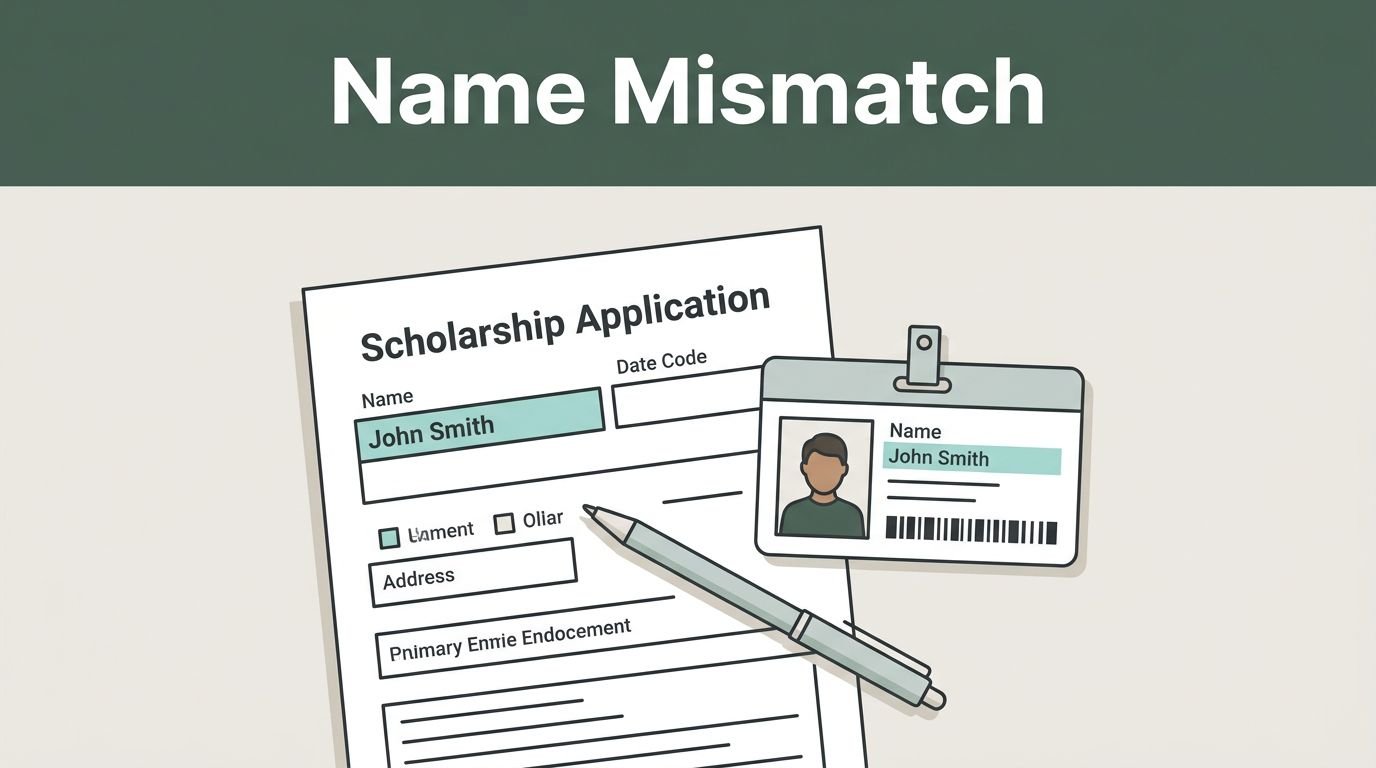
A small spelling difference can stall a scholarship file faster than you think.
If your transcript, ID, bank record, or application uses different versions of your name, the reviewer may stop and ask for proof. A scholarship name mismatch is often fixable, but only when you handle it in the right order.
That means checking which name is legal, gathering the right records, and sending a short explanation that matches every document. Start there, and the rest gets easier.
Why scholarship offices flag name differences
Scholarship reviewers are looking for one thing, a clean match between the person on the form and the person on the records. If your name appears as “A. Khan” in one place, “Aisha Khan” in another, and “Aisha K.” on a bank form, the file can look incomplete even when nothing is wrong.
That is why small gaps matter. Marriage, divorce, nickname use, transliteration, and plain clerical errors all create the same headache on the page.

Some schools spell out the rule on their own help pages. Idaho State University’s online general scholarship application help notes that identification is required for changes, and legal documentation may be needed. That is the same basic idea you will see again and again, match the identity first, then explain the difference.
Start with the legal name, not the familiar one
The name on your government ID usually sets the standard. If your passport, national ID, or court order shows your full legal name, use that version on the scholarship form unless the instructions say otherwise.
A quick check can save you days of back-and-forth. Before you upload anything, compare the exact spelling, spacing, middle name, and order of names across your key records.
Here’s a simple way to sort the most common situations:
Situation |
What it usually means |
What you should do |
|---|---|---|
Transcript shows a maiden name, but your ID shows a married name |
Your records were never updated after a legal change |
Attach the marriage certificate or divorce decree |
One document uses a nickname |
The name is familiar, not legal |
Use the full legal name and mention the alias if asked |
Passport and school record order the names differently |
The same name is formatted in two systems |
Follow the exact legal format requested by the scholarship office |
One record has a spelling error |
A clerk or school office made a mistake |
Request a corrected copy from the issuing office |
The legal name usually wins, but the paper trail has to prove why the other version appears. If your documents come from more than one country, keep the spelling consistent with the identity document the office asks for.
Gather proof that tells one story
Before you upload anything, collect every document that connects the old name to the new one. You do not need a mountain of papers, but you do need the right papers.
A strong file usually includes:
- Government ID or passport, showing the name you use now.
- Marriage certificate, divorce decree, or court order, if the name changed legally.
- Official transcript or certificate, requested from the registrar or issuing office.
- Bank letter or account record, if payment details also need to match.
- A short affidavit, only if the scholarship office asks for one.
The safest file is the one that tells the same story on every page.
Do not rely on screenshots or self-edited PDFs. If a document needs to change, request an official reissue from the school, testing agency, bank, or government office that created it.
Write a short explanation that matches the documents
Your note should read like a label, not a story. One or two lines are enough.
Say the legal name, the older name, and the reason the difference appears. Then point straight to the document that proves it. That keeps the reviewer from guessing.
A clean explanation can sound like this: your legal name appears on the ID, your transcript still shows the older name, and you attached the document that explains the change. That is all most scholarship teams need when the paperwork is otherwise in order.
If the office asks for an affidavit, keep it factual. A simple statement that both names belong to the same person is usually better than a long letter with extra details.
Do not write about old nicknames, family history, or every place your name has ever been used. Reviewers want a direct explanation, not a biography.
If the deadline is close, act in this order
Deadlines make people panic, and panic makes the file messier. If you are short on time, move in a clear sequence.
- Submit the application with the legal name that matches your main ID.
- Attach the old-name document and the proof that connects both names.
- Send a short email to the scholarship office the same day.
- Save the confirmation, the upload receipt, and any reply you get.
- Update the payment record or bank detail if award money will be sent soon.
If the scholarship portal already has your profile under the old name, fix that too. A new application with an old disbursement account can create a second delay later.
When you email the office, keep the subject line plain and useful. Include your applicant ID, your current legal name, and the phrase “name correction” or “name update” if that matches the school’s language.
Mistakes that make the problem worse
The biggest mistake is waiting and hoping the reviewer won’t notice. They usually do.
The next mistake is sending too many unrelated files. A clean set of proof beats a messy folder every time.
You also want to avoid editing a document yourself. A typed-over transcript, cropped screenshot, or blurred photo can create a bigger red flag than the original mismatch.
If the issue came from a clerical error, ask the issuing office for a corrected copy. If the issue came from marriage, divorce, or a legal name change, use the legal document that shows the change. If the issue came from a nickname or transliteration, keep the legal name on top and the other version in a short note.
Conclusion
A scholarship file doesn’t need perfect paperwork. It needs consistent paperwork.
When your names differ, lead with the legal name, attach the proof, and keep your explanation short. That approach handles most document problems without turning a small error into a long delay.
The real fix is simple, the paper trail has to tell one clear story.
This post may contain affiliate links. If you make a purchase through these links, I may earn a small commission at no extra cost to you.