

Your scholarship is not a trophy you put on a shelf. For many international students, it is a live agreement, and one missed form, one dropped class, or one bad grade can change everything.
That is why understanding scholarship renewal rules is so critical for your financial security. The challenge is that these requirements rarely sit in one neat place. They are often scattered across award letters, institutional scholarships pages, and student handbooks, which makes them easy to miss and difficult to decode.
If you have ever wondered what keeps your funding alive after the first year, you are in the right place. The requirements usually come down to a few clear criteria, and once you know them, the process of maintaining your financial support feels far less mysterious.
Key Takeaways
- Scholarships require active maintenance: Your award is a formal agreement, not a permanent trophy, and requires consistent attention to grade point averages, credit loads, and enrollment status.
- Read the fine print: Treat your original award letter as a legal contract, paying close attention to specific renewal terms, deadlines, and documentation requirements unique to your institution.
- Proactive tracking is essential: Don’t wait for the end of the semester to check your standing; monitor your GPA and credit progress throughout the term to catch potential issues early.
- Prioritize administrative deadlines: Missing a simple renewal form or documentation request can be just as damaging to your funding as failing to meet academic performance standards.
What scholarship renewal usually depends on
Most renewable awards are built on the same few pillars: cumulative GPA, credit hours, enrollment status, and conduct. That sounds simple until you see how each school defines those words.
Here is the basic pattern many schools use:
Rule |
What schools often ask |
What it means for you |
|---|---|---|
GPA |
A minimum cumulative GPA, often between 2.5 and 3.5 |
One weak term can put your award at risk |
Credit load |
Full-time enrollment, often 12 credits per term |
Dropping below full-time status can break eligibility |
Academic standing |
Good standing or satisfactory progress |
Probation can affect your status |
Paperwork |
Annual renewal form or proof of eligibility |
Missing a deadline can cancel the award |
Those numbers are not random. At the University of Michigan-Dearborn, the non-resident and international scholarship criteria require a 2.0 cumulative GPA and 24 credit hours per academic year. Iowa State’s international merit scholarship rules set the eligibility criteria at a 2.5 GPA and 12 credits per semester.

The takeaway is simple. You cannot guess your way through this process. You need the exact numbers for your specific award, not the averages you hear from other students, to ensure a successful scholarship renewal.
Read the award letter like a contract
Your award letter is where the real rules live. The scholarship may sound generous on the surface, but the renewal terms usually sit in the fine print.
Look for words like renewable, conditional, good standing, continuous enrollment, and Satisfactory Academic Progress. Those phrases tell you whether your renewable scholarships stay active automatically, or whether you need to prove yourself again every year.
Some awards renew after a grade review. Others need a form, a transcript, or confirmation from the financial aid office. A few reset each year, which means you have to meet the rules again before the next payment lands.
A scholarship can be renewable and still disappear if you miss the paperwork.
That is where many students get caught off guard. They focus on grades, then forget that the office may also want documentation by a fixed date. One missing email can do more damage than one difficult class.
If the wording feels vague, go back to the source. The school’s scholarship page often spells out the standard in plain language. Iowa State’s international merit scholarship rules are a good example because they state both the GPA and the credit-load requirement clearly.
Read your award letter as if your tuition depends on it, because it does.
Deadlines, forms, and enrollment status
Renewal problems often start with timing, not academics. You can have good grades and still lose funding if your documentation arrives late.
Some schools review scholarships after your spring semester grades post. Others want your renewal materials before fall billing starts. That gap matters. If your scholarship covers tuition, a missed date can become a real cash problem fast.
Enrollment requirements matter too. Many awards require you to stay full time, and for undergraduates that often means 12 credits per term. Some scholarships also require continuous enrollment in fall and spring, with no long gap between terms. Mizzou’s international student scholarship page is a clear example, since it asks for full-time enrollment and continuous fall and spring attendance.
That can get tricky if you change your schedule. A lighter semester, a withdrawal, or a leave of absence can change your status in the eyes of the scholarship office, even if your academic record still looks fine.
If your funding is tied to your immigration status, the stakes go up again. Your school’s international office and financial aid office need to be looking at the same course load. Otherwise, you can meet one rule and break another without meaning to.
Common reasons scholarships get cut
Most students do not lose funding because of one dramatic mistake. They lose it because a few small issues stack up.
The most common ones look like this:
- GPA drops below the threshold: A single tough term can lower your average enough to trigger a review.
- You fall below full-time status: Dropping a class can be harmless for your major, but it often prevents you from meeting the necessary credit completion requirements for your award.
- You stop making steady progress: Repeating courses, changing majors late in your undergraduate degree, or taking too long to finish can raise red flags.
- You miss a renewal deadline: Late forms, missing transcripts, and incomplete documents can stop renewal before anyone reviews your grades.
- You leave school or take a gap: A leave of absence can break continuous enrollment requirements.
- You violate conduct rules: Some scholarships include behavior standards, not just academic ones.
The hard part is that these issues often overlap. A student who drops one class may also miss the minimum credit load, then lose eligibility during the next review cycle.
That is why the safest move is to check every rule together, not one by one. GPA alone never tells the full story.
How to keep renewal simple
You do not need a perfect memory to maintain your funding; you need a system.
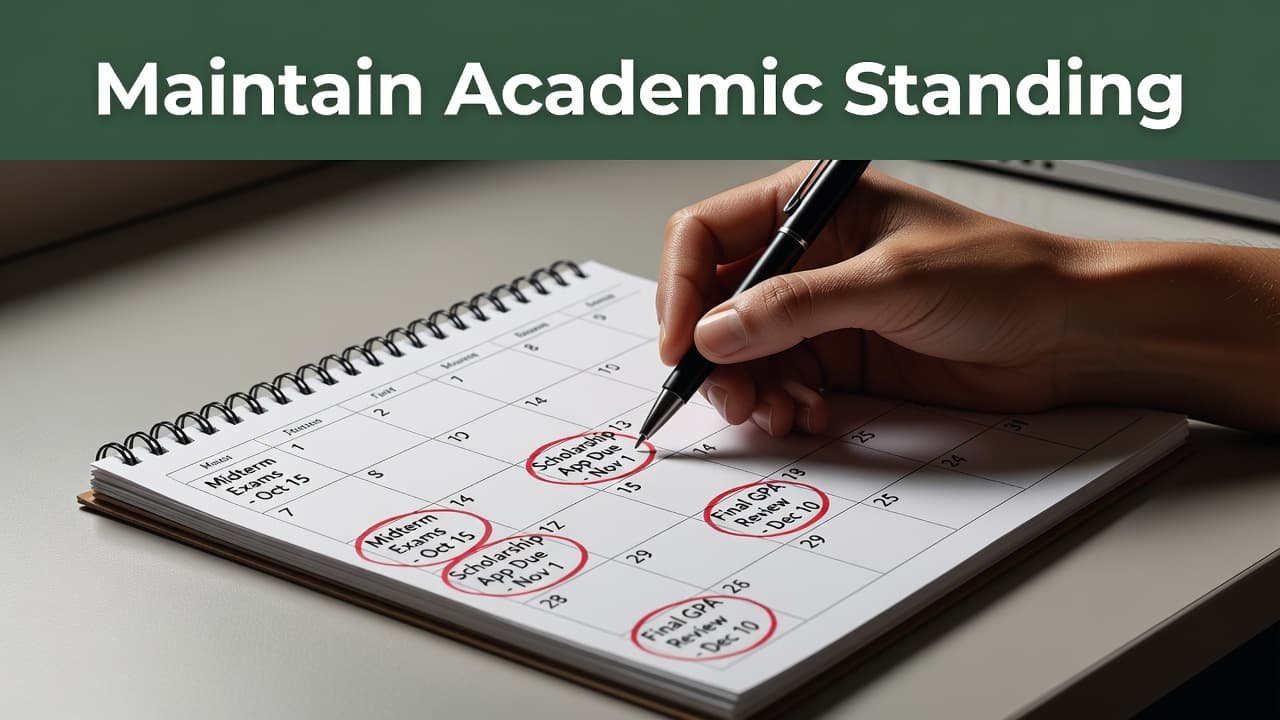
Start with the renewal date, then work backward. Put the deadline in your calendar, set a reminder a month early, and check whether your school wants a transcript, a form, or an advisor sign-off. That small habit can save a lot of stress.
Then, keep an eye on your numbers during the term, not after finals. If your GPA starts slipping, talk to an academic advisor early. If your course load looks too light, ask whether one extra class is enough to protect full-time status.
A simple routine helps more than panic ever will.
- Save your award letter so you can read the terms again whenever you need them.
- Track your GPA and credits every term to ensure you meet all renewal requirements.
- Check both office pages because financial aid and international student rules are not always the same.
- Submit renewal paperwork early so a missing document does not become a lost award.
- Keep proof of everything with screenshots, emails, transcripts, and advisor notes in one folder.
If you encounter unexpected challenges, understand the process for a scholarship appeal before you actually need it. If you face extenuating circumstances that impact your academic performance, you can submit a formal request to the scholarship committee for consideration. They will review your situation to determine if reinstatement of your funding is possible. By the time a problem shows up, you do not want to be reading the rules for the first time.
Frequently Asked Questions
What happens if I accidentally drop below the required credit load?
Dropping a class can often disqualify you from your scholarship if you fall below the mandatory full-time status, typically 12 credits. You should consult your academic advisor and the financial aid office immediately to see if there is an appeals process or if you can adjust your registration to regain eligibility.
Do I need to re-apply for my scholarship every single year?
It depends on your institution’s specific policy outlined in your award letter. Some scholarships renew automatically if you meet the criteria, while others require you to submit an annual renewal form or updated transcripts to confirm your continued eligibility.
Can my scholarship be taken away if I have a low GPA for just one semester?
Most scholarship renewals look at your cumulative GPA rather than a single term’s performance. However, if one poor semester causes your cumulative average to dip below the required threshold, you may be placed on scholarship probation or lose your funding entirely, so staying above the limit is vital.
Where can I find the official rules for my specific scholarship?
The primary source is your original award letter, which contains the specific terms of your funding. Additionally, you should review your school’s financial aid website and student handbook, as these pages house the most current definitions of “good standing” and “satisfactory academic progress.”
Keep Your Scholarship Alive
Renewal is usually less about luck and more about discipline. You must monitor your GPA, maintain the required credit load, and treat every deadline as if it were critical, because it is.
The students who maintain their funding the longest are rarely the ones who guess well. They are the ones who read the fine print early, ask questions promptly, and keep records that support their status.
If you remember one thing, make it this: scholarship renewal is a process, not a promise. Once you approach it that way, the rules stop feeling hidden, and protecting your award becomes much easier.
This post may contain affiliate links. If you make a purchase through these links, I may earn a small commission at no extra cost to you.